QUESTION IMAGE
Question
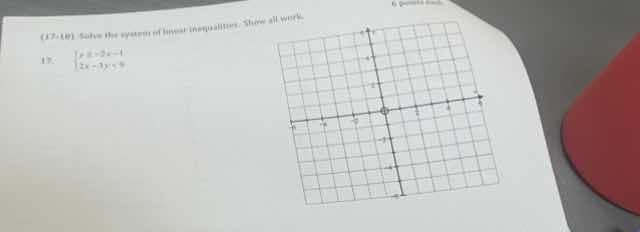
(7.7-61) solve the system of linear inequalities. show all work. 17. \
Step 1: Rewrite the inequalities in slope - intercept form
For the first inequality \(y\geq2x - 1\):
The slope - intercept form of a line is \(y=mx + b\), where \(m\) is the slope and \(b\) is the y - intercept. This inequality is already in slope - intercept form with \(m = 2\) and \(b=-1\). The line \(y = 2x-1\) is a solid line (because the inequality is \(\geq\)) and we shade above the line.
For the second inequality \(2x-3y<9\):
First, solve for \(y\).
Subtract \(2x\) from both sides: \(- 3y<-2x + 9\)
Divide both sides by \(-3\). When we divide an inequality by a negative number, the direction of the inequality sign changes. So we get \(y>\frac{2}{3}x - 3\)
The line \(y=\frac{2}{3}x - 3\) is a dashed line (because the inequality is \(>\)) and we shade above the line.
Step 2: Graph the lines
- For \(y = 2x-1\):
- The y - intercept is \(-1\), so we plot the point \((0,-1)\).
- The slope is \(2=\frac{2}{1}\), so from \((0,-1)\), we move up 2 units and right 1 unit to get the point \((1,1)\), up 2 units and right 1 unit from \((1,1)\) to get \((2,3)\), etc. We also move down 2 units and left 1 unit from \((0,-1)\) to get \((-1,-3)\) to draw the line. Since the inequality is \(y\geq2x - 1\), we shade the region above the line.
- For \(y=\frac{2}{3}x - 3\):
- The y - intercept is \(-3\), so we plot the point \((0,-3)\).
- The slope is \(\frac{2}{3}\), so from \((0,-3)\), we move up 2 units and right 3 units to get the point \((3,-1)\), up 2 units and right 3 units from \((3,-1)\) to get \((6,1)\), etc. We also move down 2 units and left 3 units from \((0,-3)\) to get \((-3,-5)\) to draw the line. Since the inequality is \(y>\frac{2}{3}x - 3\), we draw a dashed line and shade above the line.
Step 3: Find the intersection of the shaded regions
The solution to the system of inequalities is the region that is shaded by both inequalities. To find the intersection point of the two lines \(y = 2x-1\) and \(y=\frac{2}{3}x - 3\), we set them equal to each other:
\(2x-1=\frac{2}{3}x - 3\)
Subtract \(\frac{2}{3}x\) from both sides: \(2x-\frac{2}{3}x-1=-3\)
\(\frac{6x - 2x}{3}-1=-3\)
\(\frac{4x}{3}-1=-3\)
Add 1 to both sides: \(\frac{4x}{3}=-2\)
Multiply both sides by \(\frac{3}{4}\): \(x=-2\times\frac{3}{4}=-\frac{3}{2}=-1.5\)
Substitute \(x =-\frac{3}{2}\) into \(y = 2x-1\): \(y=2\times(-\frac{3}{2})-1=-3 - 1=-4\)
So the intersection point of the two lines is \((-\frac{3}{2},-4)\). The solution region is the set of all points that are above \(y = 2x-1\) (including the line) and above \(y=\frac{2}{3}x - 3\) (excluding the line).

Snap & solve any problem in the app
Get step-by-step solutions on Sovi AI
Photo-based solutions with guided steps
Explore more problems and detailed explanations
The solution to the system of linear inequalities is the region that lies above the line \(y = 2x-1\) (solid line) and above the line \(y=\frac{2}{3}x - 3\) (dashed line). The intersection point of the two lines (boundary of the solution region) is \((-\frac{3}{2},-4)\). To represent the solution, we graph the two lines as described, shade the overlapping region, and note that the solution includes all points in the overlapping shaded area.