QUESTION IMAGE
Question
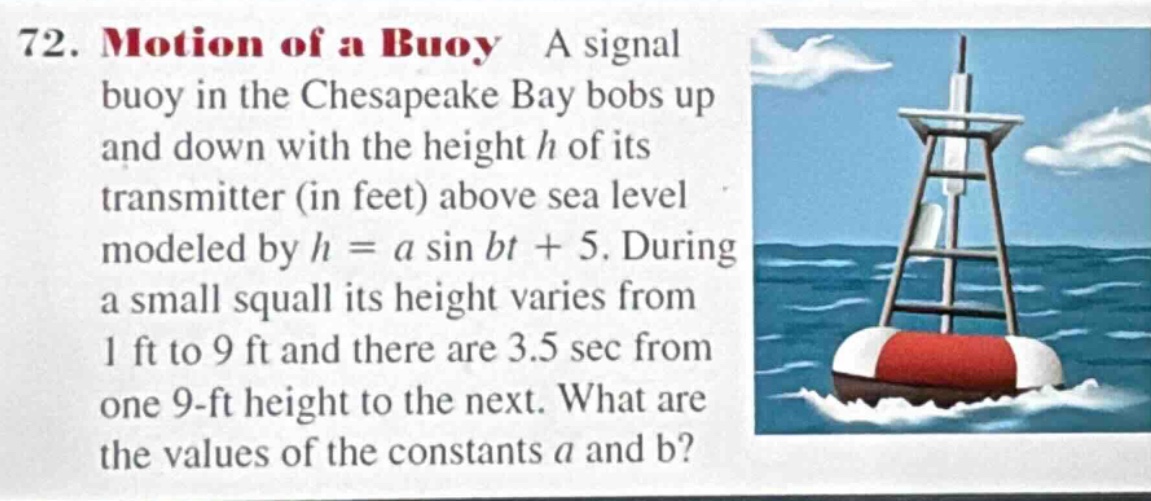
- motion of a buoy a signal buoy in the chesapeake bay bobs up and down with the height ( h ) of its transmitter (in feet) above sea level modeled by ( h = a sin bt + 5 ). during a small squall its height varies from 1 ft to 9 ft and there are 3.5 sec from one 9 - ft height to the next. what are the values of the constants ( a ) and ( b )?
Step1: Find the amplitude \(a\)
The general form of a sinusoidal function is \(h = a\sin(bt)+k\), where \(k\) is the vertical shift, and the amplitude \(|a|\) is half the distance between the maximum and minimum values. The maximum height is 9 ft and the minimum height is 1 ft. The vertical shift \(k = 5\) (from the equation \(h=a\sin(bt)+5\)). The distance between the maximum and minimum is \(9 - 1=8\) ft. So the amplitude \(a=\frac{9 - 1}{2}=\frac{8}{2} = 4\). Since the sine function can be positive or negative, but in this case, the amplitude is positive, so \(a = 4\).
Step2: Find the period and then \(b\)
The period \(T\) of a sinusoidal function \(y = A\sin(Bx)+C\) is given by \(T=\frac{2\pi}{|B|}\). We know that the time between two consecutive 9 - ft heights (which are maximums) is the period. Given that the time from one 9 - ft height to the next is 3.5 sec, so the period \(T = 3.5=\frac{7}{2}\) sec. For the function \(h = 4\sin(bt)+5\), we have \(T=\frac{2\pi}{b}\) (since \(b>0\) for the period calculation). So \(\frac{2\pi}{b}=\frac{7}{2}\). Solving for \(b\), we cross - multiply: \(b\times7 = 2\times2\pi\), so \(b=\frac{4\pi}{7}\).

Snap & solve any problem in the app
Get step-by-step solutions on Sovi AI
Photo-based solutions with guided steps
Explore more problems and detailed explanations
\(a = 4\) and \(b=\frac{4\pi}{7}\)