QUESTION IMAGE
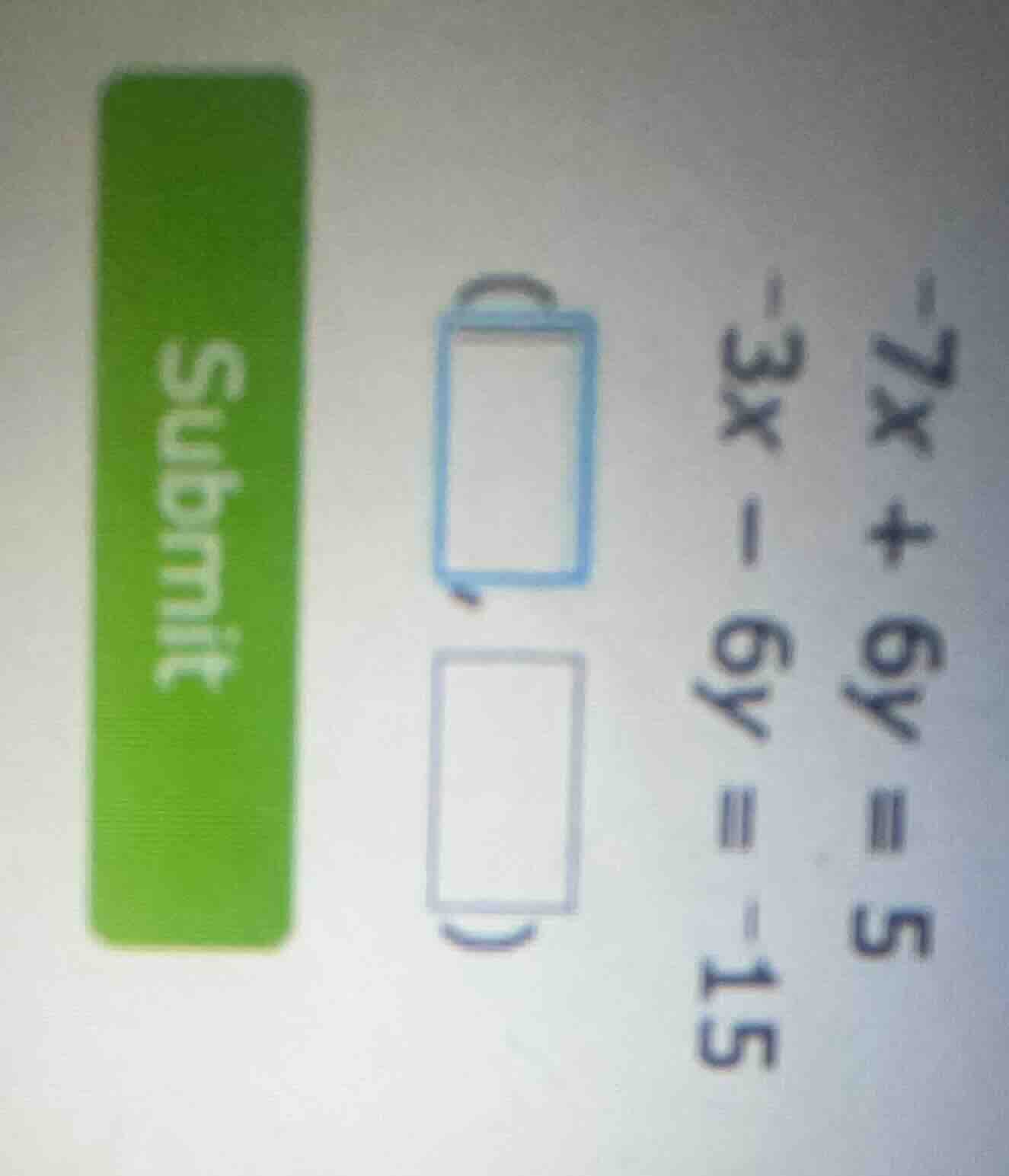
Question
-7x + 9y = 5\
-3x - 6y = -15\
(\boxed{ })
Step1: Identify the operation
We have two equations: \(-7x + 9y = 5\) and \(-3x - 9y = -15\). We can add these two equations to eliminate \(y\).
Step2: Add the equations
Adding the left - hand sides: \((-7x + 9y)+(-3x - 9y)=-7x-3x + 9y-9y\)
Simplify the left - hand side: \(-10x\)
Adding the right - hand sides: \(5+(-15)=5 - 15=-10\)
So we get the equation \(-10x=-10\)
Step3: Solve for \(x\)
Divide both sides of \(-10x=-10\) by \(-10\): \(x=\frac{-10}{-10} = 1\)
Step4: Substitute \(x = 1\) into one of the original equations
Let's substitute \(x = 1\) into \(-7x+9y = 5\)
We have \(-7(1)+9y = 5\)
Simplify: \(-7 + 9y=5\)
Add 7 to both sides: \(9y=5 + 7=12\)
Divide both sides by 9: \(y=\frac{12}{9}=\frac{4}{3}\)
But if we assume the problem is to add the two equations (maybe to solve the system), the sum of the two equations \(-7x + 9y=-3x - 9y\) (wait, no, the original equations are \(-7x + 9y = 5\) and \(-3x-9y=-15\)). If we are just adding the left - hand sides and right - hand sides:
Left - hand side sum: \((-7x + 9y)+(-3x-9y)=-10x\)
Right - hand side sum: \(5+(-15)=-10\)
If we consider the boxes, maybe we are adding the two equations. The first box (for the \(x\) coefficient) when adding \(-7x\) and \(-3x\) is \(-10x\) (so the coefficient of \(x\) is \(-10\)) and the second box (the constant term) when adding 5 and \(-15\) is \(-10\). But if we assume the problem is to fill in the boxes when adding the two equations:
When we add \(-7x+9y\) and \(-3x - 9y\), the \(x\) term is \(-7x-3x=-10x\) and the constant term (if we consider the right - hand sides) \(5+(-15)=-10\). But maybe the problem is to add the two left - hand sides and the two right - hand sides.
If we are adding the two equations \(-7x + 9y = 5\) and \(-3x-9y=-15\) together:
\((-7x+9y)+(-3x - 9y)=5+(-15)\)
Simplify left - hand side: \(-10x\)
Simplify right - hand side: \(-10\)
So the first box (for the \(x\) term) is \(-10x\) (so the coefficient of \(x\) is \(-10\)) and the second box (the constant) is \(-10\). But if we are only looking at the sum of the left - hand sides (the two expressions with \(x\) and \(y\)):
\((-7x + 9y)+(-3x-9y)=-10x+0y=-10x\)
And the sum of the right - hand sides: \(5+(-15)=-10\)

Snap & solve any problem in the app
Get step-by-step solutions on Sovi AI
Photo-based solutions with guided steps
Explore more problems and detailed explanations
If we are adding the two equations \(-7x + 9y = 5\) and \(-3x-9y=-15\), the first box (for the \(x\) - term) is \(-10x\) and the second box (the constant) is \(-10\). If we consider the coefficients and constants separately, the coefficient of \(x\) is \(-10\) and the constant is \(-10\).