QUESTION IMAGE
Question
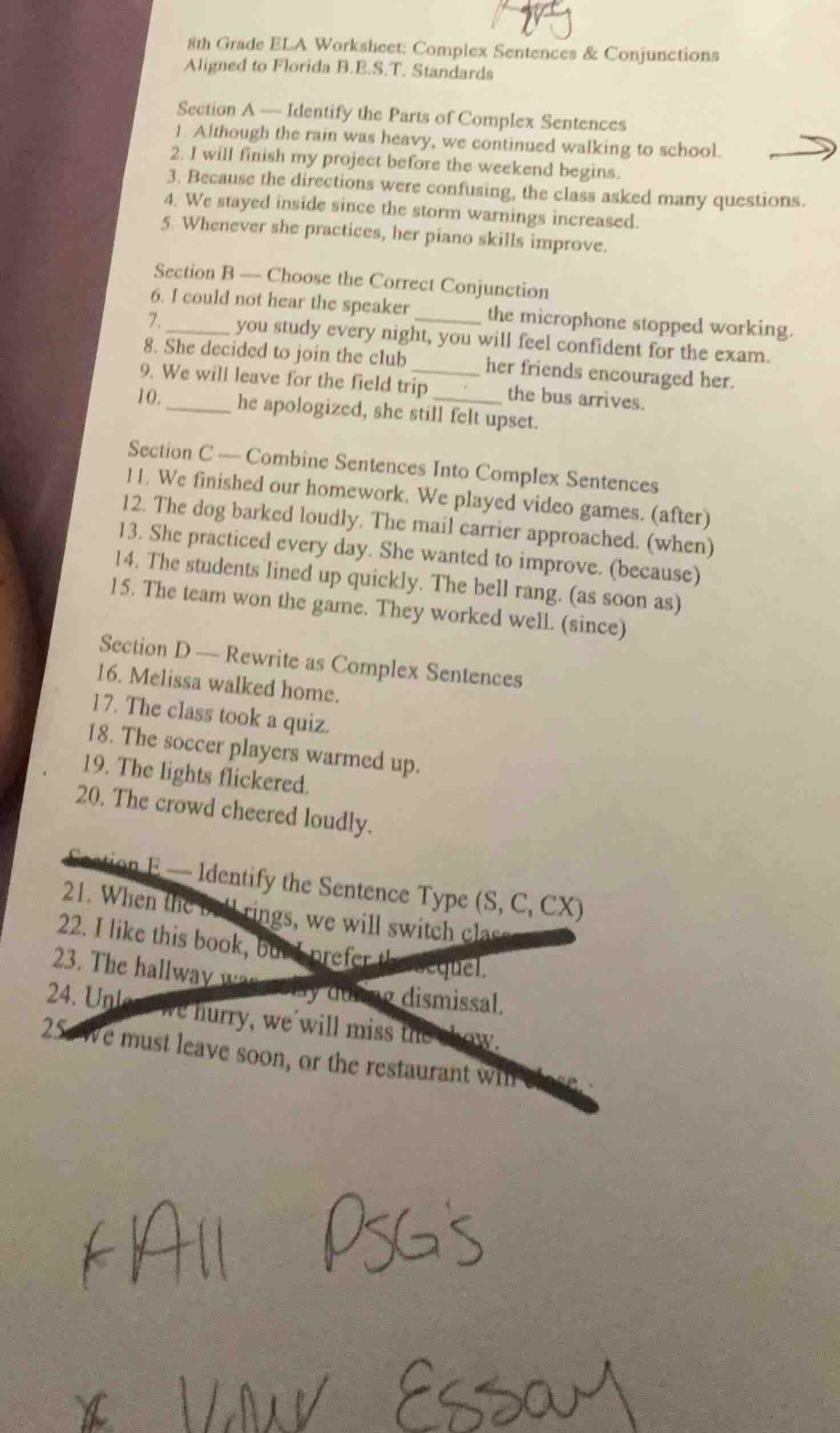
8th grade ela worksheet: complex sentences & conjunctions
aligned to florida b.e.s.t. standards
section a — identify the parts of complex sentences
- although the rain was heavy, we continued walking to school.
- i will finish my project before the weekend begins.
- because the directions were confusing, the class asked many questions.
- we stayed inside since the storm warnings increased.
- whenever she practices, her piano skills improve.
section b — choose the correct conjunction
- i could not hear the speaker ______ the microphone stopped working.
- ______ you study every night, you will feel confident for the exam.
- she decided to join the club ______ her friends encouraged her.
- we will leave for the field trip ______ the bus arrives.
- ______ he apologized, she still felt upset.
section c — combine sentences into complex sentences
- we finished our homework. we played video games. (after)
- the dog barked loudly. the mail carrier approached. (when)
- she practiced every day. she wanted to improve. (because)
- the students lined up quickly. the bell rang. (as soon as)
- the team won the game. they worked well. (since)
section d — rewrite as complex sentences
- melissa walked home.
- the class took a quiz.
- the soccer players warmed up.
- the lights flickered.
- the crowd cheered loudly.
(section e is crossed out with questions 21 - 25 also crossed out)
handwritten notes: \all psgs\, \vuw essay\
To solve these ELA (English Language Arts) problems, we'll go through each section and question:
Section A: Identify the Parts of Complex Sentences
A complex sentence has one independent clause and at least one dependent clause. The dependent clause starts with a subordinating conjunction (e.g., although, before, because, since, whenever).
- Although the rain was heavy, we continued walking to school.
- Dependent clause: Although the rain was heavy (starts with although)
- Independent clause: we continued walking to school
- I will finish my project before the weekend begins.
- Dependent clause: before the weekend begins (starts with before)
- Independent clause: I will finish my project
- Because the directions were confusing, the class asked many questions.
- Dependent clause: Because the directions were confusing (starts with because)
- Independent clause: the class asked many questions
- We stayed inside since the storm warnings increased.
- Dependent clause: since the storm warnings increased (starts with since)
- Independent clause: We stayed inside
- Whenever she practices, her piano skills improve.
- Dependent clause: Whenever she practices (starts with whenever)
- Independent clause: her piano skills improve
Section B: Choose the Correct Conjunction
Subordinating conjunctions show relationships (cause, time, contrast, condition).
- I could not hear the speaker ______ the microphone stopped working.
- Relationship: cause (the microphone stopping caused not hearing). Use because.
- Sentence: I could not hear the speaker because the microphone stopped working.
- ______ you study every night, you will feel confident for the exam.
- Relationship: condition (studying leads to confidence). Use If.
- Sentence: If you study every night, you will feel confident for the exam.
- She decided to join the club ______ her friends encouraged her.
- Relationship: cause (friends’ encouragement caused joining). Use because.
- Sentence: She decided to join the club because her friends encouraged her.
- We will leave for the field trip ______ the bus arrives.
- Relationship: time (leave when the bus arrives). Use when or as soon as.
- Sentence: We will leave for the field trip when the bus arrives.
- ______ he apologized, she still felt upset.
- Relationship: contrast (apology vs. still upset). Use Although.
- Sentence: Although he apologized, she still felt upset.
Section C: Combine Sentences Into Complex Sentences
Use the given subordinating conjunction to connect a dependent and independent clause.
- We finished our homework. We played video games. (after)
- After introduces the dependent clause (action that happened first).
- Sentence: After we finished our homework, we played video games.
- The dog barked loudly. The mail carrier approached. (when)
- When introduces the time of the action.
- Sentence: The dog barked loudly when the mail carrier approached.
- She practiced every day. She wanted to improve. (because)
- Because introduces the cause.
- Sentence: She practiced every day because she wanted to improve.
- The students lined up quickly. The bell rang. (as soon as)
- As soon as introduces immediate time.
- Sentence: The students lined up quickly as soon as the bell rang.
- The team won the game. They worked well. (since)
- Since introduces the cause.
- Sentence: *T…

Snap & solve any problem in the app
Get step-by-step solutions on Sovi AI
Photo-based solutions with guided steps
Explore more problems and detailed explanations
To solve these ELA (English Language Arts) problems, we'll go through each section and question:
Section A: Identify the Parts of Complex Sentences
A complex sentence has one independent clause and at least one dependent clause. The dependent clause starts with a subordinating conjunction (e.g., although, before, because, since, whenever).
- Although the rain was heavy, we continued walking to school.
- Dependent clause: Although the rain was heavy (starts with although)
- Independent clause: we continued walking to school
- I will finish my project before the weekend begins.
- Dependent clause: before the weekend begins (starts with before)
- Independent clause: I will finish my project
- Because the directions were confusing, the class asked many questions.
- Dependent clause: Because the directions were confusing (starts with because)
- Independent clause: the class asked many questions
- We stayed inside since the storm warnings increased.
- Dependent clause: since the storm warnings increased (starts with since)
- Independent clause: We stayed inside
- Whenever she practices, her piano skills improve.
- Dependent clause: Whenever she practices (starts with whenever)
- Independent clause: her piano skills improve
Section B: Choose the Correct Conjunction
Subordinating conjunctions show relationships (cause, time, contrast, condition).
- I could not hear the speaker ______ the microphone stopped working.
- Relationship: cause (the microphone stopping caused not hearing). Use because.
- Sentence: I could not hear the speaker because the microphone stopped working.
- ______ you study every night, you will feel confident for the exam.
- Relationship: condition (studying leads to confidence). Use If.
- Sentence: If you study every night, you will feel confident for the exam.
- She decided to join the club ______ her friends encouraged her.
- Relationship: cause (friends’ encouragement caused joining). Use because.
- Sentence: She decided to join the club because her friends encouraged her.
- We will leave for the field trip ______ the bus arrives.
- Relationship: time (leave when the bus arrives). Use when or as soon as.
- Sentence: We will leave for the field trip when the bus arrives.
- ______ he apologized, she still felt upset.
- Relationship: contrast (apology vs. still upset). Use Although.
- Sentence: Although he apologized, she still felt upset.
Section C: Combine Sentences Into Complex Sentences
Use the given subordinating conjunction to connect a dependent and independent clause.
- We finished our homework. We played video games. (after)
- After introduces the dependent clause (action that happened first).
- Sentence: After we finished our homework, we played video games.
- The dog barked loudly. The mail carrier approached. (when)
- When introduces the time of the action.
- Sentence: The dog barked loudly when the mail carrier approached.
- She practiced every day. She wanted to improve. (because)
- Because introduces the cause.
- Sentence: She practiced every day because she wanted to improve.
- The students lined up quickly. The bell rang. (as soon as)
- As soon as introduces immediate time.
- Sentence: The students lined up quickly as soon as the bell rang.
- The team won the game. They worked well. (since)
- Since introduces the cause.
- Sentence: The team won the game since they worked well.
Section D: Rewrite as Complex Sentences
Add a dependent clause (with a subordinating conjunction) to the simple sentence.
- Melissa walked home.
- Add a dependent clause (e.g., time, reason). Example: Melissa walked home after she finished her homework.
- The class took a quiz.
- Example: The class took a quiz when the teacher arrived.
- The soccer players warmed up.
- Example: The soccer players warmed up before the game started.
- The lights flickered.
- Example: The lights flickered because the power surged.
- The crowd cheered loudly.
- Example: The crowd cheered loudly when their team scored.
Section E: Identify the Sentence Type (S, C, CX)
- S = Simple (one independent clause)
- C = Compound (two independent clauses, joined by and, but, or)
- CX = Complex (one independent + one or more dependent clauses)
- When the bell rings, we will switch classes.
- Dependent: When the bell rings; Independent: we will switch classes → CX
- I like this book, but I prefer the sequel.
- Two independent clauses (I like this book; I prefer the sequel) joined by but → C
- The hallway was noisy during dismissal.
- One independent clause → S
- Unless we hurry, we will miss the show.
- Dependent: Unless we hurry; Independent: we will miss the show → CX
- We must leave soon, or the restaurant will close.
- Two independent clauses (We must leave soon; the restaurant will close) joined by or → C
If you need help with specific questions or more examples, let me know!