QUESTION IMAGE
Question
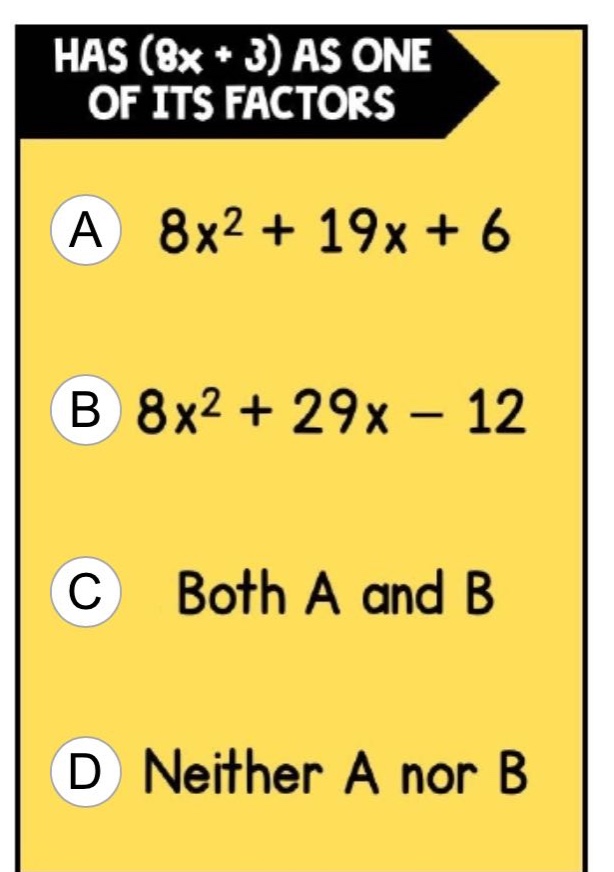
has (8x + 3) as one of its factors
a 8x² + 19x + 6
b 8x² + 29x − 12
c both a and b
d neither a nor b
Step1: Factor Option A
We factor \(8x^{2}+19x + 6\) by finding two numbers that multiply to \(8\times6 = 48\) and add to \(19\). The numbers are \(16\) and \(3\).
Rewrite the middle term: \(8x^{2}+16x + 3x+6\)
Group and factor: \(8x(x + 2)+3(x + 2)=(8x + 3)(x + 2)\)
Step2: Factor Option B
We factor \(8x^{2}+29x-12\) by finding two numbers that multiply to \(8\times(- 12)=-96\) and add to \(29\). The numbers are \(32\) and \(-3\).
Rewrite the middle term: \(8x^{2}+32x-3x - 12\)
Group and factor: \(8x(x + 4)-3(x + 4)=(8x-3)(x + 4)\)? Wait, no, wait. Wait, let's do it again. Wait, maybe I made a mistake. Wait, let's use the quadratic formula or try to factor with \((8x + 3)\) as a factor. Let's assume \((8x + 3)(ax + b)=8ax^{2}+(8b + 3a)x+3b\). For \(8x^{2}+29x-12\), \(8a = 8\) so \(a = 1\). Then \(8b+3\times1=29\) so \(8b=26\), \(b=\frac{26}{8}=\frac{13}{4}\), not integer. Wait, no, earlier factoring was wrong. Wait, let's try again. Let's list factors of \(8\times(-12)=-96\): 32 and -3. So \(8x^{2}+32x-3x - 12=8x(x + 4)-3(x + 4)=(8x - 3)(x + 4)\)? No, that gives \(8x^{2}+32x-3x - 12=8x^{2}+29x - 12\). Wait, but \((8x + 3)\) is not a factor here? Wait, no, wait my first factoring of A was correct. Wait, let's check by multiplying \((8x + 3)\) with another binomial. For option A: \((8x + 3)(x + 2)=8x^{2}+16x+3x + 6=8x^{2}+19x + 6\), which matches. For option B: Let's suppose \((8x + 3)(x + c)=8x^{2}+(8c + 3)x+3c\). We need \(8c + 3=29\) so \(8c=26\), \(c=\frac{13}{4}\), and \(3c=-12\) so \(c = - 4\). Contradiction. Wait, so my initial factoring of B was wrong. Wait, no, wait I think I messed up the sign. Wait, the quadratic is \(8x^{2}+29x - 12\). Let's use the formula for factoring \(ax^{2}+bx + c\). The roots are \(x=\frac{-b\pm\sqrt{b^{2}-4ac}}{2a}=\frac{-29\pm\sqrt{29^{2}-4\times8\times(-12)}}{2\times8}=\frac{-29\pm\sqrt{841 + 384}}{16}=\frac{-29\pm\sqrt{1225}}{16}=\frac{-29\pm35}{16}\). So roots are \(\frac{-29 + 35}{16}=\frac{6}{16}=\frac{3}{8}\) and \(\frac{-29-35}{16}=\frac{-64}{16}=-4\). So the factors are \((x-\frac{3}{8})(x + 4)=(8x - 3)(x + 4)\), which is what I had before. So \((8x + 3)\) is not a factor of B. Wait, but that contradicts? Wait, no, wait the problem says "HAS (8x + 3) AS ONE OF ITS FACTORS". So option A has \((8x + 3)\) as a factor, option B: let's check by plugging \(x=-\frac{3}{8}\) into \(8x^{2}+29x-12\). \(8\times(-\frac{3}{8})^{2}+29\times(-\frac{3}{8})-12=8\times\frac{9}{64}-\frac{87}{8}-12=\frac{9}{8}-\frac{87}{8}-\frac{96}{8}=\frac{9 - 87-96}{8}=\frac{-174}{8}
eq0\). So \((8x + 3)\) is not a factor of B. Wait, but earlier when I factored A, it was correct. So option A has \((8x + 3)\) as a factor, option B does not? Wait, no, wait I think I made a mistake in factoring B. Wait, let's try again. Let's use the method of grouping correctly. For \(8x^{2}+29x - 12\), we need two numbers that multiply to \(8\times(-12)=-96\) and add to \(29\). The numbers are 32 and -3. So:
\(8x^{2}+32x-3x - 12=8x(x + 4)-3(x + 4)=(8x - 3)(x + 4)\). So \((8x + 3)\) is not a factor. But wait, the first factoring of A is correct. So option A has \((8x + 3)\) as a factor, option B does not? But the option C says both A and B. Wait, maybe I made a mistake. Wait, let's check option B again. Let's multiply \((8x + 3)\) with \((x + k)\):
\((8x + 3)(x + k)=8x^{2}+(8k + 3)x+3k\). We need \(8k + 3 = 29\) (coefficient of x) and \(3k=-12\) (constant term). From \(3k=-12\), \(k = - 4\). Then \(8\times(-4)+3=-32 + 3=-29\), not 29. So the coefficient of x would be -29, but in option B it's +29. So if we have \((8x - 3)(x + 4)=8x^{2…

Snap & solve any problem in the app
Get step-by-step solutions on Sovi AI
Photo-based solutions with guided steps
Explore more problems and detailed explanations
A. \(8x^{2}+19x + 6\)