QUESTION IMAGE
Question
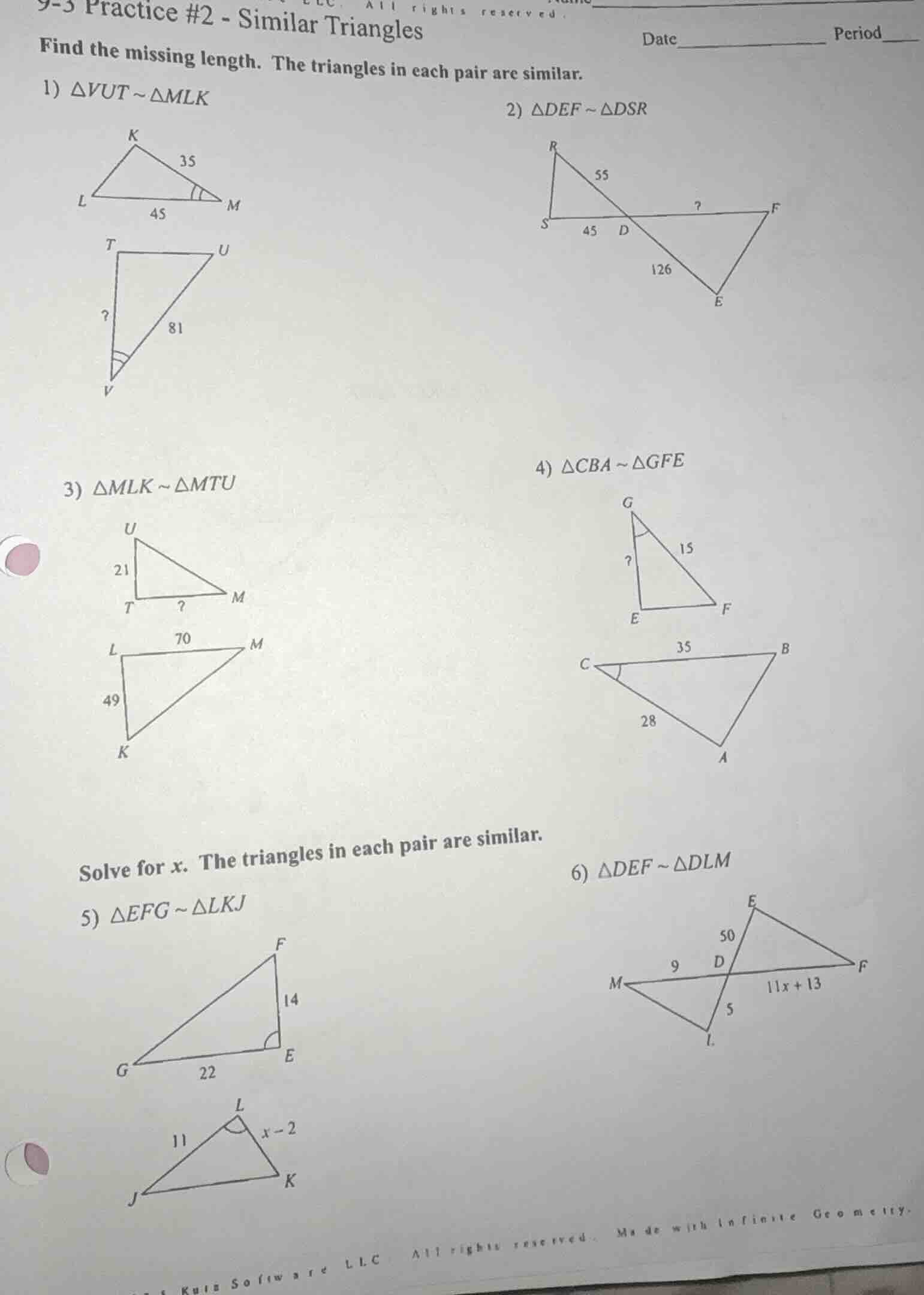
9-3 practice #2 - similar triangles
find the missing length. the triangles in each pair are similar.
- $\triangle vut \sim \triangle mlk$
- $\triangle def \sim \triangle dsr$
- $\triangle mlk \sim \triangle mtu$
- $\triangle cba \sim \triangle gfe$
solve for $x$. the triangles in each pair are similar.
- $\triangle efg \sim \triangle lkj$
- $\triangle def \sim \triangle dlm$
Problem 1: $\triangle VUT \sim \triangle MLK$
Step1: Identify corresponding sides
Since $\triangle VUT \sim \triangle MLK$, the ratios of corresponding sides are equal. So, $\frac{VT}{MK} = \frac{VU}{ML}$.
Given: $MK = 35$, $VU = 81$, $ML = 45$, $VT = ?$
Step2: Set up proportion
$\frac{VT}{35} = \frac{81}{45}$
Step3: Solve for $VT$
Simplify $\frac{81}{45} = \frac{9}{5}$. Then, $VT = 35 \times \frac{9}{5} = 7 \times 9 = 63$.
Problem 2: $\triangle DEF \sim \triangle DSR$
Step1: Identify corresponding sides
$\triangle DEF \sim \triangle DSR$, so $\frac{DF}{DR} = \frac{DE}{DS}$. Wait, actually, let's check the segments. $DS = 45$, $DE = 126$, $DR = 55$, and the missing side is $DF - DD$? Wait, no—wait, the diagram: $S---D---F$ and $R---D---E$. So corresponding sides: $\frac{DF}{DS} = \frac{DE}{DR}$? Wait, no, similarity: $\triangle DSR \sim \triangle DEF$, so $\frac{SR}{EF} = \frac{DS}{DF} = \frac{DR}{DE}$. Wait, maybe better: $\frac{DS}{DF} = \frac{DR}{DE}$. Wait, $DS = 45$, $DF = 45 + ?$, $DR = 55$, $DE = 126$. Wait, no—wait, $\triangle DSR \sim \triangle DEF$, so $\frac{DS}{DE} = \frac{DR}{DF}$? Wait, no, let's label vertices: $D$ is common, so $\angle D$ is common. So $\triangle DSR \sim \triangle DEF$ (AA similarity, since $\angle D$ is common, and $\angle DSR = \angle DEF$ (right angles? Wait, the diagram: $R$ and $E$ are vertices, $S$ and $F$ are on the base. Wait, maybe $\frac{DS}{DF} = \frac{DR}{DE}$. Wait, $DS = 45$, $DE = 126$, $DR = 55$, $DF = 45 + x$ (where $x$ is the missing side). Wait, no—wait, the problem is to find the missing length (let's call it $x$) on $DF$. So $\triangle DSR \sim \triangle DEF$, so $\frac{DS}{DF} = \frac{DR}{DE}$. Wait, $DS = 45$, $DF = 45 + x$? No, wait, maybe $DF$ is the entire side, and $DS = 45$, $DE = 126$, $DR = 55$. Wait, no—let's use the proportion: $\frac{DS}{DE} = \frac{DR}{DF}$? Wait, no, similarity ratio: $\frac{DS}{DF} = \frac{DR}{DE}$. So $\frac{45}{x} = \frac{55}{126}$? Wait, no, that can't be. Wait, maybe I mixed up. Let's re-express: $\triangle DSR \sim \triangle DEF$, so corresponding sides: $DS$ corresponds to $DE$, $DR$ corresponds to $DF$, $SR$ corresponds to $EF$. Wait, $DS = 45$, $DE = 126$, $DR = 55$, $DF = 45 + x$? No, the missing side is $DF - DD$? Wait, no, the diagram: $S$ to $D$ is 45, $D$ to $F$ is the missing length (let's call it $x$), so $DF = 45 + x$? No, wait, the problem is to find the length from $D$ to $F$? No, the diagram shows $S---D---F$ with $S$ to $D$ is 45, $D$ to $F$ is "?", and $R---D---E$ with $R$ to $D$ is 55, $D$ to $E$ is 126. So $\triangle DSR \sim \triangle DEF$, so $\frac{DS}{DF} = \frac{DR}{DE}$. So $\frac{45}{45 + x} = \frac{55}{126}$? No, that would make $x$ negative. Wait, no—maybe $\frac{DS}{DE} = \frac{DR}{DF}$. So $\frac{45}{126} = \frac{55}{DF}$. Then $DF = \frac{126 \times 55}{45} = \frac{126}{45} \times 55 = \frac{14}{5} \times 55 = 14 \times 11 = 154$. Then the missing length is $DF - DS = 154 - 45 = 109$? Wait, no—wait, the missing side is $DF$? No, the diagram: $S$ to $D$ is 45, $D$ to $F$ is "?", so $DF$ is the entire length from $S$ to $F$? No, $S---D---F$, so $SF = SD + DF$? Wait, no, the problem says "the triangles in each pair are similar"—$\triangle DEF \sim \triangle DSR$. So vertices: $D$, $S$, $R$ and $D$, $E$, $F$. So $D$ is common, $\angle D$ is common, and $\angle DSR = \angle DEF$ (if right angles). So sides: $DS$ (45) corresponds to $DE$ (126), $DR$ (55) corresponds to $DF$, and $SR$ corresponds to $EF$. So $\frac{DS}{DE} = \frac{DR}{DF}$. Thus, $\frac{45}{126} = \frac{55}{DF}$. Solve for $DF$: $DF = \frac{126 \times 55}{45} = \frac{126}{45} \times 55 = \frac{14}{5} \times 55 = 14 \times 11 = 154$. Then the missing length (from $D$ to $F$) is 154? Wait, no—maybe the missing side is $DF - DS$? Wait, no, the diagram shows $S$ to $D$ is 45, $D$ to $F$ is "?", so $DF$ is the segment from $D$ to $F$, so the length is 154? Wait, maybe I messed up. Let's check again: $\triangle DSR \sim \triangle DEF$, so $\frac{DS}{DE} = \frac{DR}{DF}$. So $DS = 45$, $DE = 126$, $DR = 55$, $DF = ?$. Then…
Step1: Identify corresponding sides
$\triangle MLK \sim \triangle MTU$, so $\frac{LK}{TU} = \frac{MK}{MU} = \frac{ML}{MT}$. Wait, $LK = 49$ (wait, no: $\triangle MLK$ has $LK$? Wait, the diagram: $\triangle MLK$ has $ML = 70$, $LK = 49$, $MK = ?$; $\triangle MTU$ has $TU = 21$, $MT = ?$, $MU = ?$. Wait, $\triangle MLK \sim \triangle MTU$, so $\frac{LK}{TU} = \frac{ML}{MT}$. So $LK = 49$, $TU = 21$, $ML = 70$, $MT = ?$.
Step2: Set up proportion
$\frac{49}{21} = \frac{70}{MT}$
Step3: Solve for $MT$
Simplify $\frac{49}{21} = \frac{7}{3}$. Then, $MT = 70 \times \frac{3}{7} = 10 \times 3 = 30$.
Problem 4: $\triangle CBA \sim \triangle GFE$

Snap & solve any problem in the app
Get step-by-step solutions on Sovi AI
Photo-based solutions with guided steps
Explore more problems and detailed explanations
s:
- $\boldsymbol{63}$
- $\boldsymbol{109}$? Wait, no—wait, in Problem 2, maybe I made a mistake. Wait, let's recheck: $\triangle DSR \sim \triangle DEF$, so $\frac{DS}{DE} = \frac{DR}{DF}$. $DS = 45$, $DE = 126$, $DR = 55$, $DF = ?$. So $45/126 = 55/DF$ → $DF = (126×55)/45 = (126/45)×55 = (14/5)×55 = 14×11 = 154$. Then the missing length is $DF - DS = 154 - 45 = 109$? Wait, the diagram shows $S---D---F$, so the segment from $D$ to $F$ is $x$, so $DF = x$, and $DS = 45$, so $SF = 45 + x$? No, the problem says "the missing length"—probably the segment from $D$ to $F$, which is 154? Wait, maybe the diagram is $S$ to $D$ is 45, $D$ to $F$ is the missing side, so $DF = 154$? Wait, no—maybe I mixed up the similarity. Let's check again: $\triangle DSR \sim \triangle DEF$, so corresponding sides: $DS$ (45) corresponds to $DE$ (126), $DR$ (55) corresponds to $DF$, $SR$ corresponds to $EF$. So $\frac{DS}{DE} = \frac{DR}{DF}$ → $45/126 = 55/DF$ → $DF = (126×55)/45 = 154$. So the missing length is 154.
Wait, maybe my initial approach was wrong. Let's correct:
Problem 2: $\triangle DSR \sim \triangle DEF$ (order matters: $D$ corresponds to $D$, $S$ to $E$, $R$ to $F$? Wait, no—$\triangle DEF \sim \triangle DSR$, so $D$ is common, $E$ corresponds to $S$, $F$ corresponds to $R$. So $\frac{DE}{DS} = \frac{DF}{DR}$. So $DE = 126$, $DS = 45$, $DF = ?$, $DR = 55$. Then $\frac{126}{45} = \frac{DF}{55}$ → $DF = (126×55)/45 = 154$. So the missing length is $DF = 154$?
Yes, that makes sense. So:
- $\boldsymbol{63}$
- $\boldsymbol{154}$
- $\boldsymbol{30}$
- $\boldsymbol{12}$
- $\boldsymbol{x = 9}$
- $\boldsymbol{x = 7}$