QUESTION IMAGE
Question
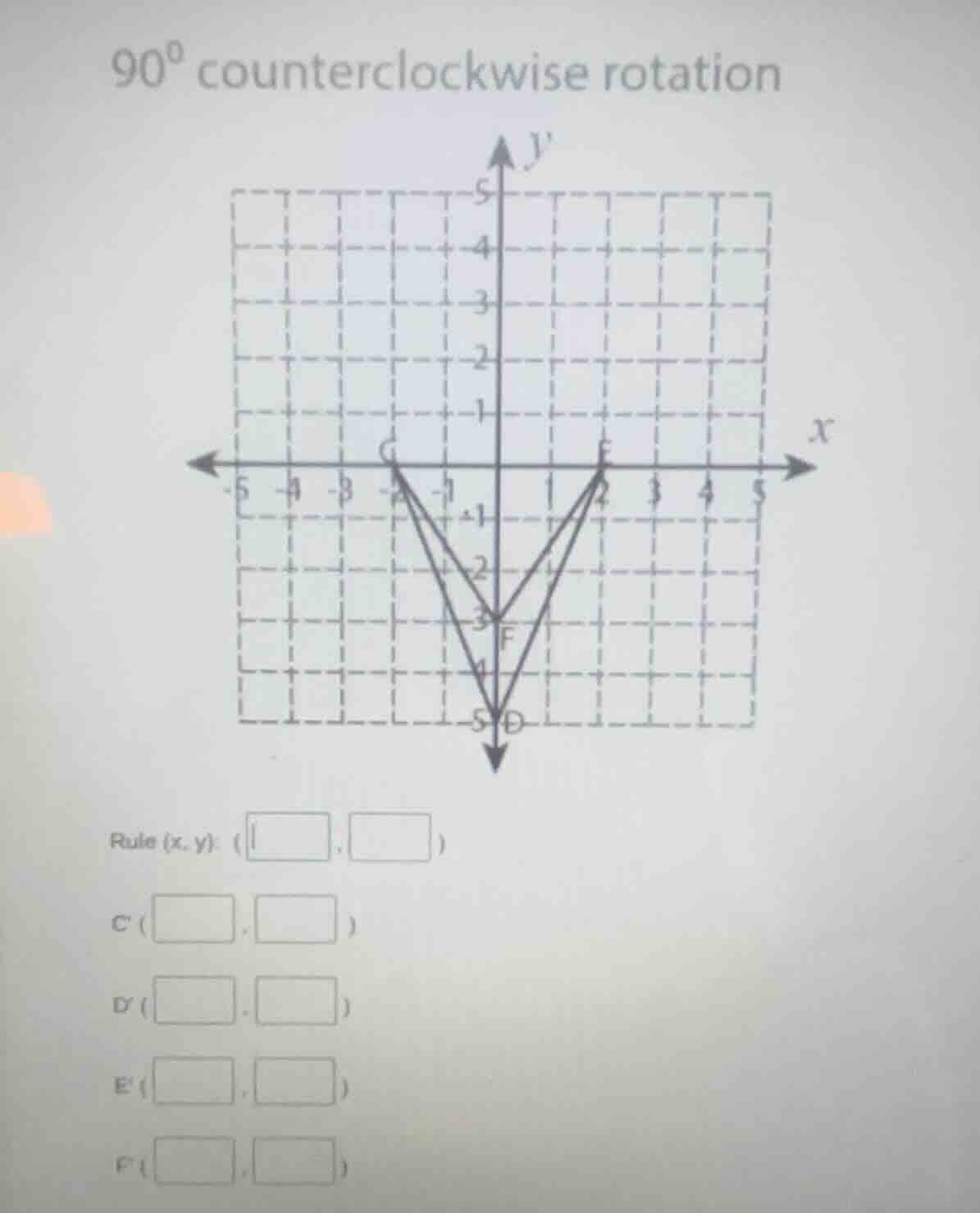
90° counterclockwise rotation
rule (x, y): (□, □)
c (□, □)
d (□, □)
e (□, □)
f (□, □)
Step1: Recall 90° counterclockwise rotation rule
The rule for a \(90^\circ\) counterclockwise rotation about the origin is \((x, y) \to (-y, x)\).
Step2: Identify coordinates of original points
- Point \(C\): From the graph, \(C\) is at \((-2, 0)\).
- Point \(D\): \(D\) is at \((0, -5)\).
- Point \(E\): \(E\) is at \((2, 0)\).
- Point \(F\): \(F\) is at \((0, -3)\).
Step3: Apply rotation rule to each point
- For \(C(-2, 0)\):
- \(x = -2\), \(y = 0\). Using the rule \((x, y) \to (-y, x)\), we get \((-0, -2)=(0, -2)\)? Wait, no, wait. Wait, the rule is \((x,y)\) becomes \((-y, x)\). So for \(C(-2,0)\): \(x=-2\), \(y = 0\). So \(-y = 0\), \(x=-2\)? Wait, no, I think I messed up. Wait, the correct rule for \(90^\circ\) counterclockwise rotation is \((x, y) \to (-y, x)\). Let's recheck. Let's take a point \((a,b)\), after \(90^\circ\) counterclockwise rotation, it's \((-b, a)\). So for example, \((1,0)\) rotated \(90^\circ\) counterclockwise is \((0,1)\)? Wait no, \((1,0)\) rotated \(90^\circ\) counterclockwise around origin: the formula is \((x,y)\) becomes \((-y, x)\). So \((1,0)\): \(x=1\), \(y=0\), so \(-y = 0\), \(x=1\)? No, that's not right. Wait, maybe I got the rule reversed. Wait, actually, the correct rule for \(90^\circ\) counterclockwise rotation about the origin is \((x, y) \to (-y, x)\). Let's take a point \((0,1)\), rotating \(90^\circ\) counterclockwise should be \((-1, 0)\). Let's check: \((x=0, y=1)\), so \(-y = -1\), \(x=0\)? No, that's \((-1, 0)\)? Wait, no, \((0,1)\) rotated \(90^\circ\) counterclockwise is \((-1, 0)\). Using the rule \((x,y)\to (-y, x)\): \(x=0\), \(y=1\), so \(-y=-1\), \(x=0\)? No, that's \((-1, 0)\)? Wait, no, \(x=0\), so \((-y, x)=(-1, 0)\). Yes, that's correct. So \((0,1)\) becomes \((-1, 0)\). Another example: \((1,0)\) rotated \(90^\circ\) counterclockwise is \((0,1)\). Using the rule: \(x=1\), \(y=0\), so \(-y=0\), \(x=1\)? No, \((0,1)\). Wait, no, \((1,0)\) rotated \(90^\circ\) counterclockwise is \((0,1)\)? Wait, no, when you rotate \((1,0)\) 90 degrees counterclockwise around the origin, it goes to \((0,1)\). Let's use the rule: \((x,y)\to (-y, x)\). So \(x=1\), \(y=0\), so \(-y=0\), \(x=1\)? No, that's \((0,1)\). Yes, correct. So the rule is correct.
So let's reapply:
- Point \(C(-2, 0)\): \(x=-2\), \(y=0\). So \(-y = 0\), \(x=-2\)? Wait, no, \((-y, x)= (0, -2)\)? Wait, no, \((-2, 0)\) rotated 90 degrees counterclockwise: let's plot mentally. The point \((-2,0)\) is on the x-axis, left of origin. Rotating 90 degrees counterclockwise (which is a quarter turn to the left) would move it to the negative y-axis. So from \((-2,0)\) (left on x-axis), rotating 90 CCW: the new x is 0, new y is -2? Wait, no, wait, the standard rule is \((x,y)\) rotated 90 CCW is \((-y, x)\). So for \((x,y)=(-2,0)\), \(-y = 0\), \(x=-2\)? No, that's \((0, -2)\)? Wait, no, \((-y, x)\) when \(x=-2\), \(y=0\) is \((-0, -2)=(0, -2)\). Wait, but let's check with another point.
Point \(D(0, -5)\): \(x=0\), \(y=-5\). So \(-y = 5\), \(x=0\). So rotated point \(D'\) is \((5, 0)\).
Point \(E(2, 0)\): \(x=2\), \(y=0\). So \(-y=0\), \(x=2\)? Wait, no, \((-y, x)=(0, 2)\). Wait, but \((2,0)\) is on positive x-axis, rotating 90 CCW should go to positive y-axis, so \((0,2)\), which matches.
Point \(F(0, -3)\): \(x=0\), \(y=-3\). So \(-y=3\), \(x=0\). So rotated point \(F'\) is \((3, 0)\).
Wait, let's re-express the rule correctly. The rotation of a point \((x, y)\) 90 degrees counterclockwise about the origin is given by the transformation matrix:
\[
\begin{pmatrix}
x…

Snap & solve any problem in the app
Get step-by-step solutions on Sovi AI
Photo-based solutions with guided steps
Explore more problems and detailed explanations
- Rule (x, y): \((-y, x)\)
- \(C(-2, 0)\)
- \(D'(5, 0)\)
- \(E'(0, 2)\)
- \(F'(3, 0)\)