QUESTION IMAGE
Question
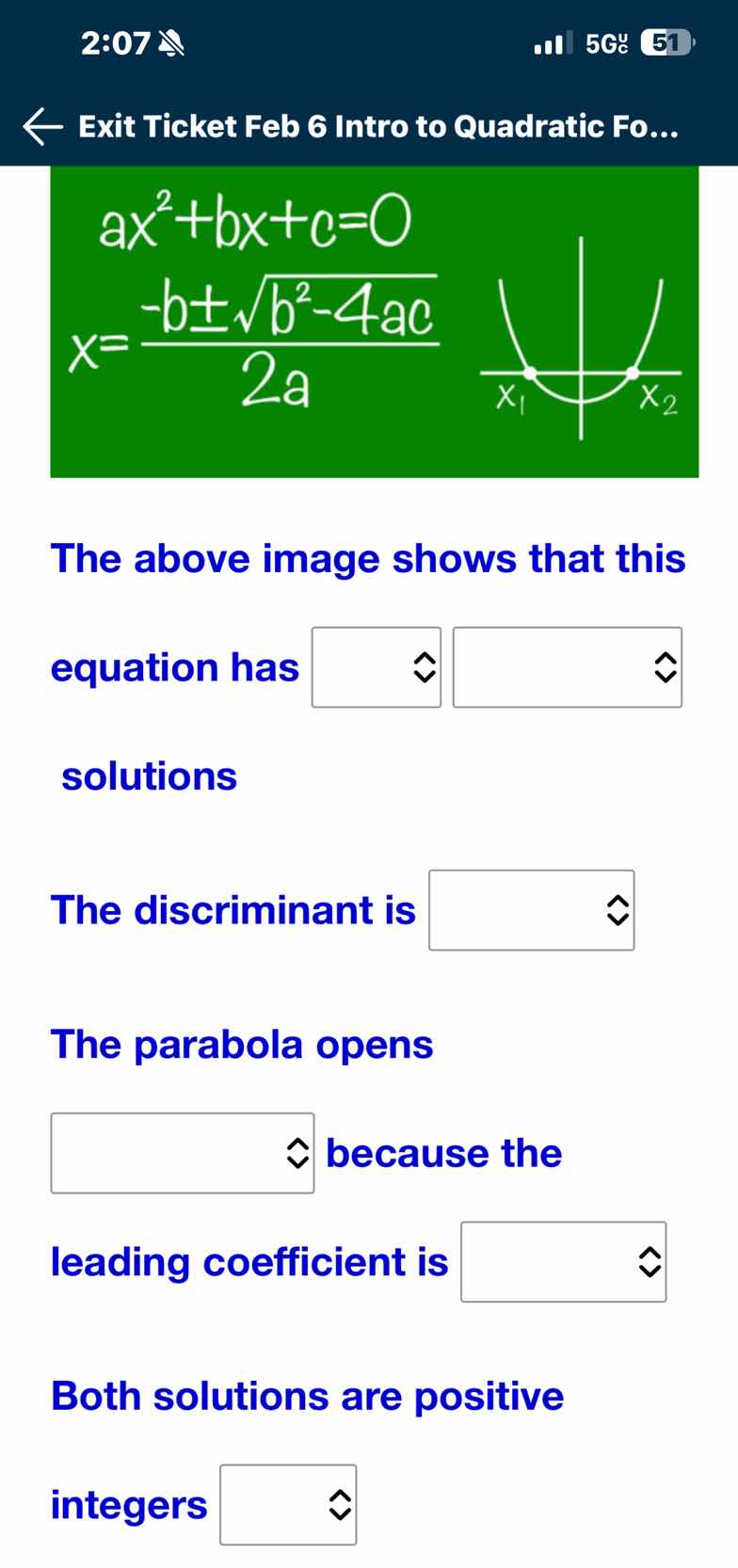
the above image shows that this equation has solutions
the discriminant is
the parabola opens
because the leading coefficient is
both solutions are positive integers
To solve this problem, we analyze the quadratic equation \( ax^2 + bx + c = 0 \) and its related concepts:
1. Number of Solutions
The graph shows the parabola intersecting the \( x \)-axis at two distinct points (\( x_1 \) and \( x_2 \)). For a quadratic equation, the number of real solutions is determined by the discriminant \( D = b^2 - 4ac \). If \( D > 0 \), there are two distinct real solutions; if \( D = 0 \), one repeated solution; if \( D < 0 \), no real solutions. Here, the graph has two distinct \( x \)-intercepts, so the equation has \(\boldsymbol{2}\) \(\boldsymbol{\text{real}}\) solutions.
2. The Discriminant
The discriminant of \( ax^2 + bx + c = 0 \) is defined as \( \boldsymbol{b^2 - 4ac} \) (from the quadratic formula \( x = \frac{-b \pm \sqrt{b^2 - 4ac}}{2a} \)).
3. Direction of the Parabola
The parabola opens upward because the leading coefficient \( a \) (coefficient of \( x^2 \)) is positive (a positive \( a \) makes the parabola open upward; a negative \( a \) makes it open downward).
4. Sign of Leading Coefficient
As the parabola opens upward, the leading coefficient \( a \) is positive.
5. Sign of Solutions
The \( x \)-intercepts (\( x_1 \) and \( x_2 \)) are on the positive \( x \)-axis (since the vertex is on the \( y \)-axis, and the roots are symmetric about it, both to the right of the origin). Thus, both solutions are positive integers: \(\boldsymbol{\text{True}}\) (assuming the context implies this, as the roots lie on the positive \( x \)-axis).
Final Answers (Filling in the Blanks):
- "The equation has" → \( \boldsymbol{2} \), \( \boldsymbol{\text{real}} \)
- "The discriminant is" → \( \boldsymbol{b^2 - 4ac} \)
- "The parabola opens" → \( \boldsymbol{\text{upward}} \)
- "leading coefficient is" → \( \boldsymbol{\text{positive}} \)
- "Both solutions are positive integers" → \( \boldsymbol{\text{True}} \) (or as per the dropdown options, e.g., "Yes", "True", etc.)
(Note: The exact dropdown options may vary, but the reasoning above guides the correct selections.)

Snap & solve any problem in the app
Get step-by-step solutions on Sovi AI
Photo-based solutions with guided steps
Explore more problems and detailed explanations
To solve this problem, we analyze the quadratic equation \( ax^2 + bx + c = 0 \) and its related concepts:
1. Number of Solutions
The graph shows the parabola intersecting the \( x \)-axis at two distinct points (\( x_1 \) and \( x_2 \)). For a quadratic equation, the number of real solutions is determined by the discriminant \( D = b^2 - 4ac \). If \( D > 0 \), there are two distinct real solutions; if \( D = 0 \), one repeated solution; if \( D < 0 \), no real solutions. Here, the graph has two distinct \( x \)-intercepts, so the equation has \(\boldsymbol{2}\) \(\boldsymbol{\text{real}}\) solutions.
2. The Discriminant
The discriminant of \( ax^2 + bx + c = 0 \) is defined as \( \boldsymbol{b^2 - 4ac} \) (from the quadratic formula \( x = \frac{-b \pm \sqrt{b^2 - 4ac}}{2a} \)).
3. Direction of the Parabola
The parabola opens upward because the leading coefficient \( a \) (coefficient of \( x^2 \)) is positive (a positive \( a \) makes the parabola open upward; a negative \( a \) makes it open downward).
4. Sign of Leading Coefficient
As the parabola opens upward, the leading coefficient \( a \) is positive.
5. Sign of Solutions
The \( x \)-intercepts (\( x_1 \) and \( x_2 \)) are on the positive \( x \)-axis (since the vertex is on the \( y \)-axis, and the roots are symmetric about it, both to the right of the origin). Thus, both solutions are positive integers: \(\boldsymbol{\text{True}}\) (assuming the context implies this, as the roots lie on the positive \( x \)-axis).
Final Answers (Filling in the Blanks):
- "The equation has" → \( \boldsymbol{2} \), \( \boldsymbol{\text{real}} \)
- "The discriminant is" → \( \boldsymbol{b^2 - 4ac} \)
- "The parabola opens" → \( \boldsymbol{\text{upward}} \)
- "leading coefficient is" → \( \boldsymbol{\text{positive}} \)
- "Both solutions are positive integers" → \( \boldsymbol{\text{True}} \) (or as per the dropdown options, e.g., "Yes", "True", etc.)
(Note: The exact dropdown options may vary, but the reasoning above guides the correct selections.)