QUESTION IMAGE
Question
6 accidents will happen—at the dinner table as well as anywhere else. the duty of the guest and the hostess both is to see that no confusion and embarrassment follows.
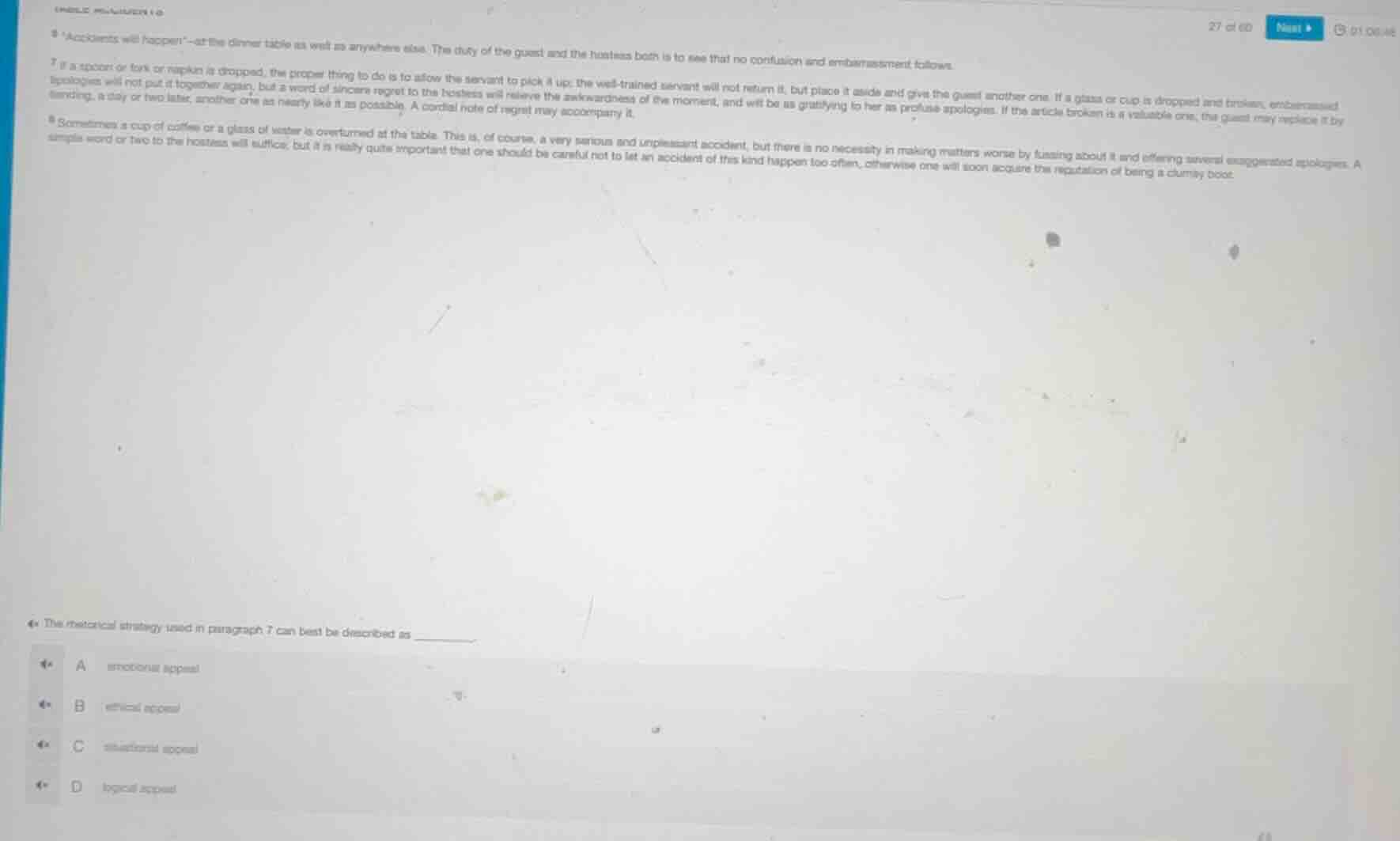
7 if a spoon or fork or napkin is dropped, the proper thing to do is to allow the servant to pick it up. the well - trained servant will not return it, but place it aside and give the guest another one. if a glass or cup is dropped and broken, embarrassed apologies will not put it together again, but a word of sincere regret to the hostess will relieve the awkwardness of the moment, and will be as gratifying to her as profuse apologies. if the article broken is a valuable one, the guest may replace it by sending, a day or two later, another one as nearly like it as possible. a cordial note of regret may accompany it.
8 sometimes a cup of coffee or a glass of water is overturned at the table. this is, of course, a very serious and unpleasant accident, but there is no necessity in making matters worse by fussing about it and offering several exaggerated apologies. a simple word or two to the hostess will suffice, but it is really quite important that one should be careful not to let an accident of this kind happen too often, otherwise one will soon acquire the reputation of being a clumsy boor.
- the rhetorical strategy used in paragraph 7 can best be described as ______.
a. emotional appeal
b. ethical appeal
c. illustrative appeal
d. logical appeal
To determine the rhetorical strategy in paragraph 7, we analyze each option:
- Option A (emotional appeal): Emotional appeal uses emotions to persuade. Paragraph 7 focuses on practical actions (e.g., letting servant pick up dropped items, replacing broken valuables) rather than evoking emotions. Eliminate A.
- Option B (ethical appeal): Ethical appeal relies on credibility/ethics. The paragraph gives practical advice on handling accidents, not on ethical character or credibility. Eliminate B.
- Option C (situational appeal): This is not a standard rhetorical appeal. The three main appeals are ethos, pathos, logos. Eliminate C.
- Option D (logical appeal): Logical appeal (logos) uses reasoning, examples, or practical steps. Paragraph 7 provides logical, step - by - step advice on handling different dinner - table accidents (dropped utensils, broken glassware) with practical actions (servant picks up, replace valuable items). This fits logical appeal.

Snap & solve any problem in the app
Get step-by-step solutions on Sovi AI
Photo-based solutions with guided steps
Explore more problems and detailed explanations
D. logical appeal