QUESTION IMAGE
Question
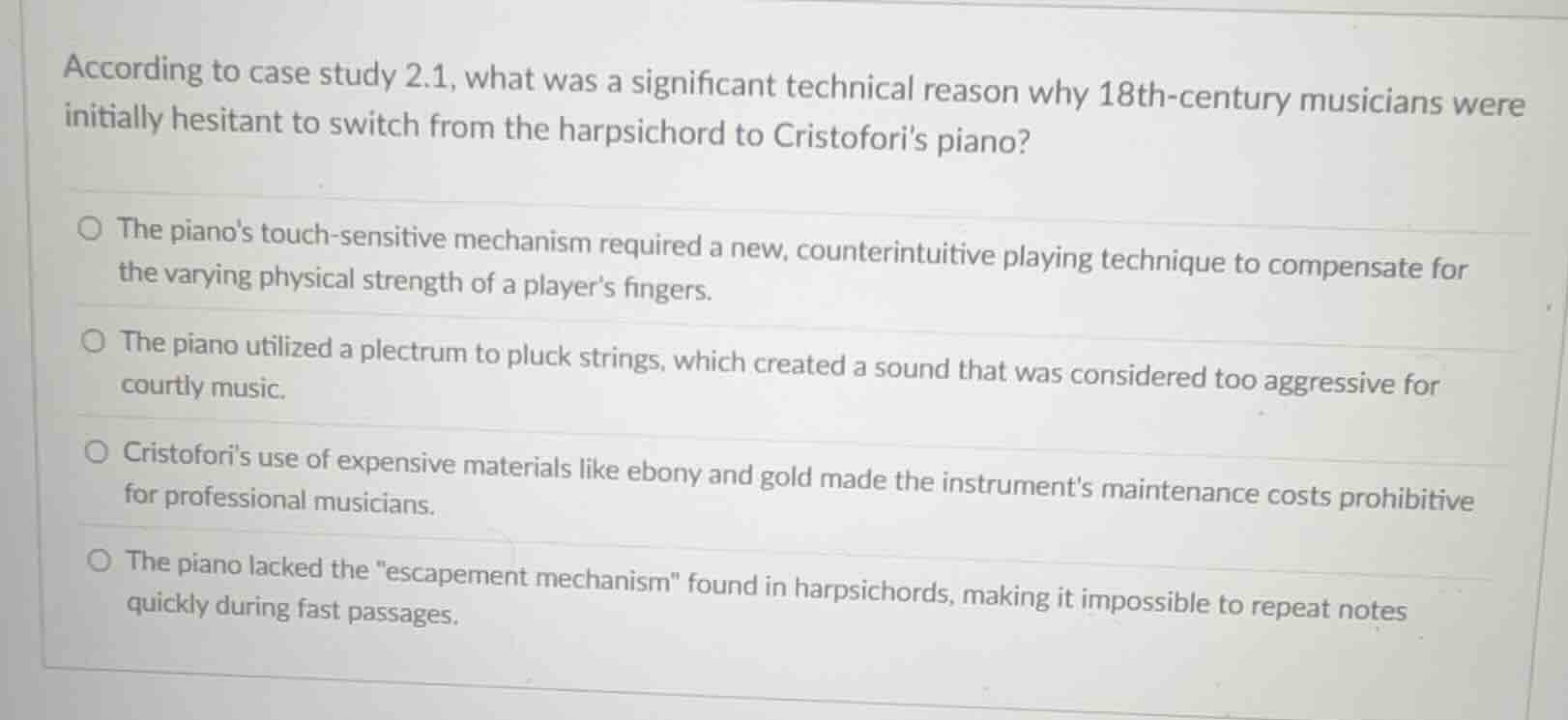
according to case study 2.1, what was a significant technical reason why 18th - century musicians were initially hesitant to switch from the harpsichord to cristofori’s piano?
- the piano’s touch - sensitive mechanism required a new, counterintuitive playing technique to compensate for the varying physical strength of a player’s fingers.
- the piano utilized a plectrum to pluck strings, which created a sound that was considered too aggressive for courtly music.
- cristofori’s use of expensive materials like ebony and gold made the instrument’s maintenance costs prohibitive for professional musicians.
- the piano lacked the “escapement mechanism” found in harpsichords, making it impossible to repeat notes quickly during fast passages.
Brief Explanations
- The harpsichord uses a plectrum to pluck strings, not the piano, so the second option is incorrect.
- Cristofori's early pianos did not use prohibitively expensive materials like gold, so the third option is incorrect.
- Cristofori's piano invented the escapement mechanism (a key innovation that let it repeat notes), so the fourth option is incorrect.
- The piano's touch-sensitive action required players to use varying finger strength to control volume, a new, counterintuitive skill compared to the harpsichord, which produced uniform volume regardless of touch. This was a major technical barrier for 18th-century musicians.

Snap & solve any problem in the app
Get step-by-step solutions on Sovi AI
Photo-based solutions with guided steps
Explore more problems and detailed explanations
The piano's touch-sensitive mechanism required a new, counterintuitive playing technique to compensate for the varying physical strength of a player's fingers.