QUESTION IMAGE
Question
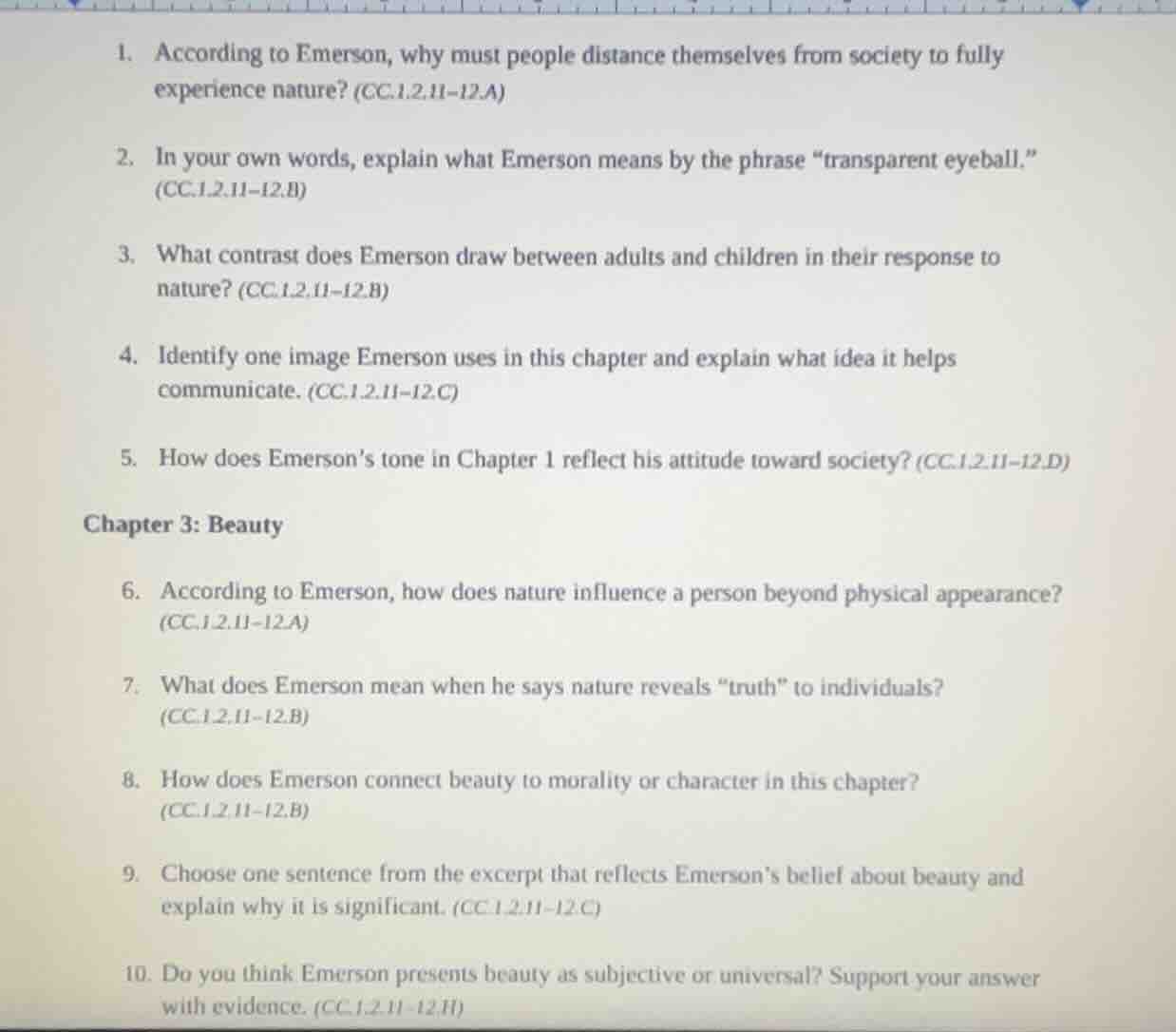
- according to emerson, why must people distance themselves from society to fully experience nature? (cc.1.2.11-12.a)
- in your own words, explain what emerson means by the phrase \transparent eyeball.\ (cc.1.2.11-12.b)
- what contrast does emerson draw between adults and children in their response to nature? (cc.1.2.11-12.b)
- identify one image emerson uses in this chapter and explain what idea it helps communicate. (cc.1.2.11-12.c)
- how does emersons tone in chapter 1 reflect his attitude toward society? (cc.1.2.11-12.d)
chapter 3: beauty
- according to emerson, how does nature influence a person beyond physical appearance? (cc.1.2.11-12.a)
- what does emerson mean when he says nature reveals \truth\ to individuals? (cc.1.2.11-12.b)
- how does emerson connect beauty to morality or character in this chapter? (cc.1.2.11-12.b)
- choose one sentence from the excerpt that reflects emersons belief about beauty and explain why it is significant. (cc.1.2.11-12.c)
- do you think emerson presents beauty as subjective or universal? support your answer with evidence. (cc.1.2.11-12.h)
Brief Explanations
- Emerson argues society imposes conformity, ego, and artificial values that distract people from the pure, unmediated connection with nature needed for spiritual and self-truth.
- The "transparent eyeball" is a metaphor for a state where the self dissolves, and the person becomes a vessel to fully receive and merge with nature, losing self-awareness to experience unity with the natural world.
- Emerson contrasts adults, who see nature through practical, self-serving lenses (as a resource or tool), with children, who perceive nature with wonder, openness, and a direct, unfiltered connection that lets them experience its spiritual essence.
- One image is the "wilderness"—Emerson uses it to communicate that untamed nature is a source of spiritual renewal and a counterpoint to the corrupting, conforming forces of civilized society.
- Emerson's tone is critical yet urgent; he rejects society's materialism and conformity, using passionate, declarative language to urge readers to reject societal constraints and embrace nature for authentic selfhood.
- Emerson claims nature nurtures a person's spiritual and intellectual growth: it inspires creativity, fosters self-reliance, and connects individuals to universal truths that shape their inner life and sense of purpose.
- For Emerson, nature reveals "truth" by reflecting the universal spiritual order that underlies all existence. By engaging with nature, individuals can access innate, intuitive truths about themselves and the universe that are hidden by societal norms.
- Emerson links beauty to morality by arguing that experiencing nature's beauty cultivates virtuous traits: it teaches humility, empathy, and a sense of unity with all living things, which shape a person's ethical character and moral compass.
- Example sentence: "The greatest delight which the fields and woods minister, is the suggestion of an occult relation between man and the vegetable." This is significant because it encapsulates Emerson's core belief that beauty in nature is not just aesthetic—it reveals a deep, spiritual connection between humans and the natural world, reinforcing his transcendentalist ideas of unity.
- Emerson presents beauty as universal. He states that nature's beauty is accessible to all who approach it with an open mind, and that it reflects a shared, universal spiritual truth, not just individual preference (e.g., he notes that certain natural forms like a sunset evoke the same awe across people).

Snap & solve any problem in the app
Get step-by-step solutions on Sovi AI
Photo-based solutions with guided steps
Explore more problems and detailed explanations
- Society imposes conformity and artificial values that block the pure, spiritual connection with nature needed for full experience.
- It describes a state where the self dissolves, letting a person merge fully with nature and experience unity with it.
- Adults view nature practically/self-servingly; children perceive it with wonder and unfiltered, spiritual openness.
- Wilderness: Communicates that untamed nature offers spiritual renewal and pushes back against society's corrupting conformity.
- His critical, passionate tone rejects society's materialism and conformity, urging readers to embrace nature for authentic selfhood.
- Nature fosters spiritual/intellectual growth, inspires creativity, and connects people to universal truths shaping inner purpose.
- Nature reflects the universal spiritual order, letting individuals access intuitive, innate truths hidden by societal norms.
- Experiencing nature's beauty cultivates virtues like humility and empathy, shaping a person's ethical character and moral compass.
- Example: "The greatest delight which the fields and woods minister, is the suggestion of an occult relation between man and the vegetable." It encapsulates his core belief in a spiritual, universal bond between humans and nature.
- Universal. He argues nature's beauty reflects shared spiritual truths accessible to all, with forms like sunsets evoking universal awe.