QUESTION IMAGE
Question
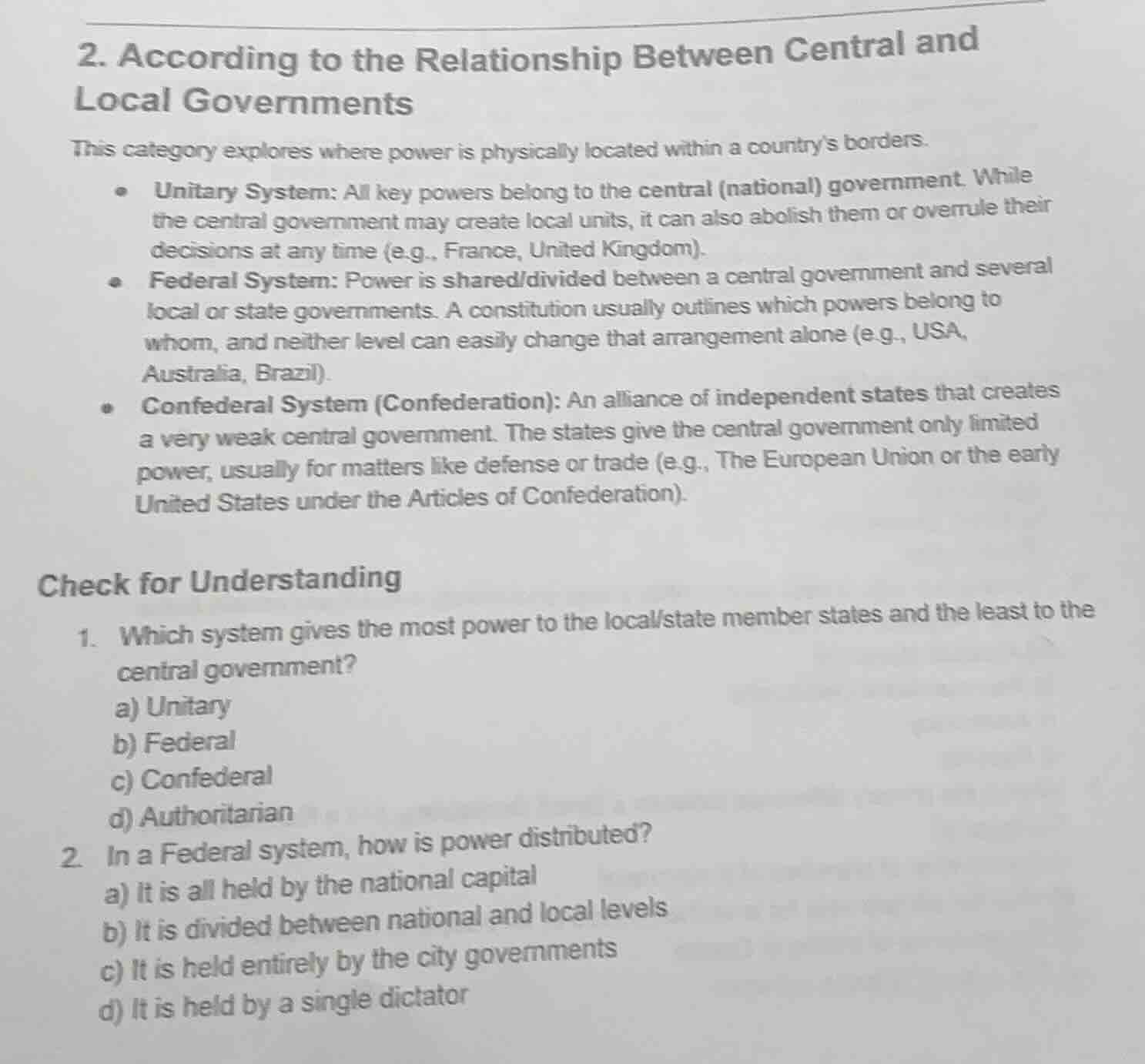
- according to the relationship between central and local governments
this category explores where power is physically located within a country’s borders.
- unitary system: all key powers belong to the central (national) government. while the central government may create local units, it can also abolish them or overrule their decisions at any time (e.g., france, united kingdom).
- federal system: power is shared/divided between a central government and several local or state governments. a constitution usually outlines which powers belong to whom, and neither level can easily change that arrangement alone (e.g., usa, australia, brazil).
- confederal system (confederation): an alliance of independent states that creates a very weak central government. the states give the central government only limited power, usually for matters like defense or trade (e.g., the european union or the early united states under the articles of confederation).
check for understanding
- which system gives the most power to the local/state member states and the least to the central government?
a) unitary
b) federal
c) confederal
d) authoritarian
- in a federal system, how is power distributed?
a) it is all held by the national capital
b) it is divided between national and local levels
c) it is held entirely by the city governments
d) it is held by a single dictator
Response
Question 1
Brief Explanations
- For option a (Unitary): The text says all key powers belong to the central government, so local has little power.
- For option b (Federal): Power is shared between central and local, not local having most.
- For option c (Confederal): It's an alliance of independent states with a very weak central government, so local/state has the most power and central the least.
- For option d (Authoritarian): This is not one of the systems described in the relationship of central - local (the systems are unitary, federal, confederal).
Brief Explanations
- Option a: This is the unitary system, not federal.
- Option b: The text defines federal system as power shared/divided between central and local/state governments.
- Option c: Entirely by city governments is incorrect, federal is about central and state/local (not just city).
- Option d: Held by a single dictator is authoritarian, not federal.

Snap & solve any problem in the app
Get step-by-step solutions on Sovi AI
Photo-based solutions with guided steps
Explore more problems and detailed explanations
c) Confederal