QUESTION IMAGE
Question
actividad b: verano versus invierno
prepara el gizmo:
- hacer clic reiniciar.
- selecciona el sim. velocidad al mínimo.
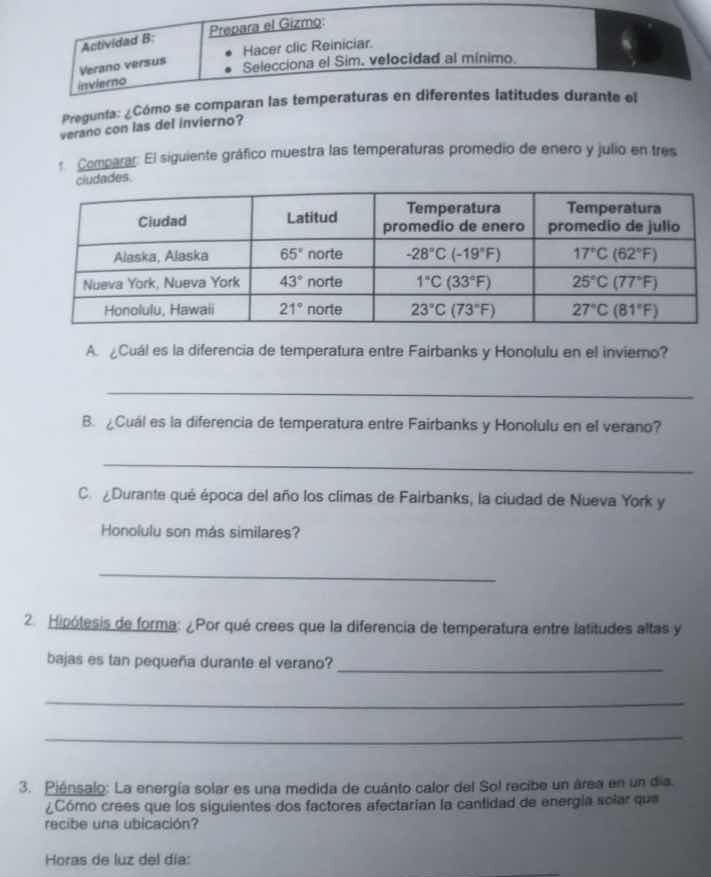
pregunta: ¿cómo se comparan las temperaturas en diferentes latitudes durante el verano con las del invierno?
- comparar: el siguiente gráfico muestra las temperaturas promedio de enero y julio en tres ciudades.
ciudad | latitud | temperatura promedio de enero | temperatura promedio de julio
--- | --- | --- | ---
alaska, alaska | 65° norte | -28°c (-19°f) | 17°c (62°f)
nueva york, nueva york | 43° norte | 1°c (33°f) | 25°c (77°f)
honolulu, hawaii | 21° norte | 23°c (73°f) | 27°c (81°f)
a. ¿cuál es la diferencia de temperatura entre fairbanks y honolulu en el invierno?
_____________________________________________________________________
b. ¿cuál es la diferencia de temperatura entre fairbanks y honolulu en el verano?
_____________________________________________________________________
c. ¿durante qué época del año los climas de fairbanks, la ciudad de nueva york y honolulu son más similares?
_____________________________________________________________________
- hipótesis de forma: ¿por qué crees que la diferencia de temperatura entre latitudes altas y bajas es tan pequeña durante el verano?
_____________________________________________________________________
_____________________________________________________________________
- piénsalo: la energía solar es una medida de cuánto calor del sol recibe un área en un día. ¿cómo crees que los siguientes dos factores afectarian la cantidad de energía solar que recibe una ubicación?
horas de luz del día:
Step1: Identify winter temps
Fairbanks (Alaska) Jan temp: $-28^\circ\text{C}$; Honolulu Jan temp: $23^\circ\text{C}$
Step2: Calculate winter temp difference
$23 - (-28) = 23 + 28 = 51^\circ\text{C}$
Step3: Identify summer temps
Fairbanks (Alaska) July temp: $17^\circ\text{C}$; Honolulu July temp: $27^\circ\text{C}$
Step4: Calculate summer temp difference
$27 - 17 = 10^\circ\text{C}$
Step5: Compare seasonal temp similarity
Winter temps: $-28^\circ\text{C}$, $1^\circ\text{C}$, $23^\circ\text{C}$ (large spread)
Summer temps: $17^\circ\text{C}$, $25^\circ\text{C}$, $27^\circ\text{C}$ (small spread)
Step6: Explain summer temp small difference
High latitudes get more summer daylight hours, reducing the solar energy gap with low latitudes, so temp differences shrink.
Step7: Explain daylight effect on solar energy
More daily daylight = more time for solar energy absorption, so higher total solar energy.

Snap & solve any problem in the app
Get step-by-step solutions on Sovi AI
Photo-based solutions with guided steps
Explore more problems and detailed explanations
A. $51^\circ\text{C}$ (or $92^\circ\text{F}$, since $93^\circ\text{F}-(-19^\circ\text{F})=112^\circ\text{F}$? Wait, correcting: $73^\circ\text{F}-(-19^\circ\text{F})=92^\circ\text{F}$; metric is $51^\circ\text{C}$)
B. $10^\circ\text{C}$ (or $14^\circ\text{F}$, since $81^\circ\text{F}-67^\circ\text{F}=14^\circ\text{F}$; metric is $10^\circ\text{C}$)
C. During the summer (julio)
- In summer, high latitudes receive many more hours of daylight each day than low latitudes, which compensates for the lower solar angle, reducing the temperature difference between the two regions.
- Horas de luz del día: The more hours of daylight a location receives, the more solar energy it can absorb in a day, so higher total solar energy; fewer daylight hours mean less total solar energy absorbed.