QUESTION IMAGE
Question
activity
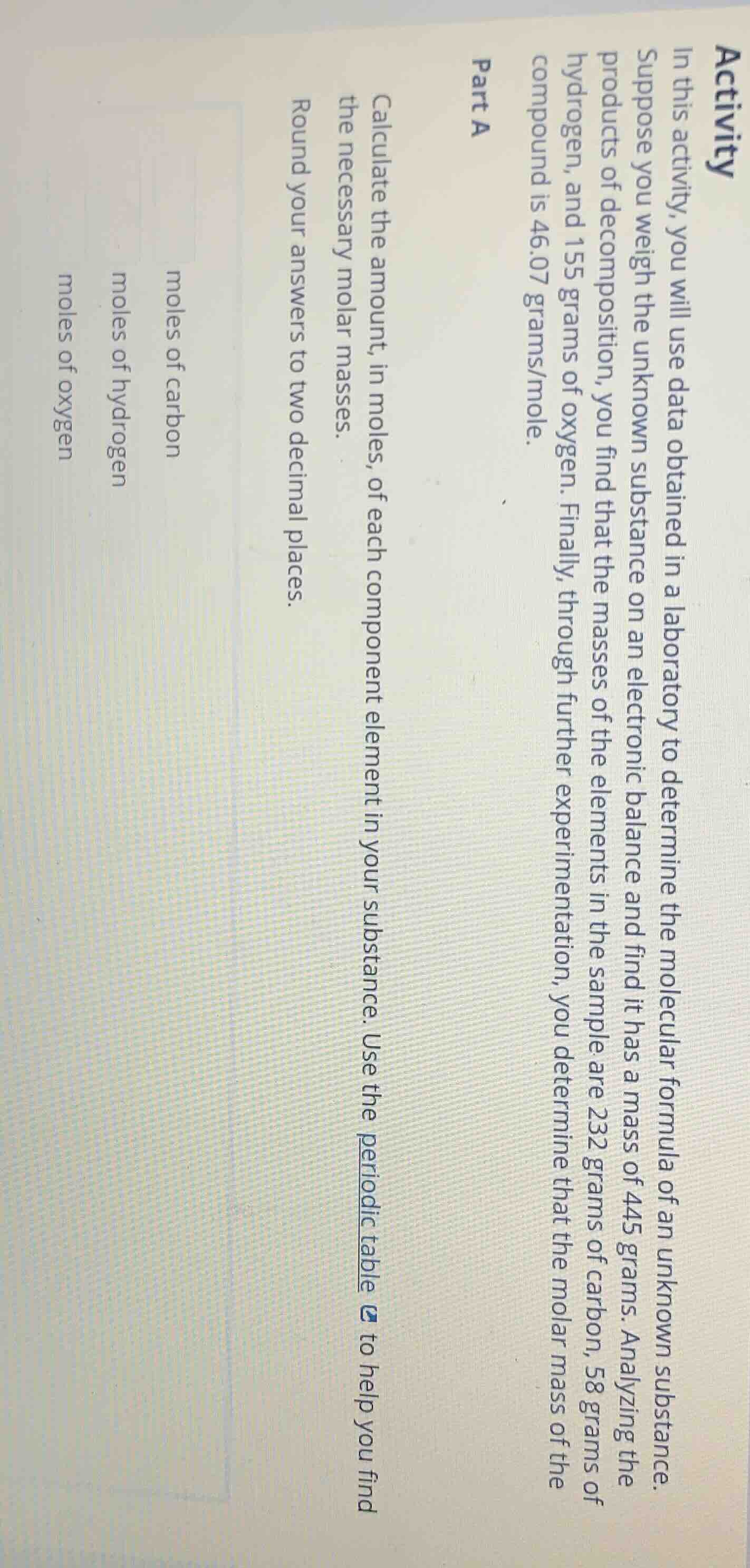
in this activity, you will use data obtained in a laboratory to determine the molecular formula of an unknown substance. suppose you weigh the unknown substance on an electronic balance and find it has a mass of 445 grams. analyzing the products of decomposition, you find that the masses of the elements in the sample are 232 grams of carbon, 58 grams of hydrogen, and 155 grams of oxygen. finally, through further experimentation, you determine that the molar mass of the compound is 46.07 grams/mole.
part a
calculate the amount, in moles, of each component element in your substance. use the periodic table to help you find the necessary molar masses.
round your answers to two decimal places.
moles of carbon
moles of hydrogen
moles of oxygen
To calculate the moles of each element, we use the formula:
$$\text{Moles} = \frac{\text{Mass (g)}}{\text{Molar Mass (g/mol)}}$$
Step 1: Moles of Carbon
Molar mass of carbon ($C$) = $12.01$ g/mol (from periodic table).
Mass of carbon = $232$ g.
$$\text{Moles of } C = \frac{232\ \text{g}}{12.01\ \text{g/mol}} \approx 19.32\ \text{moles}$$
Step 2: Moles of Hydrogen
Molar mass of hydrogen ($H$) = $1.008$ g/mol (from periodic table).
Mass of hydrogen = $58$ g.
$$\text{Moles of } H = \frac{58\ \text{g}}{1.008\ \text{g/mol}} \approx 57.54\ \text{moles}$$
Step 3: Moles of Oxygen
Molar mass of oxygen ($O$) = $16.00$ g/mol (from periodic table).
Mass of oxygen = $155$ g.
$$\text{Moles of } O = \frac{155\ \text{g}}{16.00\ \text{g/mol}} \approx 9.69\ \text{moles}$$

Snap & solve any problem in the app
Get step-by-step solutions on Sovi AI
Photo-based solutions with guided steps
Explore more problems and detailed explanations
- Moles of carbon: $\boldsymbol{19.32}$
- Moles of hydrogen: $\boldsymbol{57.54}$
- Moles of oxygen: $\boldsymbol{9.69}$