QUESTION IMAGE
Question
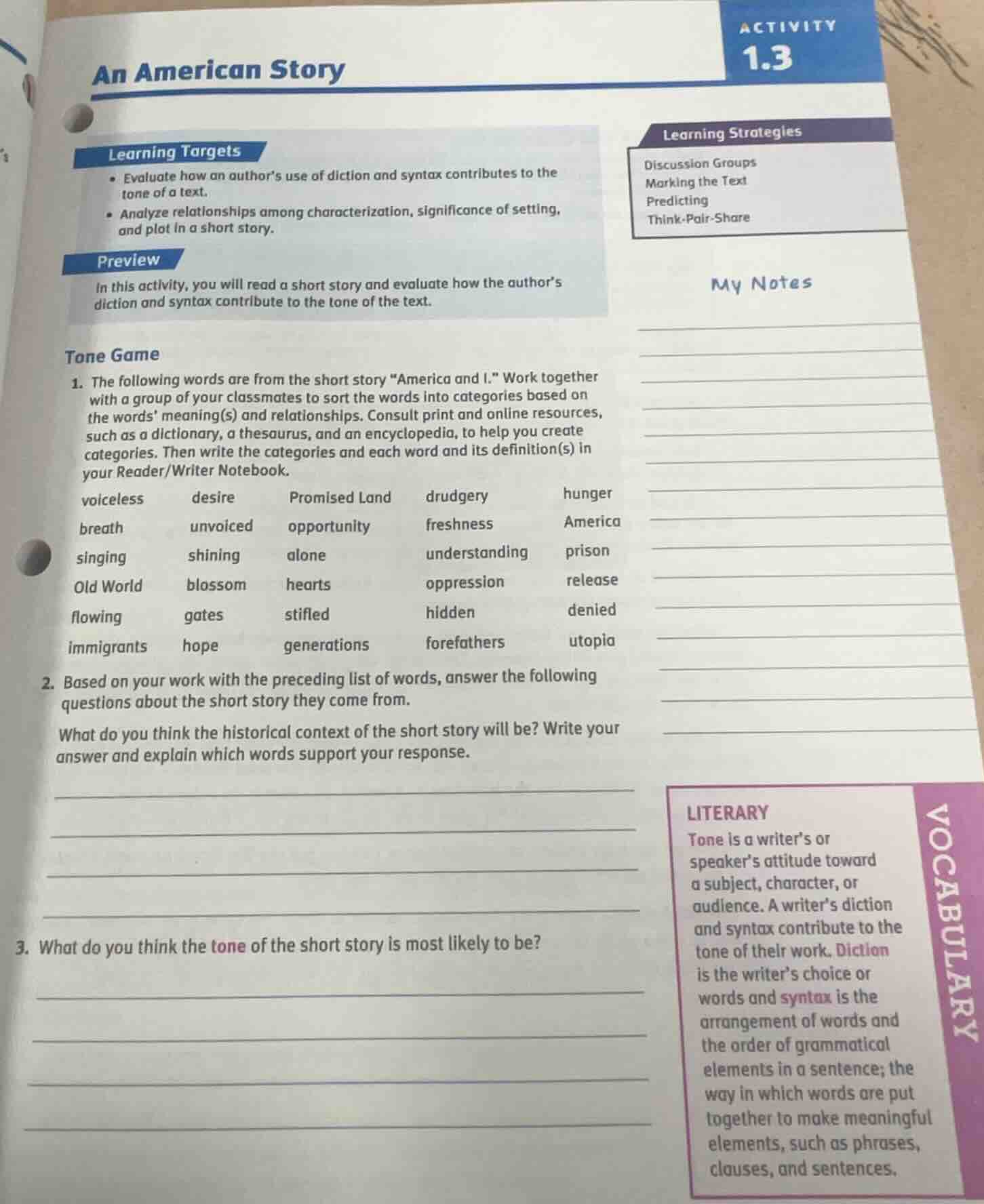
activity 1.3 an american story learning targets - evaluate how an author’s use of diction and syntax contributes to the tone of a text. - analyze relationships among characterization, significance of setting, and plot in a short story. learning strategies discussion groups marking the text predicting think - pair - share preview in this activity, you will read a short story and evaluate how the author’s diction and syntax contribute to the tone of the text. my notes tone game 1. the following words are from the short story “america and i.” work together with a group of your classmates to sort the words into categories based on the words’ meaning(s) and relationships. consult print and online resources, such as a dictionary, a thesaurus, and an encyclopedia, to help you create categories. then write the categories and each word and its definition(s) in your reader/writer notebook. voiceless desire promised land drudgery hunger breath unvoiced opportunity freshness america singing shining alone understanding prison old world blossom hearts oppression release flowing gates stifled hidden denied immigrants hope generations forefathers utopia 2. based on your work with the preceding list of words, answer the following questions about the short story they come from. what do you think the historical context of the short story will be? write your answer and explain which words support your response. 3. what do you think the tone of the short story is most likely to be? literary tone is a writer’s or speaker’s attitude toward a subject, character, or audience. a writer’s diction and syntax contribute to the tone of their work. diction is the writer’s choice of words and syntax is the arrangement of words and the order of grammatical elements in a sentence; the way in which words are put together to make meaningful elements, such as phrases, clauses, and sentences. vocabulary
Question 2
The historical context is likely about immigration to America, especially from the Old World. Words like "immigrants", "Old World", "forefathers", "generations", "Promised Land", "America", "utopia", "hope", "opportunity" support this. "Immigrants" and "Old World" imply people coming from other regions, "forefathers" and "generations" suggest a familial/historical migration timeline, and "Promised Land", "America", "utopia", "hope", "opportunity" reflect the idea of America as a land of new chances, contrasting with words like "oppression", "drudgery", "stifled" from the Old World.
The tone is likely a mix of hopeful and reflective (or bittersweet). Words like "hope", "opportunity", "blossom", "freshness", "utopia" suggest hope and optimism about America. But words like "voiceless", "oppression", "drudgery", "stifled", "denied" show the hardships of the past (Old World) or initial struggles, adding a reflective or somber layer. The contrast between these negative Old World - related words and positive America - related words creates a tone of hope for a better future but with an awareness of past struggles.

Snap & solve any problem in the app
Get step-by-step solutions on Sovi AI
Photo-based solutions with guided steps
Explore more problems and detailed explanations
The historical context is likely the experience of immigrants coming to America (probably in the late 19th/early 20th century) from the "Old World" (Europe, for example). Words like "immigrants" (people moving to a new country), "Old World" (their place of origin), "forefathers" (ancestors who migrated), "generations" (family lines moving over time), "Promised Land" and "America" (the destination), "hope" and "opportunity" (what America represented) support this. Also, words like "oppression", "drudgery", "stifled" (conditions in the Old World) contrast with the positive associations of America, showing why they migrated.