QUESTION IMAGE
Question
activity 3: multiple choice (concept understanding)
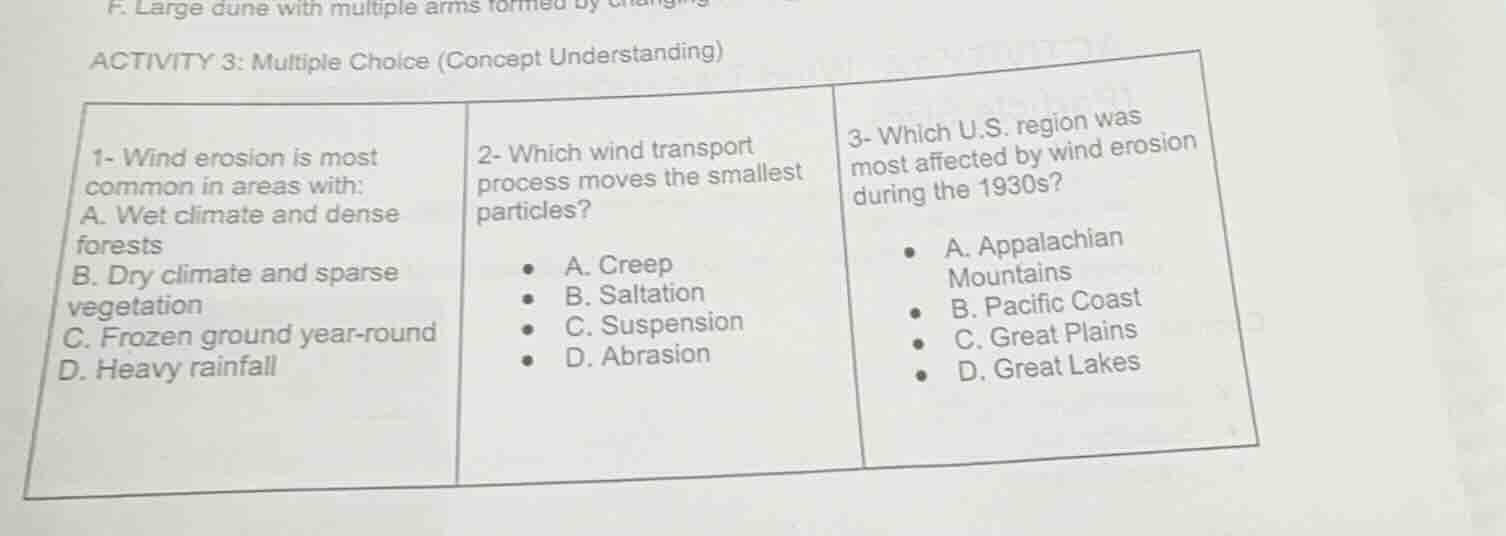
1- wind erosion is most common in areas with:
a. wet climate and dense forests
b. dry climate and sparse vegetation
c. frozen ground year - round
d. heavy rainfall
2- which wind transport process moves the smallest particles?
- a. creep
- b. saltation
- c. suspension
- d. abrasion
3- which u.s. region was most affected by wind erosion during the 1930s?
- a. appalachian mountains
- b. pacific coast
- c. great plains
- d. great lakes
Question 1
Wind erosion occurs when wind removes and transports soil particles. Dry climates have less moisture to bind soil, and sparse vegetation means less root structure to hold soil, making wind erosion more common. Wet climates (A) have moisture to stabilize soil, dense forests (A) have roots and litter to protect soil. Frozen ground (C) is stable as ice holds particles. Heavy rainfall (D) leads to water erosion, not wind. So the correct option is B.
Wind transport processes: Creep (A) moves larger, heavier particles by rolling/sliding. Saltation (B) moves medium - sized particles in short jumps. Suspension (C) lifts and carries the smallest particles (like dust) long distances as they are light enough to stay airborne. Abrasion (D) is a process of erosion (particles hitting surfaces), not transport of smallest particles. So the correct option is C.
The 1930s Dust Bowl affected the Great Plains (C). The Great Plains has dry, grassland - based ecosystems. Over - farming and drought led to loss of vegetation, exposing soil to wind erosion. Appalachian Mountains (A) are forested and hilly, not prone to large - scale wind erosion. Pacific Coast (B) has varied ecosystems (forests, coastal areas) with less wind erosion vulnerability. Great Lakes (D) region has more water and vegetation, not the main area of 1930s wind erosion. So the correct option is C.

Snap & solve any problem in the app
Get step-by-step solutions on Sovi AI
Photo-based solutions with guided steps
Explore more problems and detailed explanations
B. Dry climate and sparse vegetation