QUESTION IMAGE
Question
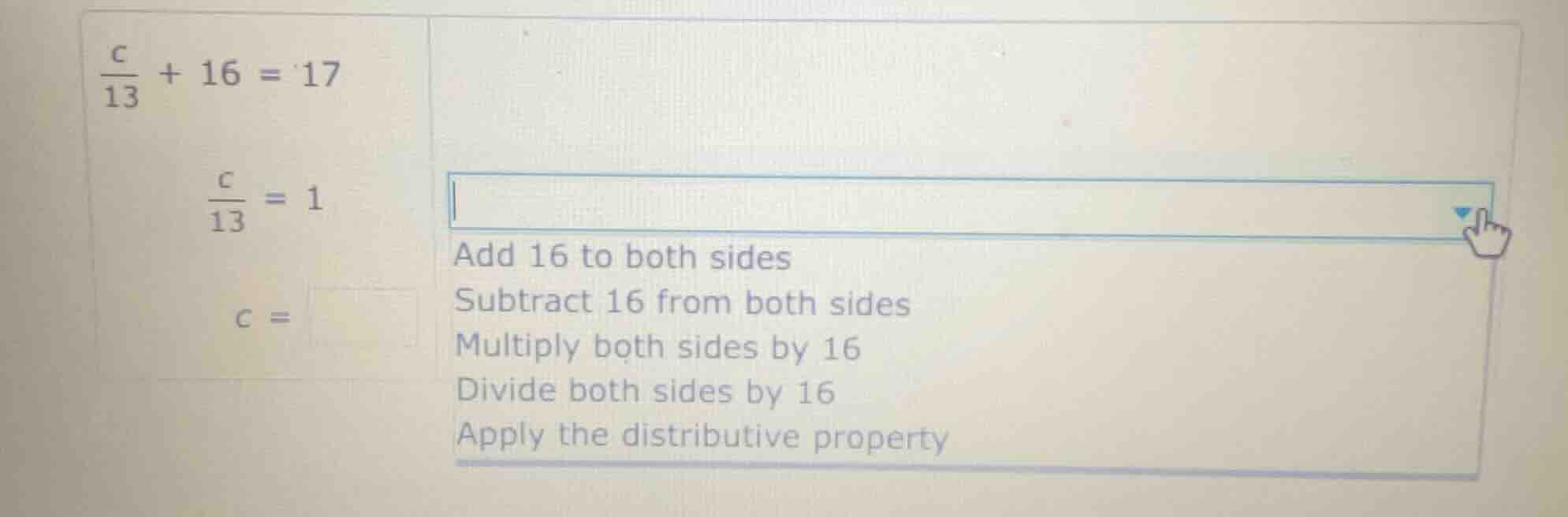
$\frac{c}{13} + 16 = 17$
$\frac{c}{13} = 1$
$c = $
add 16 to both sides
subtract 16 from both sides
multiply both sides by 16
divide both sides by 16
apply the distributive property
First, determine the operation to get from \(\boldsymbol{\frac{c}{13}+16 = 17}\) to \(\boldsymbol{\frac{c}{13}=1}\)
Step1: Identify the operation
To isolate \(\frac{c}{13}\), we need to remove the \(+ 16\) from the left - hand side. According to the subtraction property of equality, if we subtract 16 from both sides of the equation \(\frac{c}{13}+16 = 17\), we get:
\(\frac{c}{13}+16 - 16=17 - 16\)
Simplifying both sides, we have \(\frac{c}{13}=1\). So the operation is "Subtract 16 from both sides".
Step2: Solve for \(c\)
Now that we have \(\frac{c}{13}=1\), to solve for \(c\), we use the multiplication property of equality. Multiply both sides of the equation \(\frac{c}{13}=1\) by 13:
\(\frac{c}{13}\times13 = 1\times13\)
Simplifying, we get \(c = 13\).

Snap & solve any problem in the app
Get step-by-step solutions on Sovi AI
Photo-based solutions with guided steps
Explore more problems and detailed explanations
The operation to get from \(\frac{c}{13}+16 = 17\) to \(\frac{c}{13}=1\) is "Subtract 16 from both sides" and the value of \(c\) is \(13\).