QUESTION IMAGE
Question
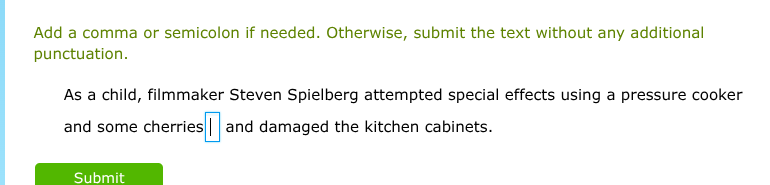
add a comma or semicolon if needed. otherwise, submit the text without any additional punctuation.
as a child, filmmaker steven spielberg attempted special effects using a pressure cooker
and some cherries and damaged the kitchen cabinets.
The two actions "attempted special effects..." and "damaged the kitchen cabinets" are part of a sequence of actions by Steven Spielberg as a child. The first part ends with "cherries" and the next part starts with "and damaged...". Since these are two independent clauses (or related actions in a sequence) connected by "and", we need to check if a comma is needed before "and". However, in this case, the two actions are closely related and the "and" is used to connect the two verb phrases ("attempted... and damaged..."). Wait, actually, the structure is: "As a child, filmmaker Steven Spielberg attempted special effects using a pressure cooker and some cherries, and damaged the kitchen cabinets." Wait, no, maybe I misread. Let's parse the sentence again. The original sentence is: "As a child, filmmaker Steven Spielberg attempted special effects using a pressure cooker and some cherries and damaged the kitchen cabinets." So the actions are "attempted" and "damaged". The "using a pressure cooker and some cherries" is a participial phrase modifying "attempted". So the two main verbs are "attempted" and "damaged", connected by "and". In this case, since the two verb phrases are part of the same subject's actions, and the "and" is connecting the two verbs, we don't need a comma before "and" here. Wait, but maybe the first "and" is between "pressure cooker" and "some cherries", which is correct (no comma needed there, as they are two items in a list). Then the second "and" is between the two actions. Let's see: "attempted special effects using a pressure cooker and some cherries" (this is one action) "and damaged the kitchen cabinets" (another action). So these are two independent verb phrases (or predicate phrases) with the same subject. In English, when two independent clauses (or predicate phrases) are connected by a coordinating conjunction like "and", if they are part of the same sentence and the subject is the same, we can use a comma before "and" for clarity, but it's not always necessary. However, in this case, the two actions are closely related (the attempt at special effects led to damaging the cabinets), so maybe a comma is not needed. Wait, but let's check the original sentence structure. The sentence is: Subject (Steven Spielberg) + Verb 1 (attempted) + Object (special effects) + Modifier (using a pressure cooker and some cherries) + and + Verb 2 (damaged) + Object (the kitchen cabinets). So the "and" here is connecting two verbs (predicates) with the same subject. In such cases, a comma before "and" is optional, but often not used if the two predicates are short and closely related. So in this case, we don't need to add a comma or semicolon. So the text should be submitted without additional punctuation.

Snap & solve any problem in the app
Get step-by-step solutions on Sovi AI
Photo-based solutions with guided steps
Explore more problems and detailed explanations
As a child, filmmaker Steven Spielberg attempted special effects using a pressure cooker and some cherries and damaged the kitchen cabinets.