QUESTION IMAGE
Question
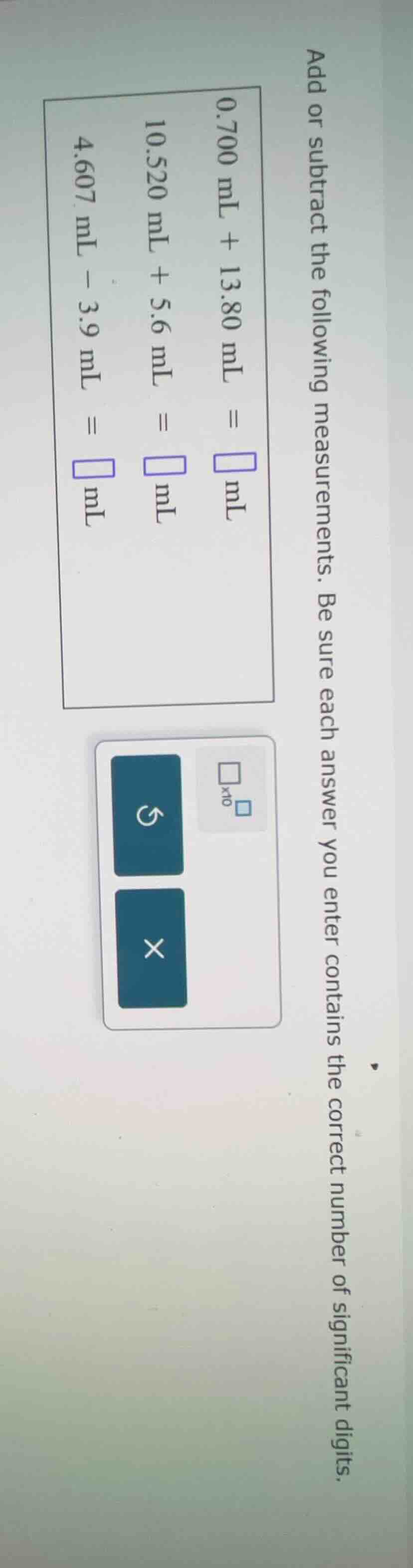
add or subtract the following measurements. be sure each answer you enter contains the correct number of significant digits.
0.700 ml + 13.80 ml = \square ml
10.520 ml + 5.6 ml = \square ml
4.607 ml - 3.9 ml = \square ml
First Calculation: \( 0.700 \, \text{mL} + 13.80 \, \text{mL} \)
Step1: Add the two volumes
\( 0.700 + 13.80 = 14.50 \)
Step2: Determine significant digits (decimal places)
\( 0.700 \) has 3 decimal places, \( 13.80 \) has 2. Result should have 2 decimal places (least decimal places in addends). So \( 14.50 \, \text{mL} \) (or \( 14.50 \) considering significant digits for addition: the number of decimal places in the result is equal to the least number of decimal places in the terms. \( 0.700 \) has 3, \( 13.80 \) has 2. So we round to 2 decimal places? Wait, no: \( 0.700 + 13.80 = 14.500 \), but \( 13.80 \) has two decimal places, \( 0.700 \) has three. The rule for addition/subtraction is that the result has the same number of decimal places as the term with the least number of decimal places. So \( 13.80 \) has two decimal places, so the result should have two decimal places? Wait, \( 0.700 \) is 0.700 (three decimal), \( 13.80 \) is 13.80 (two decimal). So when adding, we go by decimal places. So \( 0.700 + 13.80 = 14.500 \), but we round to two decimal places? Wait, no: \( 13.80 \) has two decimal places, \( 0.700 \) has three. The least is two, so the result should have two decimal places. Wait, but \( 0.700 + 13.80 = 14.500 \), which is \( 14.50 \) when rounded to two decimal places? Wait, no, \( 14.500 \) to two decimal places is \( 14.50 \). Alternatively, maybe the significant digits for addition: the number of decimal places. So \( 0.700 \) (three decimal) + \( 13.80 \) (two decimal) = \( 14.500 \), but we take two decimal places, so \( 14.50 \, \text{mL} \). But let's check the numbers: \( 0.700 \) has three significant digits after decimal, \( 13.80 \) has two. So the result should have two decimal places. So \( 14.50 \, \text{mL} \).
Second Calculation: \( 10.520 \, \text{mL} + 5.6 \, \text{mL} \)
Step1: Add the two volumes
\( 10.520 + 5.6 = 16.120 \)
Step2: Determine significant digits (decimal places)
\( 10.520 \) has 3 decimal places, \( 5.6 \) has 1. Result should have 1 decimal place (least decimal places). So round \( 16.120 \) to 1 decimal place: \( 16.1 \, \text{mL} \). Wait, \( 10.520 + 5.6 = 16.120 \), and \( 5.6 \) has one decimal place, so the result should have one decimal place. So \( 16.1 \, \text{mL} \).
Third Calculation: \( 4.607 \, \text{mL} - 3.9 \, \text{mL} \)
Step1: Subtract the two volumes
\( 4.607 - 3.9 = 0.707 \)
Step2: Determine significant digits (decimal places)
\( 4.607 \) has 3 decimal places, \( 3.9 \) has 1. Result should have 1 decimal place (least decimal places). So round \( 0.707 \) to 1 decimal place: \( 0.7 \, \text{mL} \)? Wait, no: \( 4.607 - 3.9 = 0.707 \), and \( 3.9 \) has one decimal place, so the result should have one decimal place. So \( 0.7 \, \text{mL} \)? Wait, \( 0.707 \) rounded to one decimal place is \( 0.7 \). But wait, let's check again: \( 4.607 - 3.9 = 0.707 \). The term \( 3.9 \) has one decimal place, so the result should have one decimal place. So \( 0.7 \, \text{mL} \). Wait, but maybe I made a mistake. Let's recheck:
First calculation: \( 0.700 + 13.80 = 14.500 \). The number of decimal places: \( 0.700 \) has 3, \( 13.80 \) has 2. So the result should have 2 decimal places. So \( 14.50 \, \text{mL} \) (since \( 14.500 \) rounded to two decimal places is \( 14.50 \)).
Second calculation: \( 10.520 + 5.6 = 16.120 \). \( 5.6 \) has 1 decimal place, so result has 1 decimal place: \( 16.1 \, \text{mL} \).
Third calculation: \( 4.607 - 3.9 = 0.707 \). \( 3.9 \) has 1 decimal place, so result has 1 decimal place: \( 0.7 \, \text{mL} \).
Wait, but maybe the significant digits for addition/subtraction: the number of decimal places, not significant digits. So:
- \( 0.700 \, \text{mL} + 13.80 \, \text{mL} \)
- \( 0.700 \) (3 decimal places) + \( 13.80 \) (2 decimal places) = \( 14.500 \)
- Round to 2 decimal places: \( 14.50 \, \text{mL} \) (or \( 14.50 \) as the result, since 13.80 has two decimal places, the sum should have two decimal places)
- \( 10.520 \, \text{mL} + 5.6 \, \text{mL} \)
- \( 10.520 \) (3 decimal places) + \( 5.6 \) (1 decimal place) = \( 16.120 \)
- Round to 1 decimal place: \( 16.1 \, \text{mL} \)
- \( 4.607 \, \text{mL} - 3.9 \, \text{mL} \)
- \( 4.607 \) (3 decimal places) - \( 3.9 \) (1 decimal place) = \( 0.707 \)
- Round to 1 decimal place: \( 0.7 \, \text{mL} \)
Wait, but maybe the first calculation: \( 0.700 + 13.80 = 14.50 \) (since 13.80 has two decimal places, the sum should have two decimal places. So 14.50 mL.
Second: 10.520 + 5.6 = 16.120, round to 1 decimal place: 16.1 mL.
Third: 4.607 - 3.9 = 0.707, round to 1 decimal place: 0.7 mL.
But let's check with significant digits for addition:
The rule is: For addition and subtraction, the result has the same number of decimal places as the term with the least number of decimal places.
So:
- \( 0.700 \) (3 decimal) + \( 13.80 \) (2 decimal) → result has 2 decimal places. So \( 0.700 + 13.80 = 14.500 \) → round to 2 decimal places: \( 14.50 \, \text{mL} \)
- \( 10.520 \) (3 decimal) + \( 5.6 \) (1 decimal) → result has 1 decimal place. \( 10.520 + 5.6 = 16.120 \) → round to 1 decimal place: \( 16.1 \, \text{mL} \)
- \( 4.607 \) (3 decimal) - \( 3.9 \) (1 decimal) → result has 1 decimal place. \( 4.607 - 3.9 = 0.707 \) → round to 1 decimal place: \( 0.7 \, \text{mL} \)
Yes, that seems correct.

Snap & solve any problem in the app
Get step-by-step solutions on Sovi AI
Photo-based solutions with guided steps
Explore more problems and detailed explanations
First: \( 14.50 \, \text{mL} \)
Second: \( 16.1 \, \text{mL} \)
Third: \( 0.7 \, \text{mL} \)