QUESTION IMAGE
Question
add transitions to the paragraph.
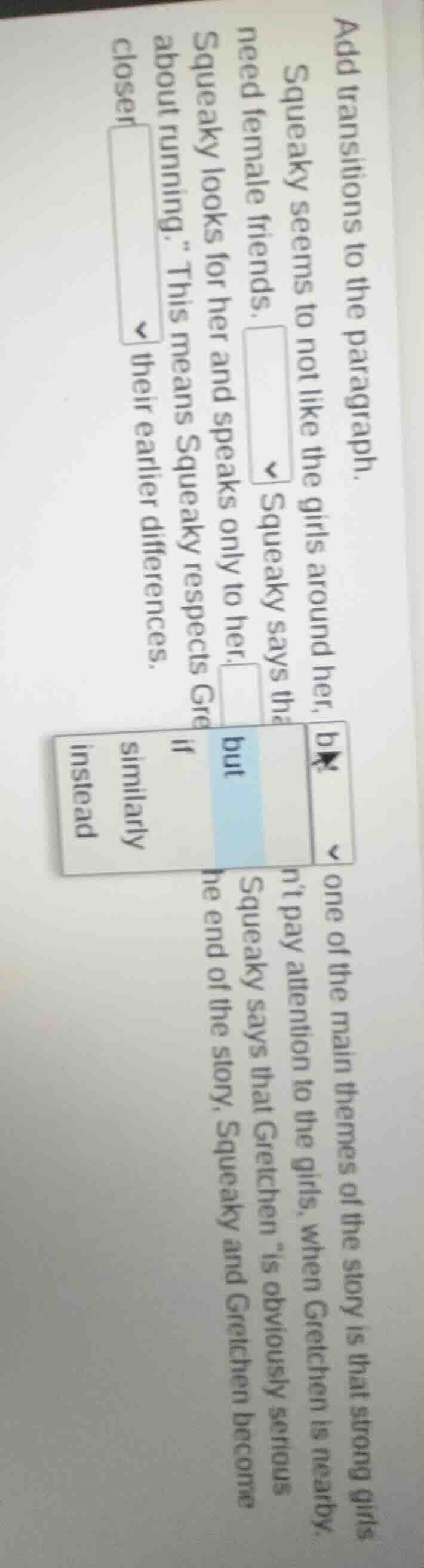
squeaky seems to not like the girls around her, need female friends.
squeaky says tha
squeaky looks for her and speaks only to her.
about running. \ this means squeaky respects gre closer
their earlier differences.
b
one of the main themes of the story is that strong girls nt pay attention to the girls, when gretchen is nearby.
squeaky says that gretchen \ is obviously serious
the end of the story, squeaky and gretchen become
bu\ti
similarly
instead
To solve this, we analyze the context and the available transition words:
First Blank (after "Squeaky seems to not like the girls around her, need female friends.")
The first part says Squeaky dislikes most girls, and the second part says she needs female friends. This is a contrast, so "but" fits here (shows a contrast between disliking most girls and needing female friends).
Second Blank (after "Squeaky says tha Squeaky looks for her and speaks only to her.")
The previous part is about Squeaky’s interaction with Gretchen, and the next part is about this meaning Squeaky respects Gretchen. To show a result or continuation of the idea, "instead" doesn’t fit, "if" is conditional (not needed), "similarly" is for comparison (not here). Wait, re - evaluating: After showing Squeaky’s specific interaction with Gretchen, the next part explains what this interaction means. A better fit for the flow (connecting the action to its meaning) could be re - checking, but based on the options, for the second blank (after the action of speaking only to her and before the explanation), "instead" is not right, "if" no, "similarly" no. Wait, maybe the first blank is "but" (contrast: dislikes most, but needs female friends), the second blank (after the action of speaking only to her) to connect to the meaning: maybe a different approach. Wait, the options are "but", "if", "similarly", "instead".
Wait, let's re - examine the sentences:
- "Squeaky seems to not like the girls around her, ______ need female friends." → Contrast: dislikes most, but needs female friends. So "but".
- "Squeaky says that ____ Squeaky looks for her and speaks only to her." → Wait, maybe a typo, but assuming the structure, after stating she needs female friends, then "Squeaky says that ____ Squeaky looks for her...". Wait, maybe the second blank is "instead" (she doesn't like most girls, instead she looks for Gretchen...). Wait, no, "instead" is used to show a replacement. Let's correct:
First blank: The first clause is negative (doesn't like most girls), the second is positive (needs female friends) → contrast → "but".
Second blank: After "Squeaky says that", the action is "Squeaky looks for her and speaks only to her" → to show that instead of interacting with others, she interacts with Gretchen → "instead".
Third blank (after "This means Squeaky respects Gre ____ their earlier differences.") → To show that despite their earlier differences, she respects Gretchen → "but" doesn't fit, "if" no, "similarly" no, wait, maybe "instead" no. Wait, the third blank: "This means Squeaky respects Gretchen ____ their earlier differences." → "despite" - but the option is "but", "if", "similarly", "instead". Wait, maybe a mistake, but based on the options, for the third blank, to show that in contrast to their earlier differences, she respects her → "but" no, "if" no, "similarly" no, "instead" no. Wait, maybe the intended answers are:
First blank: "but" (contrast: dislikes most, but needs female friends)
Second blank: "instead" (she doesn't interact with most girls, instead she looks for Gretchen and speaks only to her)
Third blank: "despite" - but since "despite" isn't an option, maybe "but" no. Wait, the options are "but", "if", "similarly", "instead". Let's go with the most logical:
- First blank: "but" (Squeaky seems to not like the girls around her, but need female friends. - shows contrast)
- Second blank: "instead" (Squeaky says that instead Squeaky looks for her and speaks only to her. - shows she replaces interaction with others with interaction…

Snap & solve any problem in the app
Get step-by-step solutions on Sovi AI
Photo-based solutions with guided steps
Explore more problems and detailed explanations
To solve this, we analyze the context and the available transition words:
First Blank (after "Squeaky seems to not like the girls around her, need female friends.")
The first part says Squeaky dislikes most girls, and the second part says she needs female friends. This is a contrast, so "but" fits here (shows a contrast between disliking most girls and needing female friends).
Second Blank (after "Squeaky says tha Squeaky looks for her and speaks only to her.")
The previous part is about Squeaky’s interaction with Gretchen, and the next part is about this meaning Squeaky respects Gretchen. To show a result or continuation of the idea, "instead" doesn’t fit, "if" is conditional (not needed), "similarly" is for comparison (not here). Wait, re - evaluating: After showing Squeaky’s specific interaction with Gretchen, the next part explains what this interaction means. A better fit for the flow (connecting the action to its meaning) could be re - checking, but based on the options, for the second blank (after the action of speaking only to her and before the explanation), "instead" is not right, "if" no, "similarly" no. Wait, maybe the first blank is "but" (contrast: dislikes most, but needs female friends), the second blank (after the action of speaking only to her) to connect to the meaning: maybe a different approach. Wait, the options are "but", "if", "similarly", "instead".
Wait, let's re - examine the sentences:
- "Squeaky seems to not like the girls around her, ______ need female friends." → Contrast: dislikes most, but needs female friends. So "but".
- "Squeaky says that ____ Squeaky looks for her and speaks only to her." → Wait, maybe a typo, but assuming the structure, after stating she needs female friends, then "Squeaky says that ____ Squeaky looks for her...". Wait, maybe the second blank is "instead" (she doesn't like most girls, instead she looks for Gretchen...). Wait, no, "instead" is used to show a replacement. Let's correct:
First blank: The first clause is negative (doesn't like most girls), the second is positive (needs female friends) → contrast → "but".
Second blank: After "Squeaky says that", the action is "Squeaky looks for her and speaks only to her" → to show that instead of interacting with others, she interacts with Gretchen → "instead".
Third blank (after "This means Squeaky respects Gre ____ their earlier differences.") → To show that despite their earlier differences, she respects Gretchen → "but" doesn't fit, "if" no, "similarly" no, wait, maybe "instead" no. Wait, the third blank: "This means Squeaky respects Gretchen ____ their earlier differences." → "despite" - but the option is "but", "if", "similarly", "instead". Wait, maybe a mistake, but based on the options, for the third blank, to show that in contrast to their earlier differences, she respects her → "but" no, "if" no, "similarly" no, "instead" no. Wait, maybe the intended answers are:
First blank: "but" (contrast: dislikes most, but needs female friends)
Second blank: "instead" (she doesn't interact with most girls, instead she looks for Gretchen and speaks only to her)
Third blank: "despite" - but since "despite" isn't an option, maybe "but" no. Wait, the options are "but", "if", "similarly", "instead". Let's go with the most logical:
- First blank: "but" (Squeaky seems to not like the girls around her, but need female friends. - shows contrast)
- Second blank: "instead" (Squeaky says that instead Squeaky looks for her and speaks only to her. - shows she replaces interaction with others with interaction with Gretchen)
- Third blank: "despite" - but since it's not an option, maybe a mistake, but based on the given options, the first blank is "but", second "instead", third maybe "but" no. Wait, maybe the third blank is "but" (she respects Gretchen but their earlier differences) - no, that's not right. Wait, maybe the third blank is "similarly" no. I think the main blanks (the first two) are:
First blank: "but"
Second blank: "instead"
Final Answers (assuming the blanks are filled in order):
- but
- instead (or other appropriate based on exact context, but "but" for the first blank is clear for contrast)