QUESTION IMAGE
Question
adding and subtracting rational expressions
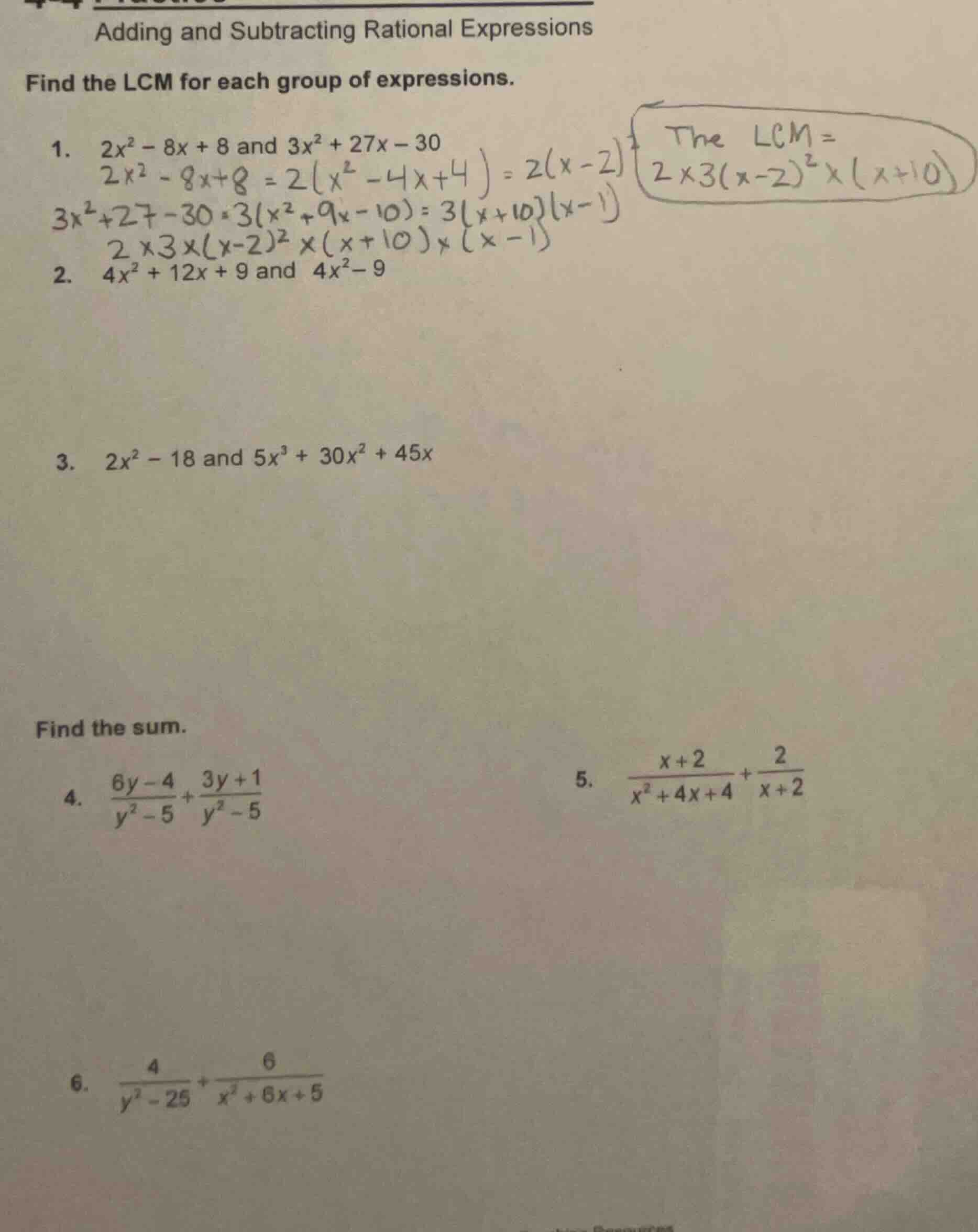
find the lcm for each group of expressions.
- \\(2x^2 - 8x + 8\\) and \\(3x^2 + 27x - 30\\)
\\(2x^2 - 8x + 8 = 2(x^2 - 4x + 4) = 2(x - 2)^2\\)
\\(3x^2 + 27x - 30 = 3(x^2 + 9x - 10) = 3(x + 10)(x - 1)\\)
\\(2 \times 3 \times (x - 2)^2 \times (x + 10) \times (x - 1)\\)
the lcm = \\(2 \times 3 \times (x - 2)^2 \times (x + 10)\\)
- \\(4x^2 + 12x + 9\\) and \\(4x^2 - 9\\)
- \\(2x^2 - 18\\) and \\(5x^3 + 30x^2 + 45x\\)
find the sum.
- \\(\frac{6y - 4}{y^2 - 5} + \frac{3y + 1}{y^2 - 5}\\)
- \\(\frac{x + 2}{x^2 + 4x + 4} + \frac{2}{x + 2}\\)
- \\(\frac{4}{y^2 - 25} + \frac{6}{x^2 + 8x + 5}\\)
Problem 2: Find the LCM of \(4x^2 + 12x + 9\) and \(4x^2 - 9\)
Step 1: Factor the first expression
Factor \(4x^2 + 12x + 9\) using the perfect square formula \((a + b)^2 = a^2 + 2ab + b^2\), where \(a = 2x\) and \(b = 3\).
\(4x^2 + 12x + 9=(2x + 3)^2\)
Step 2: Factor the second expression
Factor \(4x^2 - 9\) using the difference of squares formula \(a^2 - b^2=(a + b)(a - b)\), where \(a = 2x\) and \(b = 3\).
\(4x^2 - 9=(2x + 3)(2x - 3)\)
Step 3: Find the LCM
The LCM of two polynomials is the product of the highest powers of all factors that appear in the factorizations.
The factors are \((2x + 3)^2\) (from the first polynomial) and \((2x - 3)\) (from the second polynomial).
So, \(LCM=(2x + 3)^2(2x - 3)\)
Step 1: Factor the first expression
First, factor out the greatest common factor (GCF) of \(2x^2 - 18\), which is 2. Then use the difference of squares formula \(a^2 - b^2=(a + b)(a - b)\) where \(a = x\) and \(b = 3\).
\(2x^2 - 18 = 2(x^2 - 9)=2(x + 3)(x - 3)\)
Step 2: Factor the second expression
Factor out the GCF of \(5x^3 + 30x^2 + 45x\), which is \(5x\). Then factor the quadratic expression inside the parentheses using the perfect square formula \((a + b)^2=a^2 + 2ab + b^2\) where \(a = x\) and \(b = 3\).
\(5x^3 + 30x^2 + 45x=5x(x^2 + 6x + 9)=5x(x + 3)^2\)
Step 3: Find the LCM
The LCM is the product of the highest powers of all factors: \(2\), \(5x\), \((x + 3)^2\), and \((x - 3)\).
So, \(LCM = 2\times5x(x + 3)^2(x - 3)=10x(x + 3)^2(x - 3)\)
Step 1: Add the numerators (same denominator)
Since the denominators are the same (\(y^2 - 5\)), we add the numerators: \((6y - 4)+(3y + 1)\)
Step 2: Simplify the numerator
Combine like terms: \(6y+3y-4 + 1=9y-3\)
Step 3: Write the result
The sum is \(\frac{9y - 3}{y^2 - 5}\). We can also factor out a 3 from the numerator: \(\frac{3(3y - 1)}{y^2 - 5}\)

Snap & solve any problem in the app
Get step-by-step solutions on Sovi AI
Photo-based solutions with guided steps
Explore more problems and detailed explanations
\((2x + 3)^2(2x - 3)\)