QUESTION IMAGE
Question
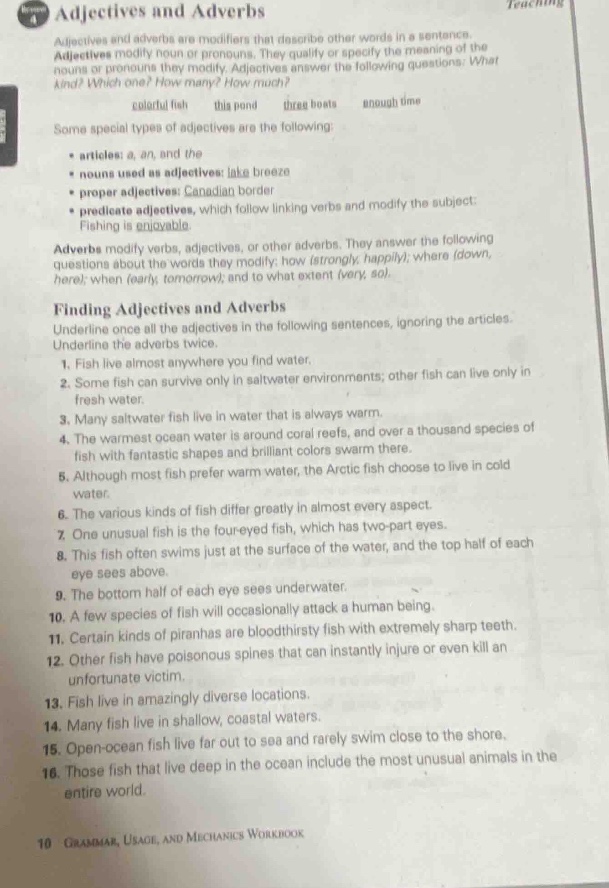
adjectives and adverbs
adjectives and adverbs are modifiers that describe other words in a sentence.
adjectives modify nouns or pronouns. they qualify or specify the meaning of the
nouns or pronouns they modify. adjectives answer the following questions: what
kind? which one? how many? how much?
colorful fish this pond three boats enough time
some special types of adjectives are the following:
- articles: a, an, and the
- nouns used as adjectives: lake breeze
- proper adjectives: canadian border
- predicate adjectives, which follow linking verbs and modify the subject:
fishing is enjoyable.
adverbs modify verbs, adjectives, or other adverbs. they answer the following
questions about the words they modify: how (strongly, happily); where (down,
here); when (early, tomorrow); and to what extent (very, so).
finding adjectives and adverbs
underline once all the adjectives in the following sentences, ignoring the articles.
underline the adverbs twice.
- fish live almost anywhere you find water.
- some fish can survive only in saltwater environments; other fish can live only in
fresh water.
- many saltwater fish live in water that is always warm.
- the warmest ocean water is around coral reefs, and over a thousand species of
fish with fantastic shapes and brilliant colors swarm there.
- although most fish prefer warm water, the arctic fish choose to live in cold
water.
- the various kinds of fish differ greatly in almost every aspect.
- one unusual fish is the four - eyed fish, which has two - part eyes.
- this fish often swims just at the surface of the water, and the top half of each
eye sees above.
- the bottom half of each eye sees underwater.
- a few species of fish will occasionally attack a human being.
- certain kinds of piranhas are bloodthirsty fish with extremely sharp teeth.
- other fish have poisonous spines that can instantly injure or even kill an
unfortunate victim.
- fish live in amazingly diverse locations.
- many fish live in shallow, coastal waters.
- open - ocean fish live far out to sea and rarely swim close to the shore.
- those fish that live deep in the ocean include the most unusual animals in the
entire world.
To solve this, we analyze each sentence to identify adjectives (underline once) and adverbs (underline twice) as per the rules (ignoring articles for adjectives):
Sentence 1: Fish live almost anywhere you find water.
- Adjective: None (no noun/pronoun modifier, ignoring article).
- Adverb: $\boldsymbol{\underline{\underline{\text{almost}}}}$ (modifies “anywhere,” answers “to what extent”).
Sentence 2: Some fish can survive only in saltwater environments; other fish can live only in fresh water.
- Adjectives: $\boldsymbol{\underline{\text{saltwater}}}$ (modifies “environments”), $\boldsymbol{\underline{\text{fresh}}}$ (modifies “water”).
- Adverbs: $\boldsymbol{\underline{\underline{\text{only}}}}$ (twice, modifies “survive” and “live,” answers “to what extent”).
Sentence 3: Many saltwater fish live in water that is always warm.
- Adjectives: $\boldsymbol{\underline{\text{saltwater}}}$ (modifies “fish”), $\boldsymbol{\underline{\text{warm}}}$ (modifies “water”).
- Adverb: $\boldsymbol{\underline{\underline{\text{always}}}}$ (modifies “is,” answers “when”).
Sentence 4: The warmest ocean water is around coral reefs, and over a thousand species of fish with fantastic shapes and brilliant colors swarm there.
- Adjectives: $\boldsymbol{\underline{\text{warmest}}}$ (modifies “water”), $\boldsymbol{\underline{\text{fantastic}}}$ (modifies “shapes”), $\boldsymbol{\underline{\text{brilliant}}}$ (modifies “colors”).
- Adverbs: $\boldsymbol{\underline{\underline{\text{over}}}}$ (modifies “a thousand,” answers “how many”), $\boldsymbol{\underline{\underline{\text{there}}}}$ (modifies “swarm,” answers “where”).
Sentence 5: Although most fish prefer warm water, the Arctic fish choose to live in cold water.
- Adjectives: $\boldsymbol{\underline{\text{warm}}}$ (modifies “water”), $\boldsymbol{\underline{\text{Arctic}}}$ (modifies “fish”), $\boldsymbol{\underline{\text{cold}}}$ (modifies “water”).
- Adverb: $\boldsymbol{\underline{\underline{\text{most}}}}$ (modifies “fish,” answers “how many”).
Sentence 6: The various kinds of fish differ greatly in almost every aspect.
- Adjective: $\boldsymbol{\underline{\text{various}}}$ (modifies “kinds”).
- Adverbs: $\boldsymbol{\underline{\underline{\text{greatly}}}}$ (modifies “differ,” answers “how”), $\boldsymbol{\underline{\underline{\text{almost}}}}$ (modifies “every,” answers “to what extent”).
Sentence 7: One unusual fish is the four - eyed fish, which has two - part eyes.
- Adjectives: $\boldsymbol{\underline{\text{unusual}}}$ (modifies “fish”), $\boldsymbol{\underline{\text{four - eyed}}}$ (modifies “fish”), $\boldsymbol{\underline{\text{two - part}}}$ (modifies “eyes”).
Sentence 8: This fish often swims just at the surface of the water, and the top half of each eye sees above.
- Adjectives: None (ignoring article, no noun/pronoun modifier).
- Adverbs: $\boldsymbol{\underline{\underline{\text{often}}}}$ (modifies “swims,” answers “when”), $\boldsymbol{\underline{\underline{\text{just}}}}$ (modifies “at,” answers “to what extent”).
Sentence 9: The bottom half of each eye sees underwater.
- Adjective: $\boldsymbol{\underline{\text{bottom}}}$ (modifies “half”).
- Adverb: $\boldsymbol{\underline{\underline{\text{underwater}}}}$ (modifies “sees,” answers “where”).
Sentence 10: A few species of fish will occasionally attack a human being.
- Adjective: $\boldsymbol{\underline{\text{human}}}$ (modifies “being”).
- Adverb: $\boldsymbol{\underline{\underline{\text{occasionally}}}}$ (modifies “will attack,” answers “when”).
Sentence 11: *C…

Snap & solve any problem in the app
Get step-by-step solutions on Sovi AI
Photo-based solutions with guided steps
Explore more problems and detailed explanations
To solve this, we analyze each sentence to identify adjectives (underline once) and adverbs (underline twice) as per the rules (ignoring articles for adjectives):
Sentence 1: Fish live almost anywhere you find water.
- Adjective: None (no noun/pronoun modifier, ignoring article).
- Adverb: $\boldsymbol{\underline{\underline{\text{almost}}}}$ (modifies “anywhere,” answers “to what extent”).
Sentence 2: Some fish can survive only in saltwater environments; other fish can live only in fresh water.
- Adjectives: $\boldsymbol{\underline{\text{saltwater}}}$ (modifies “environments”), $\boldsymbol{\underline{\text{fresh}}}$ (modifies “water”).
- Adverbs: $\boldsymbol{\underline{\underline{\text{only}}}}$ (twice, modifies “survive” and “live,” answers “to what extent”).
Sentence 3: Many saltwater fish live in water that is always warm.
- Adjectives: $\boldsymbol{\underline{\text{saltwater}}}$ (modifies “fish”), $\boldsymbol{\underline{\text{warm}}}$ (modifies “water”).
- Adverb: $\boldsymbol{\underline{\underline{\text{always}}}}$ (modifies “is,” answers “when”).
Sentence 4: The warmest ocean water is around coral reefs, and over a thousand species of fish with fantastic shapes and brilliant colors swarm there.
- Adjectives: $\boldsymbol{\underline{\text{warmest}}}$ (modifies “water”), $\boldsymbol{\underline{\text{fantastic}}}$ (modifies “shapes”), $\boldsymbol{\underline{\text{brilliant}}}$ (modifies “colors”).
- Adverbs: $\boldsymbol{\underline{\underline{\text{over}}}}$ (modifies “a thousand,” answers “how many”), $\boldsymbol{\underline{\underline{\text{there}}}}$ (modifies “swarm,” answers “where”).
Sentence 5: Although most fish prefer warm water, the Arctic fish choose to live in cold water.
- Adjectives: $\boldsymbol{\underline{\text{warm}}}$ (modifies “water”), $\boldsymbol{\underline{\text{Arctic}}}$ (modifies “fish”), $\boldsymbol{\underline{\text{cold}}}$ (modifies “water”).
- Adverb: $\boldsymbol{\underline{\underline{\text{most}}}}$ (modifies “fish,” answers “how many”).
Sentence 6: The various kinds of fish differ greatly in almost every aspect.
- Adjective: $\boldsymbol{\underline{\text{various}}}$ (modifies “kinds”).
- Adverbs: $\boldsymbol{\underline{\underline{\text{greatly}}}}$ (modifies “differ,” answers “how”), $\boldsymbol{\underline{\underline{\text{almost}}}}$ (modifies “every,” answers “to what extent”).
Sentence 7: One unusual fish is the four - eyed fish, which has two - part eyes.
- Adjectives: $\boldsymbol{\underline{\text{unusual}}}$ (modifies “fish”), $\boldsymbol{\underline{\text{four - eyed}}}$ (modifies “fish”), $\boldsymbol{\underline{\text{two - part}}}$ (modifies “eyes”).
Sentence 8: This fish often swims just at the surface of the water, and the top half of each eye sees above.
- Adjectives: None (ignoring article, no noun/pronoun modifier).
- Adverbs: $\boldsymbol{\underline{\underline{\text{often}}}}$ (modifies “swims,” answers “when”), $\boldsymbol{\underline{\underline{\text{just}}}}$ (modifies “at,” answers “to what extent”).
Sentence 9: The bottom half of each eye sees underwater.
- Adjective: $\boldsymbol{\underline{\text{bottom}}}$ (modifies “half”).
- Adverb: $\boldsymbol{\underline{\underline{\text{underwater}}}}$ (modifies “sees,” answers “where”).
Sentence 10: A few species of fish will occasionally attack a human being.
- Adjective: $\boldsymbol{\underline{\text{human}}}$ (modifies “being”).
- Adverb: $\boldsymbol{\underline{\underline{\text{occasionally}}}}$ (modifies “will attack,” answers “when”).
Sentence 11: Certain kinds of piranhas are bloodthirsty fish with extremely sharp teeth.
- Adjectives: $\boldsymbol{\underline{\text{bloodthirsty}}}$ (modifies “fish”), $\boldsymbol{\underline{\text{sharp}}}$ (modifies “teeth”).
- Adverb: $\boldsymbol{\underline{\underline{\text{extremely}}}}$ (modifies “sharp,” answers “to what extent”).
Sentence 12: Other fish have poisonous spines that can instantly injure or even kill an unfortunate victim.
- Adjectives: $\boldsymbol{\underline{\text{poisonous}}}$ (modifies “spines”), $\boldsymbol{\underline{\text{unfortunate}}}$ (modifies “victim”).
- Adverbs: $\boldsymbol{\underline{\underline{\text{instantly}}}}$ (modifies “injure,” answers “when”), $\boldsymbol{\underline{\underline{\text{even}}}}$ (modifies “kill,” answers “to what extent”).
Sentence 13: Fish live in amazingly diverse locations.
- Adjective: $\boldsymbol{\underline{\text{diverse}}}$ (modifies “locations”).
- Adverb: $\boldsymbol{\underline{\underline{\text{amazingly}}}}$ (modifies “diverse,” answers “to what extent”).
Sentence 14: Many fish live in shallow, coastal waters.
- Adjectives: $\boldsymbol{\underline{\text{shallow}}}$ (modifies “waters”), $\boldsymbol{\underline{\text{coastal}}}$ (modifies “waters”).
Sentence 15: Open - ocean fish live far out to sea and rarely swim close to the shore.
- Adjectives: $\boldsymbol{\underline{\text{Open - ocean}}}$ (modifies “fish”).
- Adverbs: $\boldsymbol{\underline{\underline{\text{far}}}}$ (modifies “out,” answers “how far”), $\boldsymbol{\underline{\underline{\text{rarely}}}}$ (modifies “swim,” answers “how often”).
Sentence 16: Those fish that live deep in the ocean include the most unusual animals in the entire world.
- Adjectives: $\boldsymbol{\underline{\text{unusual}}}$ (modifies “animals”), $\boldsymbol{\underline{\text{entire}}}$ (modifies “world”).
- Adverbs: $\boldsymbol{\underline{\underline{\text{deep}}}}$ (modifies “live,” answers “where”), $\boldsymbol{\underline{\underline{\text{most}}}}$ (modifies “unusual,” answers “to what extent”).
(Note: For each sentence, adjectives are underlined once, adverbs twice, following the task’s instructions.)