QUESTION IMAGE
Question
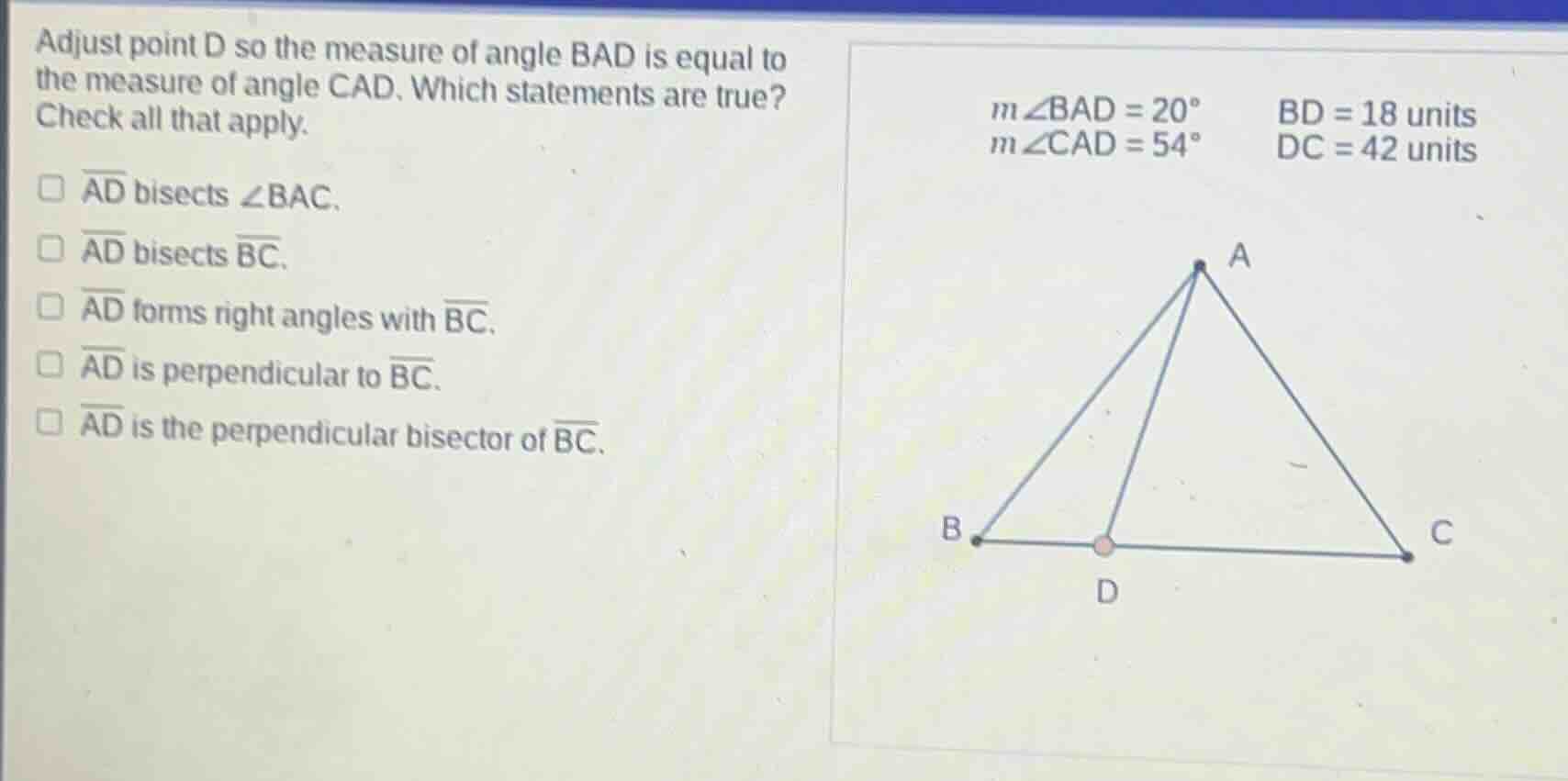
adjust point d so the measure of angle bad is equal to the measure of angle cad. which statements are true? check all that apply. \\(\overline{ad}\\) bisects \\(\angle bac\\). \\(\overline{ad}\\) bisects \\(\overline{bc}\\). \\(\overline{ad}\\) forms right angles with \\(\overline{bc}\\). \\(\overline{ad}\\) is perpendicular to \\(\overline{bc}\\). \\(\overline{ad}\\) is the perpendicular bisector of \\(\overline{bc}\\). \\(m\angle bad = 20^{\circ}\\) \\(m\angle cad = 54^{\circ}\\) \\(bd = 18\\) units \\(dc = 42\\) units
- For the first statement: By definition, an angle bisector divides an angle into two equal angles. Since we adjust \( D \) so \( m\angle BAD = m\angle CAD \), \( \overline{AD} \) bisects \( \angle BAC \). So this statement is true.
- For the second statement: A segment bisector of \( \overline{BC} \) would mean \( BD = DC \). But here \( BD = 18 \) units and \( DC = 42 \) units, so \( \overline{AD} \) does not bisect \( \overline{BC} \). This statement is false.
- For the third statement: There is no information given (and from the angle measures \( 20^\circ \) and \( 54^\circ \) we can infer it's not a right angle situation) that \( \overline{AD} \) forms right angles with \( \overline{BC} \). This statement is false.
- For the fourth statement: Perpendicular means forming a right angle (\( 90^\circ \)). Since the angles \( \angle BAD \) and \( \angle CAD \) are \( 20^\circ \) and \( 54^\circ \) (after adjustment, but even if they were equal, there's no indication of right angle with \( \overline{BC} \)), \( \overline{AD} \) is not perpendicular to \( \overline{BC} \). This statement is false.
- For the fifth statement: A perpendicular bisector needs to be both perpendicular to \( \overline{BC} \) and bisect \( \overline{BC} \). We already saw \( BD
eq DC \) and no right angle, so this is false.

Snap & solve any problem in the app
Get step-by-step solutions on Sovi AI
Photo-based solutions with guided steps
Explore more problems and detailed explanations
\(\boldsymbol{\overline{AD}}\) bisects \(\boldsymbol{\angle BAC}\) (the first option).