QUESTION IMAGE
Question
advanced algebra: concepts and connections
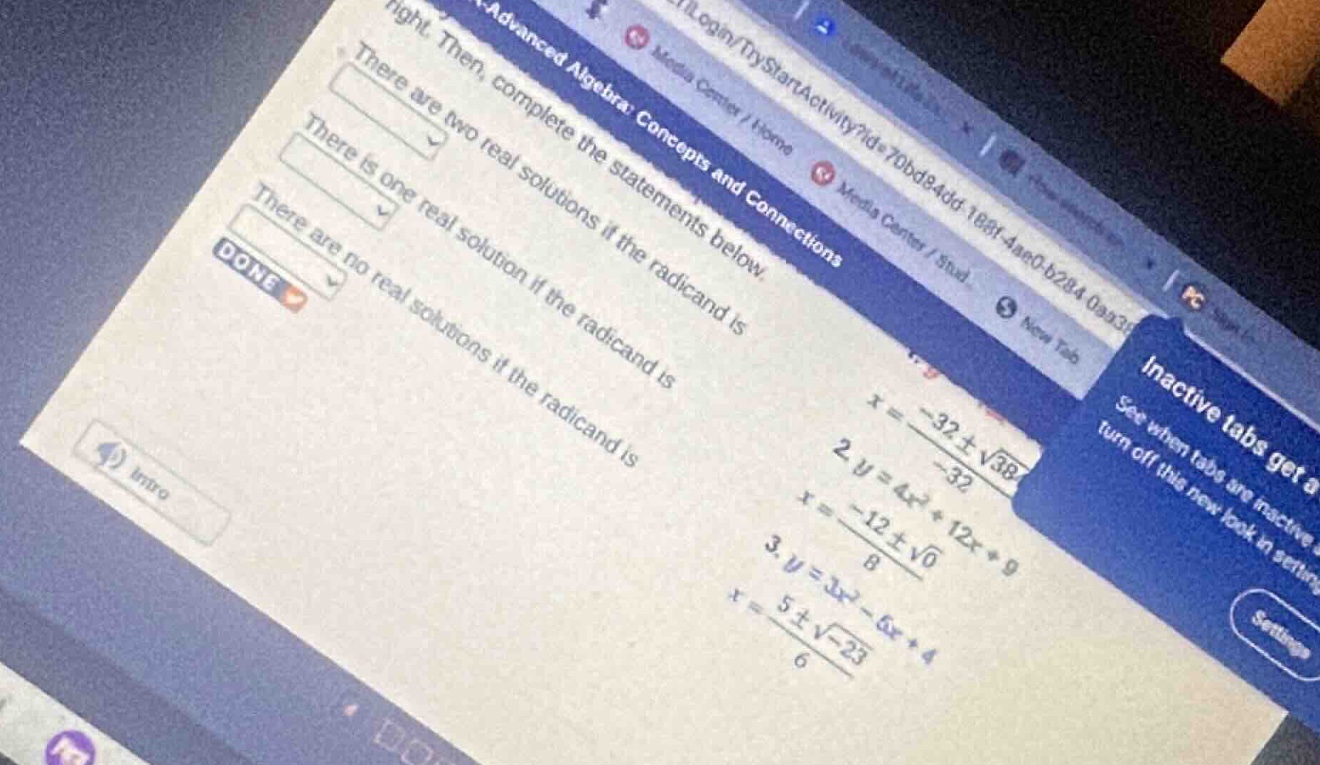
then, complete the statements below.
there are two real solutions if the radicand is
there is one real solution if the radicand is
there are no real solutions if the radicand is
- $x = \frac{-32 \pm \sqrt{384}}{-32}$
- $y = 4x^2 + 12x + 9$; $x = \frac{-12 \pm \sqrt{0}}{8}$
- $y = 3x^2 - 5x + 4$; $x = \frac{5 \pm \sqrt{-23}}{6}$
Step1: Recall discriminant rules
For a quadratic equation in the form \(ax^2 + bx + c = 0\), the discriminant (radicand in the quadratic formula \(x=\frac{-b\pm\sqrt{b^2 - 4ac}}{2a}\)) determines the number of real solutions:
- If \(b^2 - 4ac>0\), there are two real solutions.
- If \(b^2 - 4ac = 0\), there is one real solution.
- If \(b^2 - 4ac<0\), there are no real solutions.
Step2: Analyze each case
- "There are two real solutions if the radicand is" → The radicand (discriminant) must be positive (\(> 0\)).
- "There is one real solution if the radicand is" → The radicand (discriminant) must be zero (\(= 0\)).
- "There are no real solutions if the radicand is" → The radicand (discriminant) must be negative (\(< 0\)).

Snap & solve any problem in the app
Get step-by-step solutions on Sovi AI
Photo-based solutions with guided steps
Explore more problems and detailed explanations
- There are two real solutions if the radicand is \(\boldsymbol{\text{positive (greater than 0)}}\).
- There is one real solution if the radicand is \(\boldsymbol{\text{zero (equal to 0)}}\).
- There are no real solutions if the radicand is \(\boldsymbol{\text{negative (less than 0)}}\).