QUESTION IMAGE
Question
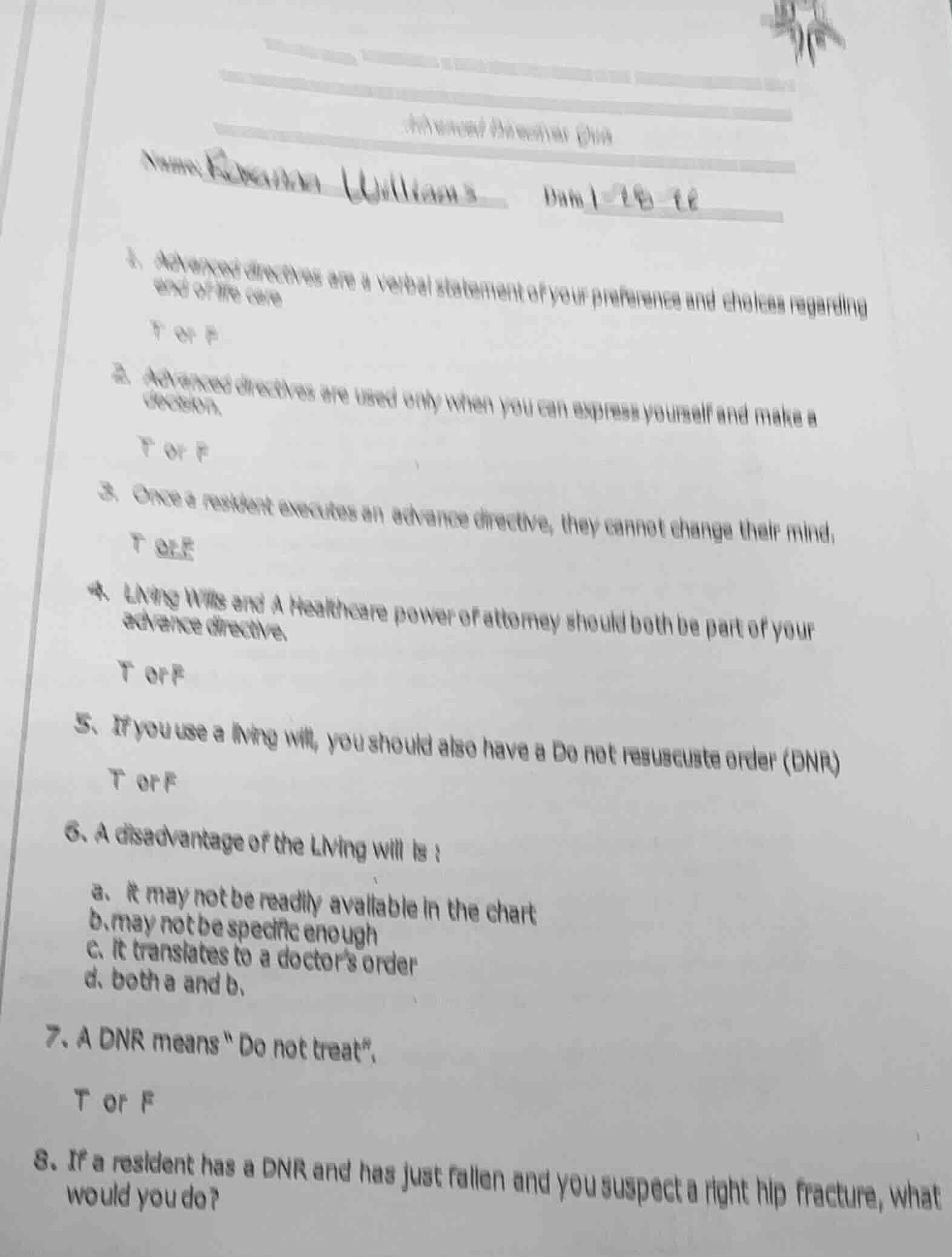
- advanced directives are a verbal statement of your preferences and choices regarding end of life care
t or f
- advanced directives are used only when you can express yourself and make a decision.
t or f
- once a resident executes an advance directive, they cannot change their mind.
t or f
- living wills and a healthcare power of attorney should both be part of your advance directive.
t or f
- if you use a living will, you should also have a do not resuscitate order (dnr)
t or f
- a disadvantage of the living will is :
a. it may not be readily available in the chart
b. may not be specific enough
c. it translates to a doctor’s order
d. both a and b.
- a dnr means \ do not treat\.
t or f
- if a resident has a dnr and has just fallen and you suspect a right hip fracture, what would you do?
Response
Question 1
Brief Explanations
Advance directives are written (not just verbal) statements of healthcare preferences. So the statement is false.
Brief Explanations
Advance directives are used when a person cannot express themselves (e.g., due to incapacity) to guide healthcare decisions. So the statement is false.
Brief Explanations
Residents can change their mind about an advance directive at any time if they are capable. So the statement is false.

Snap & solve any problem in the app
Get step-by-step solutions on Sovi AI
Photo-based solutions with guided steps
Explore more problems and detailed explanations
F