QUESTION IMAGE
Question
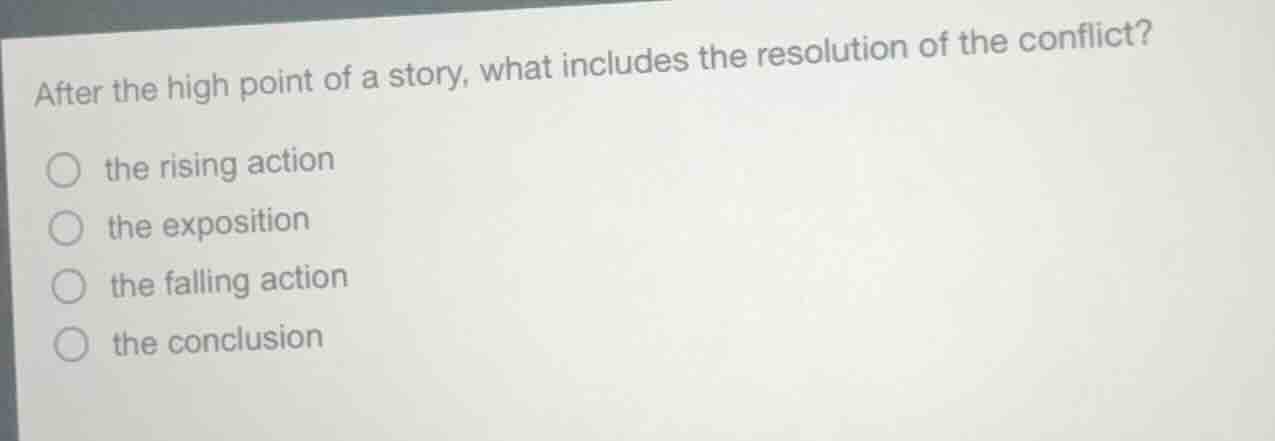
after the high point of a story, what includes the resolution of the conflict?
○ the rising action
○ the exposition
○ the falling action
○ the conclusion
To solve this, we analyze each option:
- "The rising action" occurs before the high point (climax) and builds tension, so it's incorrect.
- "The exposition" introduces the story's setting, characters, etc., at the beginning, so it's incorrect.
- "The falling action" happens after the climax (high point) and involves the resolution of the conflict as the story winds down from the climax.
- "The conclusion" (or denouement) is the very end, but the falling action includes the resolution process after the climax. Wait, actually, the conclusion (or resolution) is part of the falling action? No, let's correct: The falling action is the part after the climax where the conflict starts to be resolved, and the conclusion (resolution) is the end. But among the options, the falling action is the part after the high point that includes the resolution process. Wait, no—let's recall story structure: Exposition (setup), Rising Action (builds conflict), Climax (high point), Falling Action (conflict resolves, tension decreases), Conclusion (final resolution, end). So the falling action is after the climax (high point) and includes the resolution of the conflict. The conclusion is the end result. But the question is "what includes the resolution of the conflict" after the high point. So the falling action is when the conflict is resolved (the process), and the conclusion is the end. But among the options, the falling action is the correct choice here? Wait, no—maybe I made a mistake. Let's check the options again. The options are: rising action (before climax), exposition (before), falling action (after climax, includes resolving conflict), conclusion (the end, which is the resolution). Wait, the question is "what includes the resolution of the conflict" after the high point. So the falling action is the part after the high point where the conflict is resolved. The conclusion is the final resolution. But in story structure, the falling action leads to the conclusion. However, the options: "the falling action" is after the climax (high point) and involves the resolution of the conflict. So the correct answer is the falling action? Wait, no—wait, the conclusion (resolution) is the end. Wait, maybe the question is using "conclusion" as the resolution. Wait, let's re-express:
- Rising action: before climax, builds conflict. Incorrect.
- Exposition: beginning, introduces elements. Incorrect.
- Falling action: after climax, events that lead to resolution (the conflict is resolved here as the story moves towards the end).
- Conclusion: the end, the final resolution.
But the question is "what includes the resolution of the conflict" after the high point. So the falling action includes the resolution process. So the correct answer is the falling action? Wait, no—maybe the answer is the conclusion? Wait, no, let's check a standard story structure:
- Exposition: introduction (setting, characters, conflict introduced).
- Rising Action: events that build the conflict, leading to the climax.
- Climax: the high point, turning point, most intense part.
- Falling Action: events after the climax that resolve the conflict (tension decreases, loose ends tied).
- Resolution (Conclusion): the final outcome, the end.
So the falling action is after the climax (high point) and includes the resolution of the conflict (the process of resolving it). The conclusion is the end result. So among the options, the falling action is the part after the high point that includes the resolution of the conflict. Wait, but the option "the conclusion" is also there. Wait, maybe the qu…

Snap & solve any problem in the app
Get step-by-step solutions on Sovi AI
Photo-based solutions with guided steps
Explore more problems and detailed explanations
the falling action