QUESTION IMAGE
Question
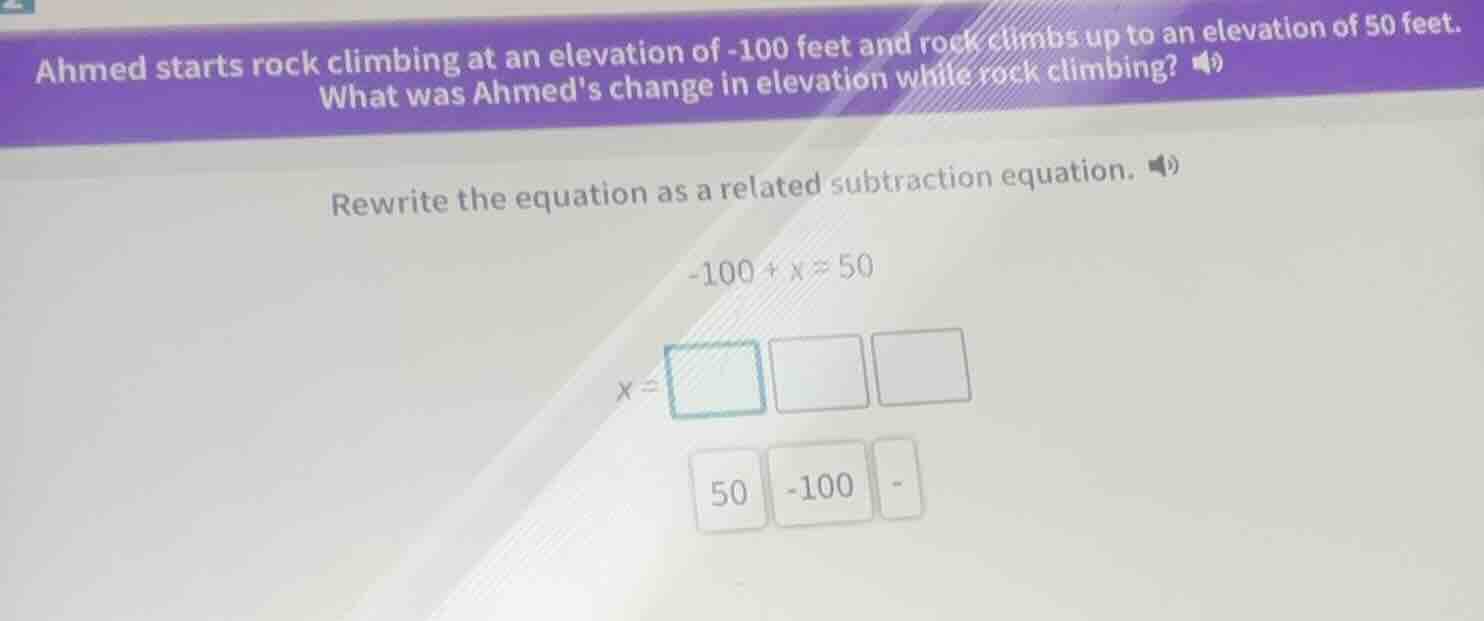
ahmed starts rock climbing at an elevation of -100 feet and rock climbs up to an elevation of 50 feet. what was ahmeds change in elevation while rock climbing? rewrite the equation as a related subtraction equation. -100 + x = 50 x = \square \square \square 50 -100 -
Step1: Isolate x in the equation
To isolate \( x \) in the equation \( -100 + x = 50 \), we can use the property of equations that allows us to add 100 to both sides, or we can rewrite it as a subtraction equation. The related subtraction equation for \( -100 + x = 50 \) is found by solving for \( x \), which is \( x = 50 - (-100) \)? Wait, no, actually, from \( -100 + x = 50 \), to solve for \( x \), we add 100 to both sides: \( x = 50 + 100 \)? Wait, no, the original equation is \( -100 + x = 50 \). To rewrite it as a subtraction equation, we can think of \( x = 50 - (-100) \)? Wait, no, let's do it step by step.
The equation is \( -100 + x = 50 \). To solve for \( x \), we can add 100 to both sides: \( x = 50 + 100 \). But the problem says "Rewrite the equation as a related subtraction equation". So starting from \( -100 + x = 50 \), we can rearrange it to \( x = 50 - (-100) \)? Wait, no, maybe I made a mistake. Wait, the equation is \( -100 + x = 50 \). Let's solve for \( x \). Subtract \( -100 \) from both sides, which is the same as adding 100. So \( x = 50 - (-100) \)? No, that's not right. Wait, the equation is \( -100 + x = 50 \). Let's add 100 to both sides: \( x = 50 + 100 \). But the problem gives us the numbers 50, -100, and -. So the related subtraction equation would be \( x = 50 - (-100) \)? Wait, no, the numbers provided are 50, -100, and -. So we need to fill in the blanks: \( x = \square \square \square \), with the options 50, -100, -. So the correct way is \( x = 50 - (-100) \)? Wait, no, that's not. Wait, the original equation is \( -100 + x = 50 \). To rewrite it as a subtraction equation, we can solve for \( x \) by subtracting \( -100 \) from both sides, which is \( x = 50 - (-100) \). But the numbers given are 50, -100, and -. So we need to arrange them as \( x = 50 - (-100) \)? Wait, no, the blanks are three: the first is the number, the second is the operation, the third is the number? Wait, the image shows \( x = \square \square \square \), with three boxes, and below are the numbers 50, -100, and -. So we need to put 50, then -, then -100? Wait, no, that would be \( x = 50 - (-100) \)? Wait, no, let's check the arithmetic. If we have \( -100 + x = 50 \), then \( x = 50 + 100 = 150 \). But using the subtraction equation, \( 50 - (-100) = 50 + 100 = 150 \), which is correct. So the related subtraction equation is \( x = 50 - (-100) \). So the first box is 50, the second is -, the third is -100. Wait, no, that would be \( x = 50 - (-100) \), but the third box is -100. Wait, maybe I messed up. Let's do it again.
The equation is \( -100 + x = 50 \). To solve for \( x \), we can add 100 to both sides: \( x = 50 + 100 \). But the problem wants a subtraction equation. So we can write \( x = 50 - (-100) \), because subtracting a negative is adding a positive. So the first number is 50, the operation is -, the second number is -100. So \( x = 50 - (-100) \).
Step2: Verify the calculation
Let's check: \( 50 - (-100) = 50 + 100 = 150 \). And if we plug \( x = 150 \) into the original equation: \( -100 + 150 = 50 \), which is correct. So the related subtraction equation is \( x = 50 - (-100) \).

Snap & solve any problem in the app
Get step-by-step solutions on Sovi AI
Photo-based solutions with guided steps
Explore more problems and detailed explanations
\( x = 50 - (-100) \) (So the first box is 50, the second is -, the third is -100)