QUESTION IMAGE
Question
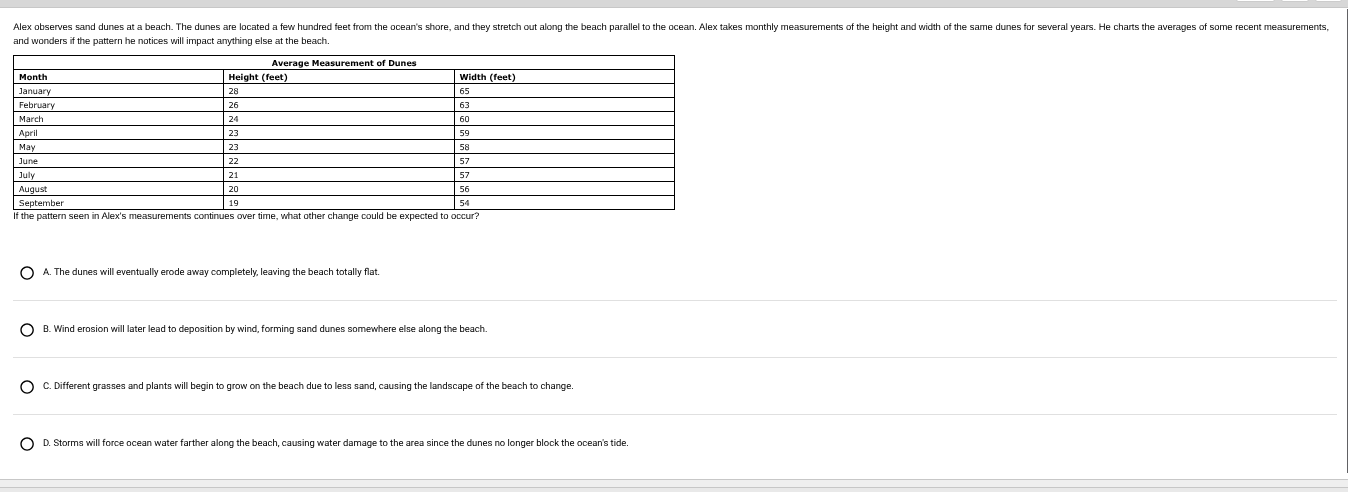
alex observes sand dunes at a beach. the dunes are located a few hundred feet from the oceans shore, and they stretch out along the beach parallel to the ocean. alex takes monthly measurements of the height and width of the same dunes for several years. he charts the averages of some recent measurements, and wonders if the pattern he notices will impact anything else at the beach.
average measurement of dunes
| month | height (feet) | width (feet) |
|---|---|---|
| february | 26 | 63 |
| march | 24 | 60 |
| april | 23 | 59 |
| may | 23 | 58 |
| june | 22 | 57 |
| july | 21 | 57 |
| august | 20 | 56 |
| september | 19 | 54 |
if the pattern seen in alexs measurements continues over time, what other change could be expected to occur?
a. the dunes will eventually erode away completely, leaving the beach totally flat.
b. wind erosion will later lead to deposition by wind, forming sand dunes somewhere else along the beach.
c. different grasses and plants will begin to grow on the beach due to less sand, causing the landscape of the beach to change.
d. storms will force ocean water farther along the beach, causing water damage to the area since the dunes no longer block the oceans tide.
First, analyze the trend in Alex's measurements: the height and width of the dunes are decreasing over time (January to September, height from 28 to 19, width from 65 to 54). Now, evaluate each option:
- Option A: Saying dunes erode completely to a totally flat beach is extreme; dunes erode gradually, and other factors (like plant growth, wind deposition) affect this. Eliminate A.
- Option B: The pattern here is dunes shrinking, not wind erosion leading to new dunes elsewhere. The data shows dunes getting smaller, not being moved. Eliminate B.
- Option C: Less sand (from shrinking dunes) could allow different plants/grasses to grow as the beach landscape changes. This is plausible as reduced sand changes the environment for vegetation.
- Option D: Dunes block tides, but if dunes shrink, would storms push water farther? However, the main change from shrinking dunes (less sand) is more about habitat for plants, not just tide blocking. Also, the pattern is gradual shrinkage, not dunes disappearing to stop blocking. So D is less likely than C.

Snap & solve any problem in the app
Get step-by-step solutions on Sovi AI
Photo-based solutions with guided steps
Explore more problems and detailed explanations
D. Storms will force ocean water farther along the beach, causing water damage to the area since the dunes no longer block the ocean’s tide.
Wait, correction: Wait, re - evaluating. The dunes are shrinking (height and width decreasing). Dunes act as a barrier against storm surges and tides. If dunes get smaller (less effective as a barrier), storms can push ocean water farther inland, causing damage. Let's re - check:
- Option C: Less sand might change vegetation, but the primary function of dunes is coastal protection. If dunes shrink, the protective barrier is reduced. Storms can then push water farther. So D is correct.
Let's re - analyze each option with the dune function:
- A: Dunes eroding completely is too extreme. The data shows a gradual decrease, not total erosion.
- B: The data shows dunes shrinking, not being transported (wind erosion depositing elsewhere). The trend is reduction, not relocation.
- C: Vegetation change is a secondary effect. The primary impact of reduced dune size (height and width) is on coastal protection (tide/storm surge blocking).
- D: Dunes block ocean tides/storms. If dunes are smaller (less height/width), they can't block as well. So storms can push water farther, causing damage. This is a direct consequence of the dunes' reduced ability to act as a barrier.
So the correct answer is D. Storms will force ocean water farther along the beach, causing water damage to the area since the dunes no longer block the ocean’s tide.