QUESTION IMAGE
Question
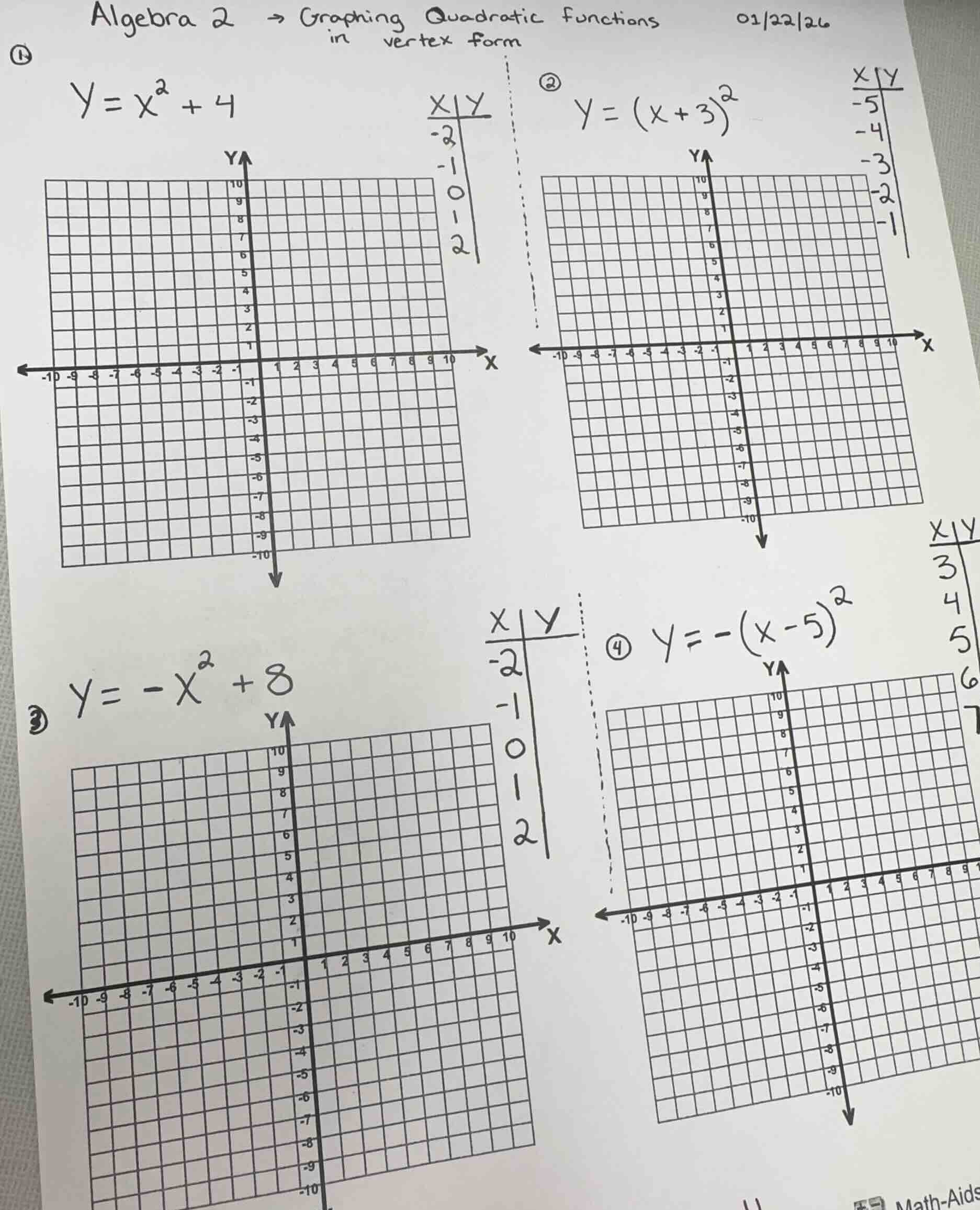
algebra 2 → graphing quadratic functions in vertex form 01/22/26
① ( y = x^2 + 4 )
② ( y = (x + 3)^2 )
③ ( y = -x^2 + 8 )
④ ( y = -(x - 5)^2 )
To solve the problem of graphing quadratic functions in vertex form, we can follow these steps for each function:
Function 1: \( y = x^2 + 4 \)
Step 1: Identify the vertex form
The vertex form of a quadratic function is \( y = a(x - h)^2 + k \), where \((h, k)\) is the vertex. For \( y = x^2 + 4 \), we can rewrite it as \( y = 1(x - 0)^2 + 4 \). So, the vertex is \((0, 4)\), and \( a = 1 \) (which means the parabola opens upwards).
Step 2: Create a table of values
We can choose some \( x \)-values around the vertex ( \( x = -2, -1, 0, 1, 2 \)) and calculate the corresponding \( y \)-values:
- For \( x = -2 \): \( y = (-2)^2 + 4 = 4 + 4 = 8 \)
- For \( x = -1 \): \( y = (-1)^2 + 4 = 1 + 4 = 5 \)
- For \( x = 0 \): \( y = 0^2 + 4 = 0 + 4 = 4 \)
- For \( x = 1 \): \( y = 1^2 + 4 = 1 + 4 = 5 \)
- For \( x = 2 \): \( y = 2^2 + 4 = 4 + 4 = 8 \)
Step 3: Plot the points and draw the parabola
Plot the points \((-2, 8)\), \((-1, 5)\), \((0, 4)\), \((1, 5)\), \((2, 8)\) on the coordinate plane and draw a smooth curve (parabola) through them. The vertex is at \((0, 4)\), and the parabola opens upwards.
Function 2: \( y = (x + 3)^2 \)
Step 1: Identify the vertex form
Rewrite \( y = (x + 3)^2 \) as \( y = 1(x - (-3))^2 + 0 \). So, the vertex is \((-3, 0)\), and \( a = 1 \) (parabola opens upwards).
Step 2: Create a table of values
Choose \( x \)-values around the vertex ( \( x = -5, -4, -3, -2, -1 \)):
- For \( x = -5 \): \( y = (-5 + 3)^2 = (-2)^2 = 4 \)
- For \( x = -4 \): \( y = (-4 + 3)^2 = (-1)^2 = 1 \)
- For \( x = -3 \): \( y = (-3 + 3)^2 = 0^2 = 0 \)
- For \( x = -2 \): \( y = (-2 + 3)^2 = 1^2 = 1 \)
- For \( x = -1 \): \( y = (-1 + 3)^2 = 2^2 = 4 \)
Step 3: Plot the points and draw the parabola
Plot the points \((-5, 4)\), \((-4, 1)\), \((-3, 0)\), \((-2, 1)\), \((-1, 4)\) and draw the parabola. The vertex is at \((-3, 0)\), opening upwards.
Function 3: \( y = -x^2 + 8 \)
Step 1: Identify the vertex form
Rewrite \( y = -x^2 + 8 \) as \( y = -1(x - 0)^2 + 8 \). So, the vertex is \((0, 8)\), and \( a = -1 \) (parabola opens downwards).
Step 2: Create a table of values
Choose \( x \)-values around the vertex ( \( x = -2, -1, 0, 1, 2 \)):
- For \( x = -2 \): \( y = -(-2)^2 + 8 = -4 + 8 = 4 \)
- For \( x = -1 \): \( y = -(-1)^2 + 8 = -1 + 8 = 7 \)
- For \( x = 0 \): \( y = -0^2 + 8 = 0 + 8 = 8 \)
- For \( x = 1 \): \( y = -1^2 + 8 = -1 + 8 = 7 \)
- For \( x = 2 \): \( y = -2^2 + 8 = -4 + 8 = 4 \)
Step 3: Plot the points and draw the parabola
Plot the points \((-2, 4)\), \((-1, 7)\), \((0, 8)\), \((1, 7)\), \((2, 4)\) and draw the parabola. The vertex is at \((0, 8)\), opening downwards.
Function 4: \( y = -(x - 5)^2 \)
Step 1: Identify the vertex form
The function is already in vertex form: \( y = -1(x - 5)^2 + 0 \). So, the vertex is \((5, 0)\), and \( a = -1 \) (parabola opens downwards).
Step 2: Create a table of values
Choose \( x \)-values around the vertex ( \( x = 3, 4, 5, 6, 7 \)):
- For \( x = 3 \): \( y = -(3 - 5)^2 = -(-2)^2 = -4 \)
- For \( x = 4 \): \( y = -(4 - 5)^2 = -(-1)^2 = -1 \)
- For \( x = 5 \): \( y = -(5 - 5)^2 = -0^2 = 0 \)
- For \( x = 6 \): \( y = -(6 - 5)^2 = -1^2 = -1 \)
- For \( x = 7 \): \( y = -(7 - 5)^2 = -2^2 = -4 \)
Step 3: Plot the points and draw the parabola
Plot the points \((3, -4)\), \((4, -1)\), \((5, 0)\), \((6, -1)\), \((7, -4)\) and draw the parabola. The vertex is at \((5, 0)\), opening downwards.
Final Answer
The graphs of the quadratic functions are drawn by following the steps above: identifying the verte…

Snap & solve any problem in the app
Get step-by-step solutions on Sovi AI
Photo-based solutions with guided steps
Explore more problems and detailed explanations
To solve the problem of graphing quadratic functions in vertex form, we can follow these steps for each function:
Function 1: \( y = x^2 + 4 \)
Step 1: Identify the vertex form
The vertex form of a quadratic function is \( y = a(x - h)^2 + k \), where \((h, k)\) is the vertex. For \( y = x^2 + 4 \), we can rewrite it as \( y = 1(x - 0)^2 + 4 \). So, the vertex is \((0, 4)\), and \( a = 1 \) (which means the parabola opens upwards).
Step 2: Create a table of values
We can choose some \( x \)-values around the vertex ( \( x = -2, -1, 0, 1, 2 \)) and calculate the corresponding \( y \)-values:
- For \( x = -2 \): \( y = (-2)^2 + 4 = 4 + 4 = 8 \)
- For \( x = -1 \): \( y = (-1)^2 + 4 = 1 + 4 = 5 \)
- For \( x = 0 \): \( y = 0^2 + 4 = 0 + 4 = 4 \)
- For \( x = 1 \): \( y = 1^2 + 4 = 1 + 4 = 5 \)
- For \( x = 2 \): \( y = 2^2 + 4 = 4 + 4 = 8 \)
Step 3: Plot the points and draw the parabola
Plot the points \((-2, 8)\), \((-1, 5)\), \((0, 4)\), \((1, 5)\), \((2, 8)\) on the coordinate plane and draw a smooth curve (parabola) through them. The vertex is at \((0, 4)\), and the parabola opens upwards.
Function 2: \( y = (x + 3)^2 \)
Step 1: Identify the vertex form
Rewrite \( y = (x + 3)^2 \) as \( y = 1(x - (-3))^2 + 0 \). So, the vertex is \((-3, 0)\), and \( a = 1 \) (parabola opens upwards).
Step 2: Create a table of values
Choose \( x \)-values around the vertex ( \( x = -5, -4, -3, -2, -1 \)):
- For \( x = -5 \): \( y = (-5 + 3)^2 = (-2)^2 = 4 \)
- For \( x = -4 \): \( y = (-4 + 3)^2 = (-1)^2 = 1 \)
- For \( x = -3 \): \( y = (-3 + 3)^2 = 0^2 = 0 \)
- For \( x = -2 \): \( y = (-2 + 3)^2 = 1^2 = 1 \)
- For \( x = -1 \): \( y = (-1 + 3)^2 = 2^2 = 4 \)
Step 3: Plot the points and draw the parabola
Plot the points \((-5, 4)\), \((-4, 1)\), \((-3, 0)\), \((-2, 1)\), \((-1, 4)\) and draw the parabola. The vertex is at \((-3, 0)\), opening upwards.
Function 3: \( y = -x^2 + 8 \)
Step 1: Identify the vertex form
Rewrite \( y = -x^2 + 8 \) as \( y = -1(x - 0)^2 + 8 \). So, the vertex is \((0, 8)\), and \( a = -1 \) (parabola opens downwards).
Step 2: Create a table of values
Choose \( x \)-values around the vertex ( \( x = -2, -1, 0, 1, 2 \)):
- For \( x = -2 \): \( y = -(-2)^2 + 8 = -4 + 8 = 4 \)
- For \( x = -1 \): \( y = -(-1)^2 + 8 = -1 + 8 = 7 \)
- For \( x = 0 \): \( y = -0^2 + 8 = 0 + 8 = 8 \)
- For \( x = 1 \): \( y = -1^2 + 8 = -1 + 8 = 7 \)
- For \( x = 2 \): \( y = -2^2 + 8 = -4 + 8 = 4 \)
Step 3: Plot the points and draw the parabola
Plot the points \((-2, 4)\), \((-1, 7)\), \((0, 8)\), \((1, 7)\), \((2, 4)\) and draw the parabola. The vertex is at \((0, 8)\), opening downwards.
Function 4: \( y = -(x - 5)^2 \)
Step 1: Identify the vertex form
The function is already in vertex form: \( y = -1(x - 5)^2 + 0 \). So, the vertex is \((5, 0)\), and \( a = -1 \) (parabola opens downwards).
Step 2: Create a table of values
Choose \( x \)-values around the vertex ( \( x = 3, 4, 5, 6, 7 \)):
- For \( x = 3 \): \( y = -(3 - 5)^2 = -(-2)^2 = -4 \)
- For \( x = 4 \): \( y = -(4 - 5)^2 = -(-1)^2 = -1 \)
- For \( x = 5 \): \( y = -(5 - 5)^2 = -0^2 = 0 \)
- For \( x = 6 \): \( y = -(6 - 5)^2 = -1^2 = -1 \)
- For \( x = 7 \): \( y = -(7 - 5)^2 = -2^2 = -4 \)
Step 3: Plot the points and draw the parabola
Plot the points \((3, -4)\), \((4, -1)\), \((5, 0)\), \((6, -1)\), \((7, -4)\) and draw the parabola. The vertex is at \((5, 0)\), opening downwards.
Final Answer
The graphs of the quadratic functions are drawn by following the steps above: identifying the vertex, creating a table of values, plotting the points, and drawing the parabola. The key features (vertex, direction of opening) and the shape of each parabola are determined by the vertex form of the quadratic function.