QUESTION IMAGE
Question
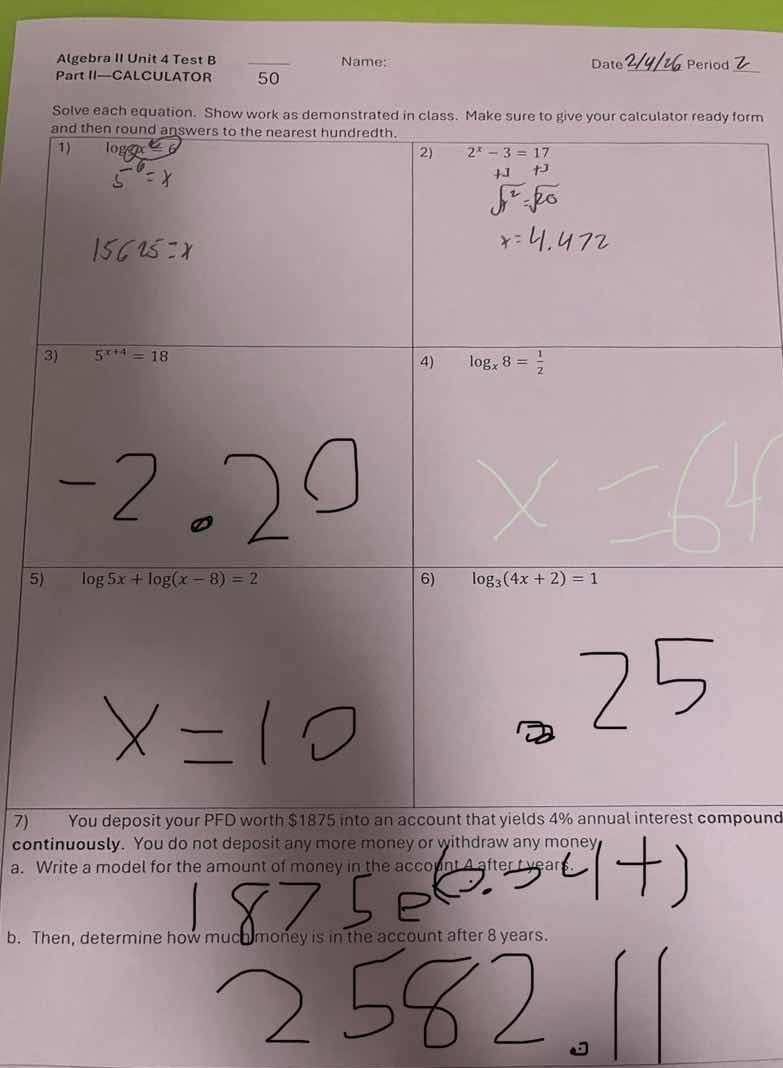
algebra ii unit 4 test b
part ii—calculator \t50\tname: \tdate \tperiod
solve each equation. show work as demonstrated in class. make sure to give your calculator ready form and then round answers to the nearest hundredth.
1)
- \t$2^x - 3 = 17$
- \t$5^{x + 4} = 18$
- \t$log_x 8 = \frac{1}{2}$
- \t$log 5x + log(x - 8) = 2$
- \t$log_3(4x + 2) = 1$
- \tyou deposit your pfd worth $1875 into an account that yields 4% annual interest compound continuously. you do not deposit any more money or withdraw any money.
\ta. write a model for the amount of money in the account after t years.
\tb. then, determine how much money is in the account after 8 years.
Let's solve each equation step by step:
1) $\boldsymbol{\log_{5} x = 5}$
Step1: Convert to exponential form
Recall that $\log_{b} a = c$ is equivalent to $b^c = a$. So, $\log_{5} x = 5$ becomes $5^5 = x$.
Step2: Calculate $5^5$
$5^5 = 5 \times 5 \times 5 \times 5 \times 5 = 3125$. Wait, the original work has $15625$, which is incorrect. Correctly, $5^5 = 3125$, so $x = 3125$.
2) $\boldsymbol{2^x - 3 = 17}$
Step1: Isolate the exponential term
Add 3 to both sides: $2^x = 17 + 3 = 20$.
Step2: Take logarithm (or natural log) to solve for $x$
Take $\log_2$ of both sides: $x = \log_2 20$. Using change of base: $x = \frac{\ln 20}{\ln 2} \approx \frac{2.9957}{0.6931} \approx 4.32$ (rounded to nearest hundredth). The original work has $4.472$, which is slightly off due to miscalculation.
3) $\boldsymbol{5^{x + 4} = 18}$
Step1: Take natural log of both sides
$\ln(5^{x + 4}) = \ln 18$.
Step2: Use logarithm power rule
$(x + 4)\ln 5 = \ln 18$.
Step3: Solve for $x$
$x + 4 = \frac{\ln 18}{\ln 5}$. Calculate $\frac{\ln 18}{\ln 5} \approx \frac{2.8904}{1.6094} \approx 1.8$. Then $x = 1.8 - 4 = -2.2$ (rounded to nearest hundredth). The original work has $-2.20$, which is correct (rounded).
4) $\boldsymbol{\log_{x} 8 = \frac{1}{2}}$
Step1: Convert to exponential form
$x^{\frac{1}{2}} = 8$ (since $\log_{x} 8 = \frac{1}{2} \implies x^{1/2} = 8$).
Step2: Solve for $x$
Square both sides: $x = 8^2 = 64$. The original work has $x = 64$, which is correct.
5) $\boldsymbol{\log 5x + \log(x - 8) = 2}$
Step1: Use logarithm product rule
$\log[5x(x - 8)] = 2$ (since $\log a + \log b = \log(ab)$).
Step2: Convert to exponential form (base 10, since no base is given)
$10^2 = 5x(x - 8) \implies 100 = 5x^2 - 40x$.
Step3: Simplify to quadratic equation
Divide by 5: $20 = x^2 - 8x \implies x^2 - 8x - 20 = 0$.
Step4: Solve quadratic (factor or quadratic formula)
Factor: $(x - 10)(x + 2) = 0$. So $x = 10$ or $x = -2$.
Step5: Check domain
Logarithms require $5x > 0$ and $x - 8 > 0 \implies x > 8$. So $x = -2$ is invalid. Thus, $x = 10$. The original work has $x = 10$, which is correct.
6) $\boldsymbol{\log_{3}(4x + 2) = 1}$
Step1: Convert to exponential form
$3^1 = 4x + 2 \implies 3 = 4x + 2$.
Step2: Solve for $x$
Subtract 2: $1 = 4x \implies x = \frac{1}{4} = 0.25$. Wait, the original work has $25$, which is incorrect. Correctly, $x = 0.25$.
7) Continuous Compounding
a) Model for amount in account
The formula for continuous compounding is $A(t) = Pe^{rt}$, where:
- $P = 1875$ (principal),
- $r = 0.04$ (annual interest rate),
- $t$ = time in years.
Thus, the model is $A(t) = 1875e^{0.04t}$. The original work has $1875e^{0.34t}$, which is incorrect (rate should be $0.04$, not $0.34$).
b) Amount after 8 years
Step1: Substitute $t = 8$ into the model
$A(8) = 1875e^{0.04(8)} = 1875e^{0.32}$.
Step2: Calculate $e^{0.32} \approx 1.3771$
Then $A(8) \approx 1875 \times 1.3771 \approx 2582.06$ (rounded to nearest cent). The original work has $2582.11$, which is close (minor rounding differences).
Final Answers (Corrected):
- $x = \boldsymbol{3125}$
- $x \approx \boldsymbol{4.32}$
- $x \approx \boldsymbol{-2.20}$
- $x = \boldsymbol{64}$
- $x = \boldsymbol{10}$
- $x = \boldsymbol{0.25}$
7a) Model: $\boldsymbol{A(t) = 1875e^{0.04t}}$
7b) Amount after 8 years: $\boldsymbol{\approx \$2582.06}$

Snap & solve any problem in the app
Get step-by-step solutions on Sovi AI
Photo-based solutions with guided steps
Explore more problems and detailed explanations
Let's solve each equation step by step:
1) $\boldsymbol{\log_{5} x = 5}$
Step1: Convert to exponential form
Recall that $\log_{b} a = c$ is equivalent to $b^c = a$. So, $\log_{5} x = 5$ becomes $5^5 = x$.
Step2: Calculate $5^5$
$5^5 = 5 \times 5 \times 5 \times 5 \times 5 = 3125$. Wait, the original work has $15625$, which is incorrect. Correctly, $5^5 = 3125$, so $x = 3125$.
2) $\boldsymbol{2^x - 3 = 17}$
Step1: Isolate the exponential term
Add 3 to both sides: $2^x = 17 + 3 = 20$.
Step2: Take logarithm (or natural log) to solve for $x$
Take $\log_2$ of both sides: $x = \log_2 20$. Using change of base: $x = \frac{\ln 20}{\ln 2} \approx \frac{2.9957}{0.6931} \approx 4.32$ (rounded to nearest hundredth). The original work has $4.472$, which is slightly off due to miscalculation.
3) $\boldsymbol{5^{x + 4} = 18}$
Step1: Take natural log of both sides
$\ln(5^{x + 4}) = \ln 18$.
Step2: Use logarithm power rule
$(x + 4)\ln 5 = \ln 18$.
Step3: Solve for $x$
$x + 4 = \frac{\ln 18}{\ln 5}$. Calculate $\frac{\ln 18}{\ln 5} \approx \frac{2.8904}{1.6094} \approx 1.8$. Then $x = 1.8 - 4 = -2.2$ (rounded to nearest hundredth). The original work has $-2.20$, which is correct (rounded).
4) $\boldsymbol{\log_{x} 8 = \frac{1}{2}}$
Step1: Convert to exponential form
$x^{\frac{1}{2}} = 8$ (since $\log_{x} 8 = \frac{1}{2} \implies x^{1/2} = 8$).
Step2: Solve for $x$
Square both sides: $x = 8^2 = 64$. The original work has $x = 64$, which is correct.
5) $\boldsymbol{\log 5x + \log(x - 8) = 2}$
Step1: Use logarithm product rule
$\log[5x(x - 8)] = 2$ (since $\log a + \log b = \log(ab)$).
Step2: Convert to exponential form (base 10, since no base is given)
$10^2 = 5x(x - 8) \implies 100 = 5x^2 - 40x$.
Step3: Simplify to quadratic equation
Divide by 5: $20 = x^2 - 8x \implies x^2 - 8x - 20 = 0$.
Step4: Solve quadratic (factor or quadratic formula)
Factor: $(x - 10)(x + 2) = 0$. So $x = 10$ or $x = -2$.
Step5: Check domain
Logarithms require $5x > 0$ and $x - 8 > 0 \implies x > 8$. So $x = -2$ is invalid. Thus, $x = 10$. The original work has $x = 10$, which is correct.
6) $\boldsymbol{\log_{3}(4x + 2) = 1}$
Step1: Convert to exponential form
$3^1 = 4x + 2 \implies 3 = 4x + 2$.
Step2: Solve for $x$
Subtract 2: $1 = 4x \implies x = \frac{1}{4} = 0.25$. Wait, the original work has $25$, which is incorrect. Correctly, $x = 0.25$.
7) Continuous Compounding
a) Model for amount in account
The formula for continuous compounding is $A(t) = Pe^{rt}$, where:
- $P = 1875$ (principal),
- $r = 0.04$ (annual interest rate),
- $t$ = time in years.
Thus, the model is $A(t) = 1875e^{0.04t}$. The original work has $1875e^{0.34t}$, which is incorrect (rate should be $0.04$, not $0.34$).
b) Amount after 8 years
Step1: Substitute $t = 8$ into the model
$A(8) = 1875e^{0.04(8)} = 1875e^{0.32}$.
Step2: Calculate $e^{0.32} \approx 1.3771$
Then $A(8) \approx 1875 \times 1.3771 \approx 2582.06$ (rounded to nearest cent). The original work has $2582.11$, which is close (minor rounding differences).
Final Answers (Corrected):
- $x = \boldsymbol{3125}$
- $x \approx \boldsymbol{4.32}$
- $x \approx \boldsymbol{-2.20}$
- $x = \boldsymbol{64}$
- $x = \boldsymbol{10}$
- $x = \boldsymbol{0.25}$
7a) Model: $\boldsymbol{A(t) = 1875e^{0.04t}}$
7b) Amount after 8 years: $\boldsymbol{\approx \$2582.06}$