QUESTION IMAGE
Question
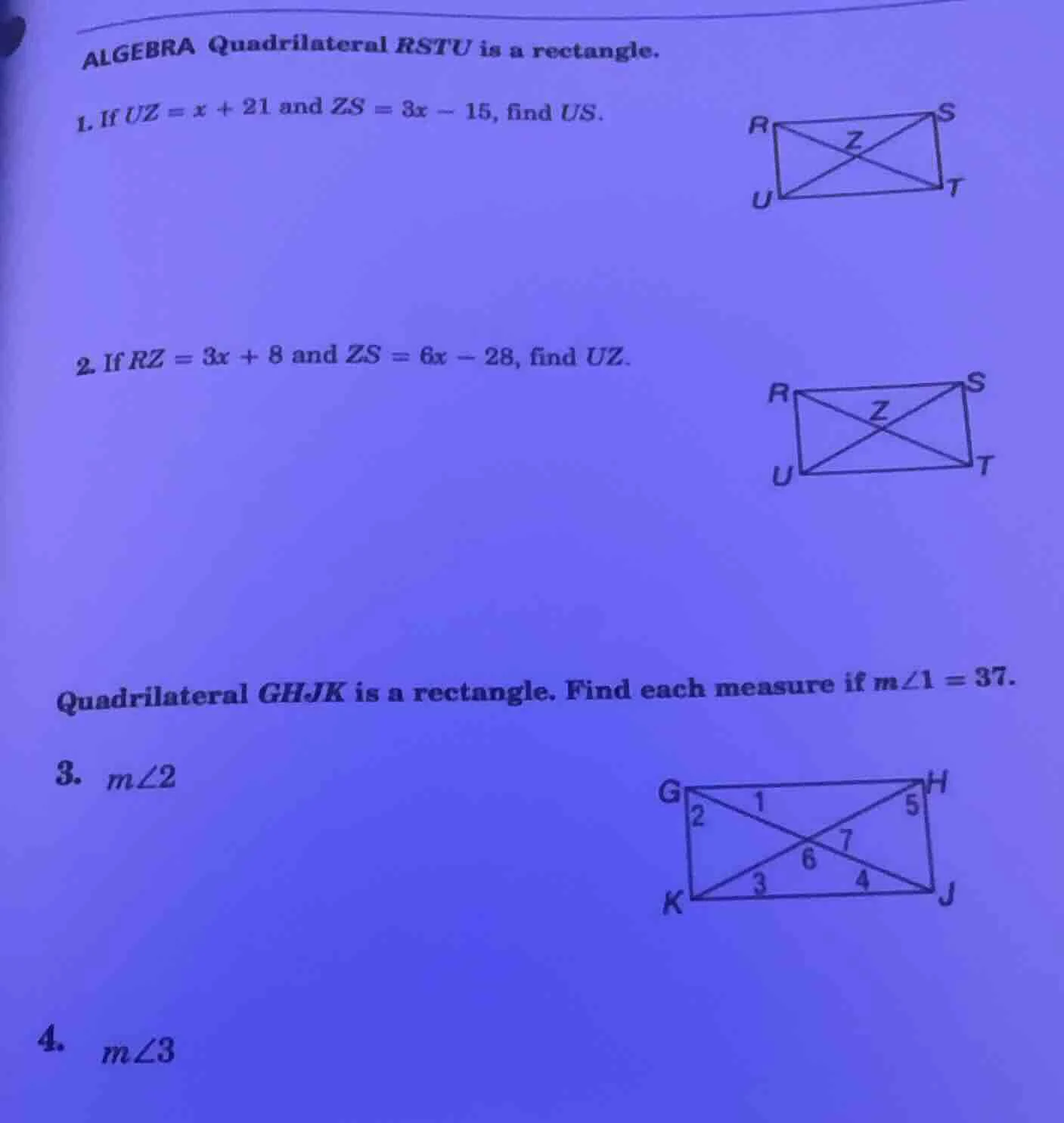
algebra quadrilateral rstu is a rectangle.
- if uz = x + 21 and zs = 3x - 15, find us.
- if rz = 3x + 8 and zs = 6x - 28, find uz.
quadrilateral ghj k is a rectangle. find each measure if m∠1 = 37.
- m∠2
- m∠3
Problem 1
Step1: Recall rectangle diagonal property
In a rectangle, diagonals bisect each other, so \(UZ = ZS\).
Set \(x + 21=3x - 15\)
Step2: Solve for \(x\)
Subtract \(x\) from both sides: \(21 = 2x - 15\)
Add 15 to both sides: \(36 = 2x\)
Divide by 2: \(x = 18\)
Step3: Find \(UZ\) and \(ZS\)
\(UZ=18 + 21 = 39\), \(ZS = 3\times18 - 15=39\)
Step4: Find \(US\)
Since \(US=UZ + ZS\), \(US = 39+39 = 78\)
Step1: Recall rectangle diagonal property
In a rectangle, diagonals bisect each other, so \(RZ = ZS\).
Set \(3x + 8=6x - 28\)
Step2: Solve for \(x\)
Subtract \(3x\) from both sides: \(8 = 3x - 28\)
Add 28 to both sides: \(36 = 3x\)
Divide by 3: \(x = 12\)
Step3: Find \(RZ\) (and \(ZS\))
\(RZ=3\times12 + 8 = 44\), so \(ZS = 44\)
Step4: Find \(UZ\)
In a rectangle, diagonals are equal and bisect each other, so \(UZ = RZ = 44\)
Step1: Recall rectangle angle properties
In rectangle \(GHJK\), \(GH\parallel JK\) and diagonals bisect each other. Also, \(\angle1\) and \(\angle2\) are related to the right angle at \(G\). Since diagonals bisect each other, triangle \(GKH\) is isoceles? Wait, actually, in a rectangle, \(\angle GKJ = 90^\circ\), and diagonals are equal and bisect each other. Also, \(\angle1 = 37^\circ\), and \(\angle1\) and \(\angle2\) are such that \(\angle1+\angle2 + 90^\circ?\) No, wait, in rectangle, \(GK = HJ\) (diagonals), and \(GH\parallel JK\), so \(\angle1=\angle3\) (alternate interior angles), but for \(\angle2\): since \(\angle1 = 37^\circ\), and in triangle \(GKH\), the diagonal divides the rectangle, and \(\angle2=90^\circ - \angle1\)? Wait, no, actually, in rectangle, \(\angle KGH = 90^\circ\), and diagonals bisect each other, so \(G\) to center is equal to center to \(H\), so triangle \(GZH\) (Z is center) is isoceles? Wait, maybe better: in rectangle, \(\angle1 = 37^\circ\), and \(\angle2 = 90^\circ - 37^\circ=53^\circ\)? Wait, no, let's think again. The diagonals in a rectangle are equal and bisect each other, so \(GK = HJ\), and \(GH\parallel JK\). So \(\angle1\) and \(\angle3\) are equal (alternate interior angles). Also, \(\angle2\) and \(\angle1\) are complementary? Wait, \(\angle KGH = 90^\circ\), so \(\angle1+\angle2 = 90^\circ\), so \(\angle2 = 90 - 37 = 53^\circ\)
Step2: Confirm
Since \(\angle KGH = 90^\circ\) (rectangle angle), and \(\angle1 = 37^\circ\), then \(\angle2=90^\circ - 37^\circ = 53^\circ\)

Snap & solve any problem in the app
Get step-by-step solutions on Sovi AI
Photo-based solutions with guided steps
Explore more problems and detailed explanations
\(US = 78\)