QUESTION IMAGE
Question
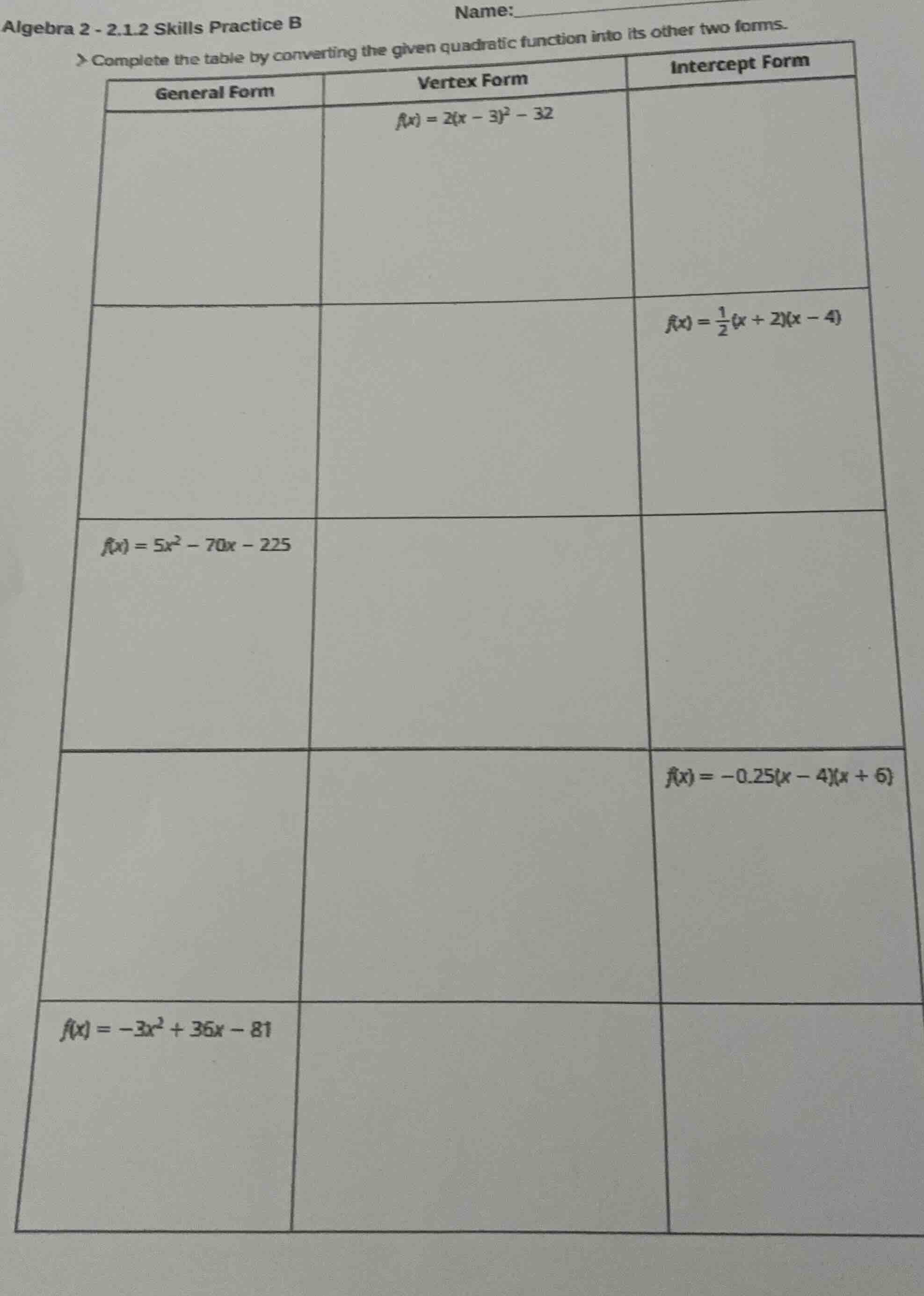
algebra 2 - 2.1.2 skills practice b
name:
complete the table by converting the given quadratic function into its other two forms.
general form\tvertex form\tintercept form
\t$f(x) = 2(x - 3)^2 - 32$\t
\t\t$f(x) = \frac{1}{2}(x + 2)(x - 4)$
$f(x) = 5x^2 - 70x - 225$\t\t
\t\t$f(x) = -0.25(x - 4)(x + 6)$
$f(x) = -3x^2 + 36x - 81$\t\t
Let's solve each row of the table by converting the quadratic function into the required forms. We'll start with the first row.
Row 1: Vertex Form given \( f(x) = 2(x - 3)^2 - 32 \)
Step 1: Convert Vertex Form to General Form
Expand \( 2(x - 3)^2 - 32 \):
\[
\]
Step 2: Convert Vertex Form to Intercept Form
Set \( f(x) = 0 \):
\[
\]
So the roots are \( x = 7 \) and \( x = -1 \). Then the intercept form is:
\[
f(x) = 2(x - 7)(x + 1)
\]
Row 2: Intercept Form given \( f(x) = \frac{1}{2}(x + 2)(x - 4) \)
Step 1: Convert Intercept Form to General Form
Expand \( \frac{1}{2}(x + 2)(x - 4) \):
\[
\]
Step 2: Convert Intercept Form to Vertex Form
First, expand the intercept form to general form (already done above: \( f(x) = \frac{1}{2}x^2 - x - 4 \)). Then complete the square:
\[
\]
Row 3: General Form given \( f(x) = 5x^2 - 70x - 225 \)
Step 1: Convert General Form to Vertex Form (Complete the Square)
Factor out the coefficient of \( x^2 \) from the first two terms:
\[
\]
Step 2: Convert General Form to Intercept Form (Factor)
Set \( f(x) = 0 \):
\[
\]
So the roots are \( x = 15 \) and \( x = -3 \). Then the intercept form is:
\[
f(x) = 5(x - 15)(x + 3)
\]
Row 4: Intercept Form given \( f(x) = -0.25(x - 4)(x + 6) \)
Step 1: Convert Intercept Form to General Form
Expand \( -0.25(x - 4)(x + 6) \):
\[
\]
Step 2: Convert Intercept Form to Vertex Form
First, expand the intercept form to general form (already done above: \( f(x) = -0.25x^2 - 0.5x + 6 \)). Then complete the square:
\[
\]
Row 5: General Form given \( f(x) = -3x^2 + 36x - 81 \)
Step 1: Convert General Form to Vertex Form (Complete the Square)
Factor out the coefficient of \( x^2 \) from the first two terms:
\[
\]
Step 2: Convert General Form to Intercept Form (Factor)
Set \( f(x) = 0 \):
\[
\]
So the roots are \( x = 3 \) and \( x = 9 \). Then the intercept form is:
\[
f(x) = -3(x - 3)(x - 9)
\]
Now, let's summarize the results in the table:
| General Form | Vertex Form | Intercept Form |
| ---------------------------- | --------------------------------- | ------------------------… |

Snap & solve any problem in the app
Get step-by-step solutions on Sovi AI
Photo-based solutions with guided steps
Explore more problems and detailed explanations
Let's solve each row of the table by converting the quadratic function into the required forms. We'll start with the first row.
Row 1: Vertex Form given \( f(x) = 2(x - 3)^2 - 32 \)
Step 1: Convert Vertex Form to General Form
Expand \( 2(x - 3)^2 - 32 \):
\[
\]
Step 2: Convert Vertex Form to Intercept Form
Set \( f(x) = 0 \):
\[
\]
So the roots are \( x = 7 \) and \( x = -1 \). Then the intercept form is:
\[
f(x) = 2(x - 7)(x + 1)
\]
Row 2: Intercept Form given \( f(x) = \frac{1}{2}(x + 2)(x - 4) \)
Step 1: Convert Intercept Form to General Form
Expand \( \frac{1}{2}(x + 2)(x - 4) \):
\[
\]
Step 2: Convert Intercept Form to Vertex Form
First, expand the intercept form to general form (already done above: \( f(x) = \frac{1}{2}x^2 - x - 4 \)). Then complete the square:
\[
\]
Row 3: General Form given \( f(x) = 5x^2 - 70x - 225 \)
Step 1: Convert General Form to Vertex Form (Complete the Square)
Factor out the coefficient of \( x^2 \) from the first two terms:
\[
\]
Step 2: Convert General Form to Intercept Form (Factor)
Set \( f(x) = 0 \):
\[
\]
So the roots are \( x = 15 \) and \( x = -3 \). Then the intercept form is:
\[
f(x) = 5(x - 15)(x + 3)
\]
Row 4: Intercept Form given \( f(x) = -0.25(x - 4)(x + 6) \)
Step 1: Convert Intercept Form to General Form
Expand \( -0.25(x - 4)(x + 6) \):
\[
\]
Step 2: Convert Intercept Form to Vertex Form
First, expand the intercept form to general form (already done above: \( f(x) = -0.25x^2 - 0.5x + 6 \)). Then complete the square:
\[
\]
Row 5: General Form given \( f(x) = -3x^2 + 36x - 81 \)
Step 1: Convert General Form to Vertex Form (Complete the Square)
Factor out the coefficient of \( x^2 \) from the first two terms:
\[
\]
Step 2: Convert General Form to Intercept Form (Factor)
Set \( f(x) = 0 \):
\[
\]
So the roots are \( x = 3 \) and \( x = 9 \). Then the intercept form is:
\[
f(x) = -3(x - 3)(x - 9)
\]
Now, let's summarize the results in the table:
| General Form | Vertex Form | Intercept Form |
|---|---|---|
| \( \frac{1}{2}x^2 - x - 4 \) | \( \frac{1}{2}(x - 1)^2 - \frac{9}{2} \) | \( \frac{1}{2}(x + 2)(x - 4) \) |
| \( 5x^2 - 70x - 225 \) | \( 5(x - 7)^2 - 470 \) | \( 5(x - 15)(x + 3) \) |
| \( -0.25x^2 - 0.5x + 6 \) | \( -0.25(x + 1)^2 + 6.25 \) | \( -0.25(x - 4)(x + 6) \) |
| \( -3x^2 + 36x - 81 \) | \( -3(x - 6)^2 + 27 \) | \( -3(x - 3)(x - 9) \) |