QUESTION IMAGE
Question
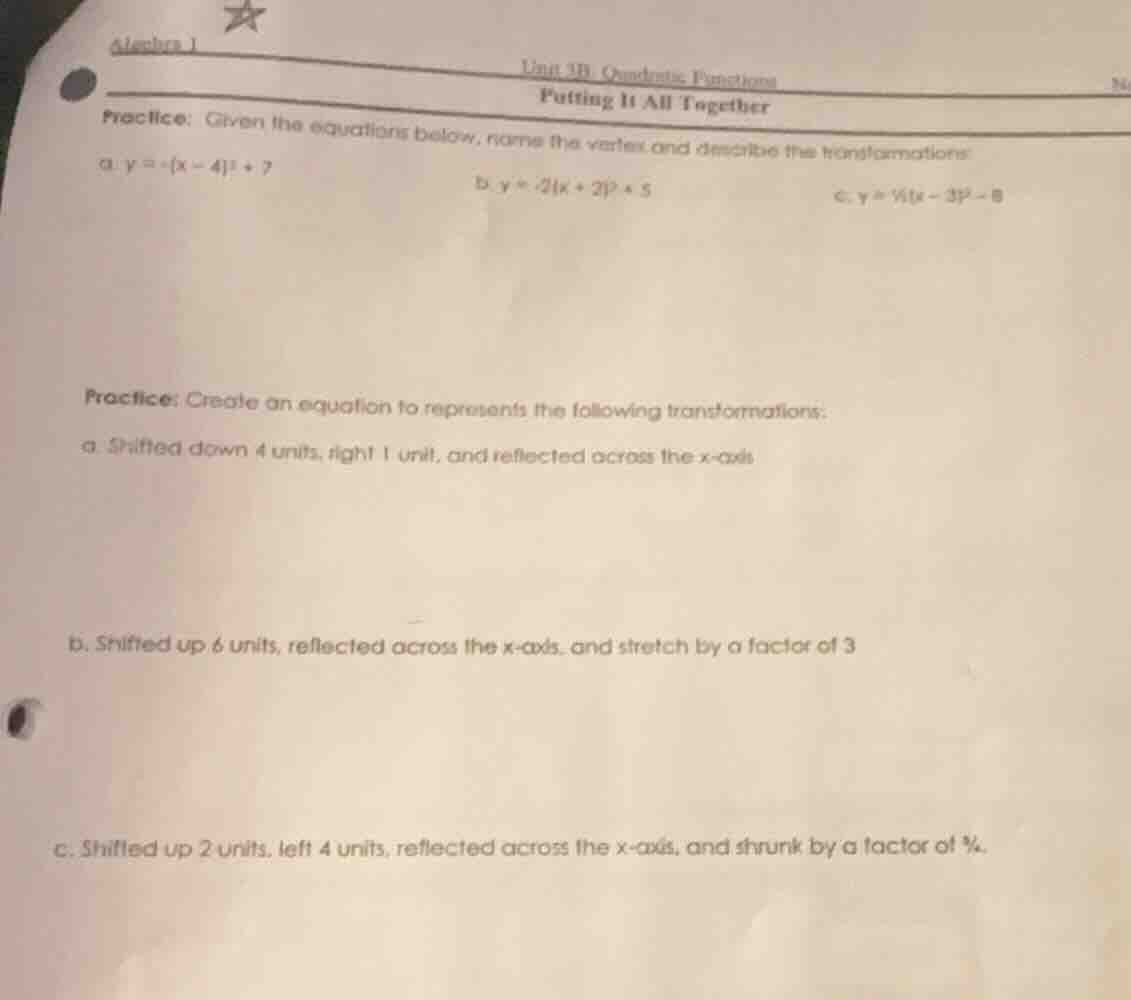
algebra 1 unit 3b quadratic functions putting it all together practice: given the equations below, name the vertex and describe the transformations: a. $y = -(x - 4)^2 + 7$ b. $y = -2(x + 2)^2 + 5$ c. $y = ½(x - 3)^2 - 8$ practice: create an equation to represents the following transformations: a. shifted down 4 units, right 1 unit, and reflected across the x - axis b. shifted up 6 units, reflected across the x - axis, and stretch by a factor of 3 c. shifted up 2 units, left 4 units, reflected across the x - axis, and shrunk by a factor of ¼.
Part 1: Naming Vertex and Describing Transformations
We use the vertex form of a quadratic function: \( y = a(x - h)^2 + k \), where \((h, k)\) is the vertex, \(a\) determines vertical stretch/shrink and reflection, and \(h, k\) determine horizontal/vertical shifts.
a. \( y = -(x - 4)^2 + 7 \)
Step 1: Identify Vertex
Compare with \( y = a(x - h)^2 + k \): \( h = 4 \), \( k = 7 \). So vertex is \((4, 7)\).
Step 2: Describe Transformations
- \( a = -1 \): Reflect over \( x \)-axis (since \( a < 0 \)).
- \( h = 4 \): Shift right 4 units.
- \( k = 7 \): Shift up 7 units.
- No stretch/shrink (since \( |a| = 1 \)).
b. \( y = -2(x + 2)^2 + 5 \)
Step 1: Identify Vertex
Rewrite \( (x + 2) \) as \( (x - (-2)) \), so \( h = -2 \), \( k = 5 \). Vertex: \((-2, 5)\).
Step 2: Describe Transformations
- \( a = -2 \): Reflect over \( x \)-axis (\( a < 0 \)) and vertically stretch by factor 2 (\( |a| = 2 \)).
- \( h = -2 \): Shift left 2 units (since \( h = -2 \), \( x - (-2) = x + 2 \)).
- \( k = 5 \): Shift up 5 units.
c. \( y = \frac{1}{3}(x - 3)^2 - 8 \)
Step 1: Identify Vertex
Compare with \( y = a(x - h)^2 + k \): \( h = 3 \), \( k = -8 \). Vertex: \((3, -8)\).
Step 2: Describe Transformations
- \( a = \frac{1}{3} \): Vertically shrink by factor \( \frac{1}{3} \) (since \( 0 < |a| < 1 \)).
- \( h = 3 \): Shift right 3 units.
- \( k = -8 \): Shift down 8 units.
- No reflection (since \( a > 0 \)).
Part 2: Creating Equations for Transformations
We start with the parent function \( y = x^2 \) (vertex \((0, 0)\), \( a = 1 \)) and apply transformations. The general form after transformations is \( y = a(x - h)^2 + k \), where:
- Reflection over \( x \)-axis: \( a = -1 \) (or negative \( a \)).
- Horizontal shift: \( h \) (right: \( h > 0 \); left: \( h < 0 \)).
- Vertical shift: \( k \) (up: \( k > 0 \); down: \( k < 0 \)).
- Stretch/shrink: \( |a| \) (stretch if \( |a| > 1 \), shrink if \( 0 < |a| < 1 \)).
a. Shifted down 4 units, right 1 unit, and reflected across the \( x \)-axis
Step 1: Determine \( a, h, k \)
- Reflection over \( x \)-axis: \( a = -1 \).
- Shift right 1 unit: \( h = 1 \) (since \( y = a(x - h)^2 + k \), right shift means \( h = 1 \)).
- Shift down 4 units: \( k = -4 \) (down shift means \( k \) is negative).
Step 2: Write the Equation
Substitute \( a = -1 \), \( h = 1 \), \( k = -4 \) into \( y = a(x - h)^2 + k \):
\( y = -1(x - 1)^2 - 4 \) or \( y = -(x - 1)^2 - 4 \).
b. Shifted up 6 units, reflected across the \( x \)-axis, and stretched by a factor of 3
Step 1: Determine \( a, h, k \)
- Reflection over \( x \)-axis: \( a = -3 \) (stretch by 3, so \( |a| = 3 \); reflection, so \( a = -3 \)).
- No horizontal shift: \( h = 0 \) (since no left/right shift).
- Shift up 6 units: \( k = 6 \).
Step 2: Write the Equation
Substitute \( a = -3 \), \( h = 0 \), \( k = 6 \) into \( y = a(x - h)^2 + k \):
\( y = -3(x - 0)^2 + 6 \) or \( y = -3x^2 + 6 \).
c. Shifted up 2 units, left 4 units, reflected across the \( x \)-axis, and shrunk by a factor of \( \frac{1}{4} \)
Step 1: Determine \( a, h, k \)
- Reflection over \( x \)-axis and shrink by \( \frac{1}{4} \): \( a = -\frac{1}{4} \) (negative for reflection, \( |a| = \frac{1}{4} \) for shrink).
- Shift left 4 units: \( h = -4 \) (left shift means \( h = -4 \), since \( y = a(x - h)^2 + k \), left shift is \( x - (-4) = x + 4 \), so \( h = -4 \)).
- Shift up 2 units: \( k = 2 \).
Step 2: Write the Equation
Substitute \( a = -\frac{1}{4} \), \( h = -4 \), \( k = 2 \) into \( y = a(x - h)^2 + k \):
\( y = -\fra…

Snap & solve any problem in the app
Get step-by-step solutions on Sovi AI
Photo-based solutions with guided steps
Explore more problems and detailed explanations
Part 1: Naming Vertex and Describing Transformations
We use the vertex form of a quadratic function: \( y = a(x - h)^2 + k \), where \((h, k)\) is the vertex, \(a\) determines vertical stretch/shrink and reflection, and \(h, k\) determine horizontal/vertical shifts.
a. \( y = -(x - 4)^2 + 7 \)
Step 1: Identify Vertex
Compare with \( y = a(x - h)^2 + k \): \( h = 4 \), \( k = 7 \). So vertex is \((4, 7)\).
Step 2: Describe Transformations
- \( a = -1 \): Reflect over \( x \)-axis (since \( a < 0 \)).
- \( h = 4 \): Shift right 4 units.
- \( k = 7 \): Shift up 7 units.
- No stretch/shrink (since \( |a| = 1 \)).
b. \( y = -2(x + 2)^2 + 5 \)
Step 1: Identify Vertex
Rewrite \( (x + 2) \) as \( (x - (-2)) \), so \( h = -2 \), \( k = 5 \). Vertex: \((-2, 5)\).
Step 2: Describe Transformations
- \( a = -2 \): Reflect over \( x \)-axis (\( a < 0 \)) and vertically stretch by factor 2 (\( |a| = 2 \)).
- \( h = -2 \): Shift left 2 units (since \( h = -2 \), \( x - (-2) = x + 2 \)).
- \( k = 5 \): Shift up 5 units.
c. \( y = \frac{1}{3}(x - 3)^2 - 8 \)
Step 1: Identify Vertex
Compare with \( y = a(x - h)^2 + k \): \( h = 3 \), \( k = -8 \). Vertex: \((3, -8)\).
Step 2: Describe Transformations
- \( a = \frac{1}{3} \): Vertically shrink by factor \( \frac{1}{3} \) (since \( 0 < |a| < 1 \)).
- \( h = 3 \): Shift right 3 units.
- \( k = -8 \): Shift down 8 units.
- No reflection (since \( a > 0 \)).
Part 2: Creating Equations for Transformations
We start with the parent function \( y = x^2 \) (vertex \((0, 0)\), \( a = 1 \)) and apply transformations. The general form after transformations is \( y = a(x - h)^2 + k \), where:
- Reflection over \( x \)-axis: \( a = -1 \) (or negative \( a \)).
- Horizontal shift: \( h \) (right: \( h > 0 \); left: \( h < 0 \)).
- Vertical shift: \( k \) (up: \( k > 0 \); down: \( k < 0 \)).
- Stretch/shrink: \( |a| \) (stretch if \( |a| > 1 \), shrink if \( 0 < |a| < 1 \)).
a. Shifted down 4 units, right 1 unit, and reflected across the \( x \)-axis
Step 1: Determine \( a, h, k \)
- Reflection over \( x \)-axis: \( a = -1 \).
- Shift right 1 unit: \( h = 1 \) (since \( y = a(x - h)^2 + k \), right shift means \( h = 1 \)).
- Shift down 4 units: \( k = -4 \) (down shift means \( k \) is negative).
Step 2: Write the Equation
Substitute \( a = -1 \), \( h = 1 \), \( k = -4 \) into \( y = a(x - h)^2 + k \):
\( y = -1(x - 1)^2 - 4 \) or \( y = -(x - 1)^2 - 4 \).
b. Shifted up 6 units, reflected across the \( x \)-axis, and stretched by a factor of 3
Step 1: Determine \( a, h, k \)
- Reflection over \( x \)-axis: \( a = -3 \) (stretch by 3, so \( |a| = 3 \); reflection, so \( a = -3 \)).
- No horizontal shift: \( h = 0 \) (since no left/right shift).
- Shift up 6 units: \( k = 6 \).
Step 2: Write the Equation
Substitute \( a = -3 \), \( h = 0 \), \( k = 6 \) into \( y = a(x - h)^2 + k \):
\( y = -3(x - 0)^2 + 6 \) or \( y = -3x^2 + 6 \).
c. Shifted up 2 units, left 4 units, reflected across the \( x \)-axis, and shrunk by a factor of \( \frac{1}{4} \)
Step 1: Determine \( a, h, k \)
- Reflection over \( x \)-axis and shrink by \( \frac{1}{4} \): \( a = -\frac{1}{4} \) (negative for reflection, \( |a| = \frac{1}{4} \) for shrink).
- Shift left 4 units: \( h = -4 \) (left shift means \( h = -4 \), since \( y = a(x - h)^2 + k \), left shift is \( x - (-4) = x + 4 \), so \( h = -4 \)).
- Shift up 2 units: \( k = 2 \).
Step 2: Write the Equation
Substitute \( a = -\frac{1}{4} \), \( h = -4 \), \( k = 2 \) into \( y = a(x - h)^2 + k \):
\( y = -\frac{1}{4}(x - (-4))^2 + 2 \) or \( y = -\frac{1}{4}(x + 4)^2 + 2 \).
Final Answers (Summarized)
Part 1: Vertex and Transformations
a. Vertex: \(\boldsymbol{(4, 7)}\); Transformations: Reflected over \( x \)-axis, shifted right 4 units, shifted up 7 units.
b. Vertex: \(\boldsymbol{(-2, 5)}\); Transformations: Reflected over \( x \)-axis, vertically stretched by factor 2, shifted left 2 units, shifted up 5 units.
c. Vertex: \(\boldsymbol{(3, -8)}\); Transformations: Vertically shrunk by factor \( \frac{1}{3} \), shifted right 3 units, shifted down 8 units.
Part 2: Equations
a. \(\boldsymbol{y = -(x - 1)^2 - 4}\)
b. \(\boldsymbol{y = -3x^2 + 6}\)
c. \(\boldsymbol{y = -\frac{1}{4}(x + 4)^2 + 2}\)