QUESTION IMAGE
Question
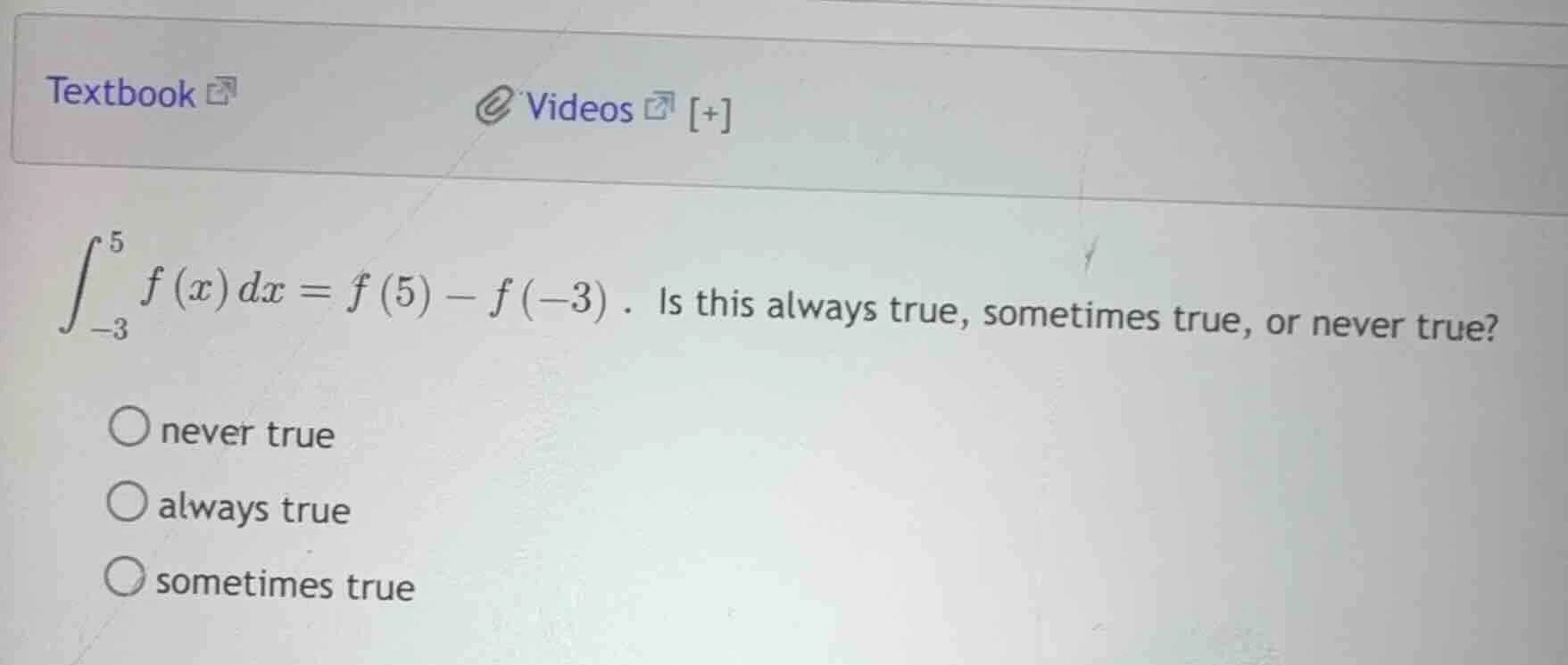
$$\int_{-3}^{5} f(x) dx = f(5) - f(-3)$$. is this always true, sometimes true, or never true? \
\
\bigcirc never true \
\bigcirc always true \
\bigcirc sometimes true
Step1: Recall Fundamental Theorem of Calculus
The Fundamental Theorem of Calculus, Part 2, states that if \( F(x) \) is an antiderivative of \( f(x) \) (i.e., \( F'(x)=f(x) \)) and \( f(x) \) is continuous on the interval \([a,b]\), then \(\int_{a}^{b} f(x) dx = F(b) - F(a)\).
Step2: Analyze the Given Equation
The given equation is \(\int_{-3}^{5} f(x) dx = f(5) - f(-3)\). For this to hold, \( f(x) \) would need to be its own antiderivative, meaning \( F(x)=f(x) \), so \( F'(x)=f'(x)=f(x) \). This is only true for specific functions (e.g., \( f(x)=0 \) or \( f(x)=e^x \) since the derivative of \( e^x \) is \( e^x \)). However, for most functions, \( f(x) \) is not its own antiderivative. But there exist some functions (like \( f(x)=0 \) or \( f(x)=e^x \)) where if we take \( F(x)=f(x) \) (since their derivatives equal themselves), then \(\int_{-3}^{5} f(x) dx = F(5)-F(-3)=f(5)-f(-3)\). So it's not always true (because most functions don't satisfy \( f'(x)=f(x) \)), but it can be true for some functions.

Snap & solve any problem in the app
Get step-by-step solutions on Sovi AI
Photo-based solutions with guided steps
Explore more problems and detailed explanations
sometimes true (corresponding to the option: sometimes true)