QUESTION IMAGE
Question
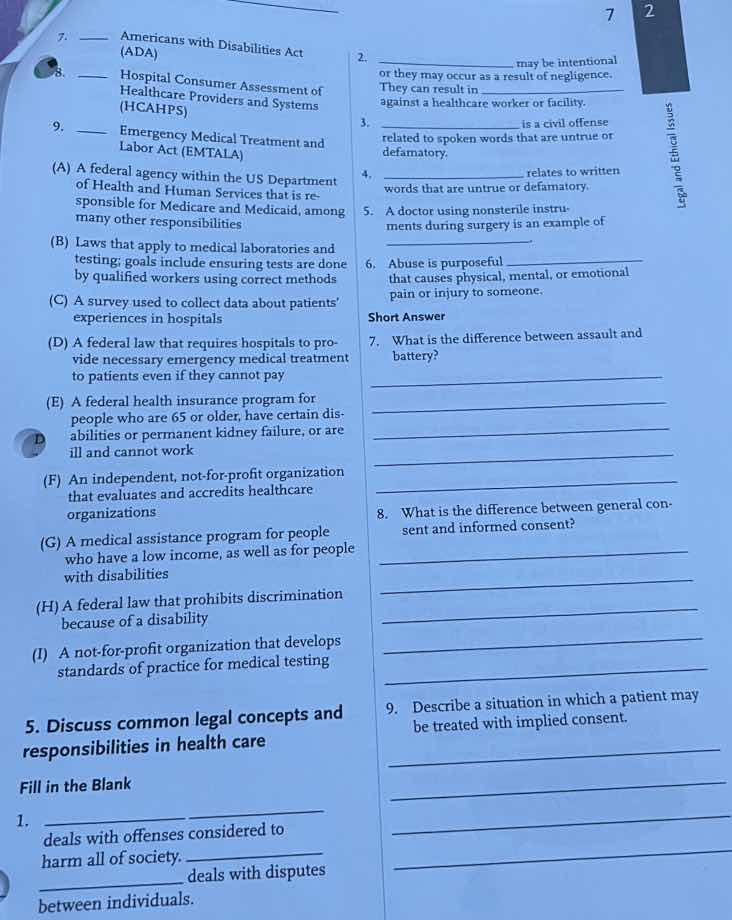
- ___ americans with disabilities act (ada)
- ___ hospital consumer assessment of healthcare providers and systems (hcahps)
- ___ emergency medical treatment and labor act (emtala)
(a) a federal agency within the us department of health and human services that is responsible for medicare and medicaid, among many other responsibilities
(b) laws that apply to medical laboratories and testing; goals include ensuring tests are done by qualified workers using correct methods
(c) a survey used to collect data about patients’ experiences in hospitals
(d) a federal law that requires hospitals to provide necessary emergency medical treatment to patients even if they cannot pay
(e) a federal health insurance program for people who are 65 or older, or have certain disabilities or permanent kidney failure, or are ill and cannot work
(f) an independent, not - for - profit organization that evaluates and accredits healthcare organizations
(g) a medical assistance program for people who have a low income, as well as for people with disabilities
(h) a federal law that prohibits discrimination because of a disability
(i) a not - for - profit organization that develops standards of practice for medical testing
- discuss common legal concepts and responsibilities in health care
fill in the blank
- _ deals with offenses considered to harm all of society. _ deals with disputes between individuals.
- _ may be intentional or they may occur as a result of negligence. they can result in _ against a healthcare worker or facility.
- ___ is a civil offense related to spoken words that are untrue or defamatory.
- ___ relates to written words that are untrue or defamatory.
- a doctor using nonsterile instruments during surgery is an example of ___.
- abuse is purposeful ___ that causes physical, mental, or emotional pain or injury to someone.
short answer
- what is the difference between assault and battery?
- what is the difference between general consent and informed consent?
- describe a situation in which a patient may be treated with implied consent.
Matching Section
- 7. Americans with Disabilities Act (ADA)
Matches (H): A federal law that prohibits discrimination because of a disability
- 8. Hospital Consumer Assessment of Healthcare Providers and Systems (HCAHPS)
Matches (C): A survey used to collect data about patients' experiences in hospitals
- 9. Emergency Medical Treatment and Labor Act (EMTALA)
Matches (D): A federal law that requires hospitals to provide necessary emergency medical treatment to patients even if they cannot pay
Fill in the Blank
- Criminal law addresses harms to society; civil law covers individual disputes.
- Torts are intentional/negligent acts leading to liability.
- Slander is spoken false/defamatory language.
- Libel is written false/defamatory language.
- An act of negligence is an accidental breach of duty.
- Intentional harm describes purposeful abusive acts.
- Assault is the threat of harm; battery is physical contact.
- General consent covers routine care; informed consent requires full disclosure.
- Implied consent applies when a patient cannot communicate.

Snap & solve any problem in the app
Get step-by-step solutions on Sovi AI
Photo-based solutions with guided steps
Explore more problems and detailed explanations
- Criminal law deals with offenses considered to harm all of society. Civil law deals with disputes between individuals.
- Torts may be intentional or they may occur as a result of negligence. They can result in lawsuits against a healthcare worker or facility.
- Slander is a civil offense related to spoken words that are untrue or defamatory.
- Libel relates to written words that are untrue or defamatory.
- A doctor using nonsterile instruments during surgery is an example of negligence.
- Abuse is purposeful intentional harm that causes physical, mental, or emotional pain or injury to someone.