QUESTION IMAGE
Question
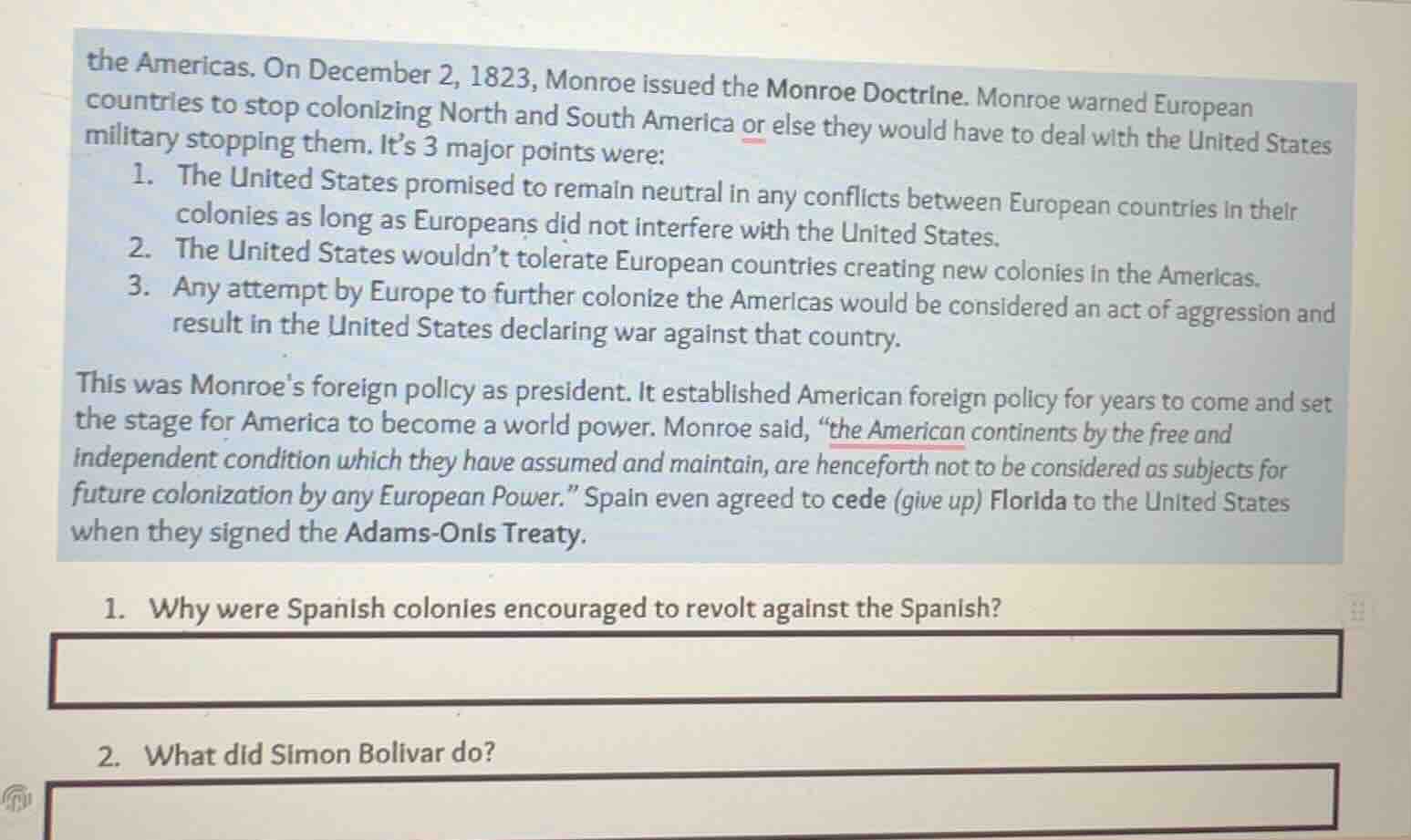
the americas. on december 2, 1823, monroe issued the monroe doctrine. monroe warned european countries to stop colonizing north and south america or else they would have to deal with the united states military stopping them. it’s 3 major points were:
- the united states promised to remain neutral in any conflicts between european countries in their colonies as long as europeans did not interfere with the united states.
- the united states wouldn’t tolerate european countries creating new colonies in the americas.
- any attempt by europe to further colonize the americas would be considered an act of aggression and result in the united states declaring war against that country.
this was monroe’s foreign policy as president. it established american foreign policy for years to come and set the stage for america to become a world power. monroe said, “the american continents by the free and independent condition which they have assumed and maintain, are henceforth not to be considered as subjects for future colonization by any european power.” spain even agreed to cede (give up) florida to the united states when they signed the adams-onís treaty.
- why were spanish colonies encouraged to revolt against the spanish?
- what did simon bolivar do?
Sub - Question 1
The Monroe Doctrine (1823) stated that the Americas were no longer open for European colonization. This gave a sense of support (implicit or perceived) to Spanish colonies. Also, the political climate of the time, with ideas of independence and self - governance spreading, combined with the fact that the US would oppose European interference in the Americas, made Spanish colonies feel they could revolt as they might get backing (or at least not face new European colonization attempts to suppress them) and had a chance to gain independence.
Simon Bolivar was a key figure in the Latin American wars of independence. He led revolutionary forces against Spanish rule. He played a major role in liberating several countries, including Venezuela, Colombia, Ecuador, Peru, and Bolivia (named after him). He was a military and political leader who united different regions in the fight against Spanish colonialism and helped establish independent states in South America.

Snap & solve any problem in the app
Get step-by-step solutions on Sovi AI
Photo-based solutions with guided steps
Explore more problems and detailed explanations
Spanish colonies were encouraged to revolt because the Monroe Doctrine (1823) declared the Americas off - limits to new European colonization, reducing the likelihood of new Spanish (or other European) efforts to suppress revolts. Also, the spread of independence - minded ideas and the US's stance against European interference in the Americas gave colonies the sense they could seek independence, with the US potentially opposing Spanish attempts to re - assert control.