QUESTION IMAGE
Question
analyzing central and circumscribed angles
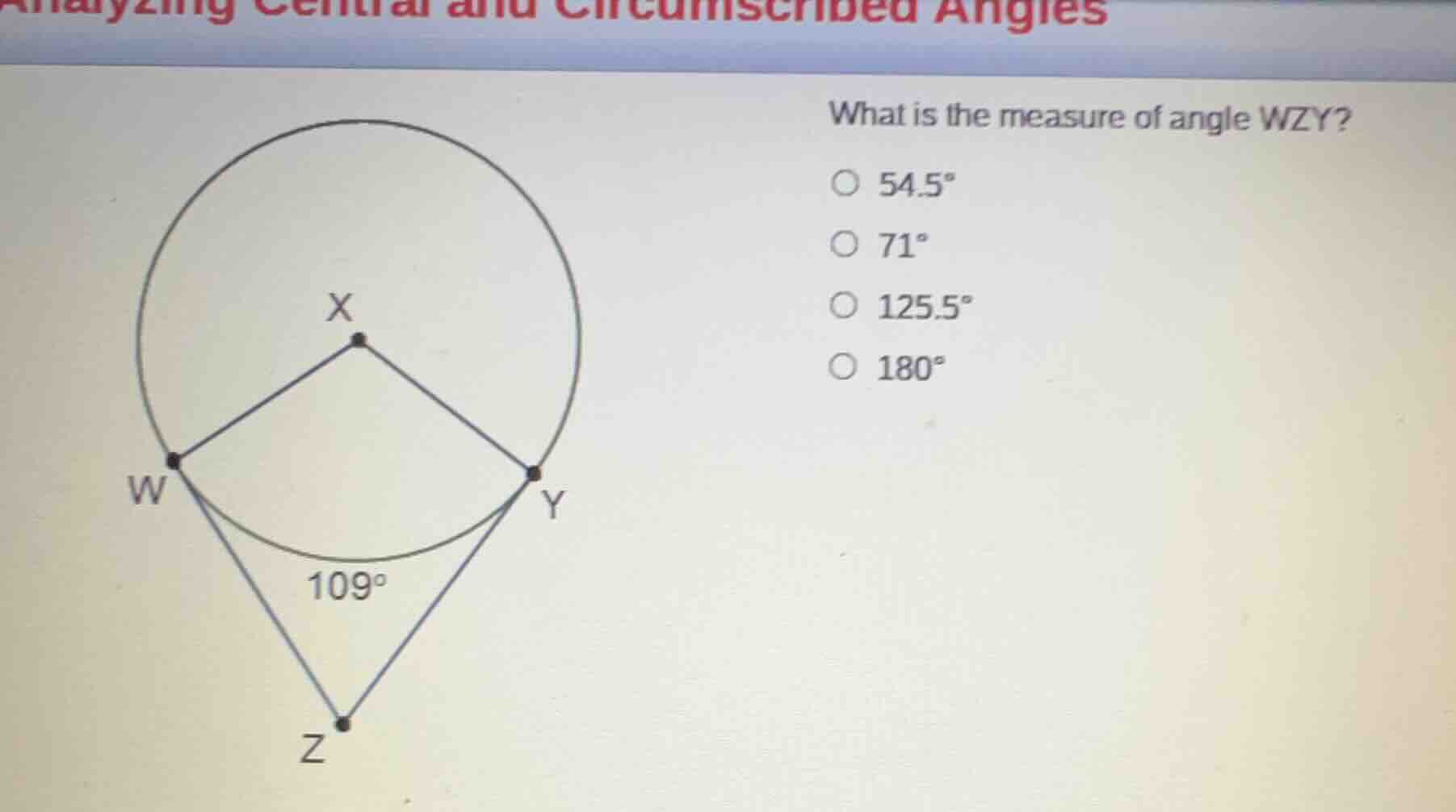
what is the measure of angle wzy?
○ 54.5°
○ 71°
○ 125.5°
○ 180°
(there is a circle with center x, points w and y on the circle. triangle wzy with z at the bottom, angle at z between wz and yz, and the arc wy has a measure of 109°)
Step1: Recall the property of tangents and quadrilaterals
Tangents to a circle from a common external point are equal, and the radius is perpendicular to the tangent at the point of contact. So, $\angle XWZ = \angle XYZ = 90^\circ$. In quadrilateral $XWZY$, the sum of interior angles is $360^\circ$. Let $\angle WZY = x$, $\angle WXY = 109^\circ$ (given the arc measure, but wait, actually, the central angle over the arc $WY$: Wait, no, the angle at $Z$ is $\angle WZY$, and we know that $ZW$ and $ZY$ are tangents, so $XW \perp ZW$ and $XY \perp ZY$. So quadrilateral $XWZY$ has two right angles at $W$ and $Y$. So sum of angles: $\angle XWZ + \angle WZY + \angle XYZ + \angle WXY = 360^\circ$. Wait, no, $\angle WXY$ is the central angle? Wait, the given angle at $Z$: Wait, the diagram shows that the arc $WY$ has a central angle? Wait, no, the angle between the two tangents: The measure of the angle between two tangents drawn from an external point to a circle is equal to the supplement of the measure of the central angle subtended by the intercepted arc. Wait, the formula is: If two tangents are drawn from an external point $Z$ to a circle with center $X$, touching the circle at $W$ and $Y$, then $\angle WZY + \angle WXY = 180^\circ$, where $\angle WXY$ is the central angle. Wait, no, actually, the sum of the angle between the tangents ($\angle WZY$) and the central angle ($\angle WXY$) is $180^\circ$? Wait, no, let's think again. The quadrilateral $XWZY$ has $\angle XWZ = 90^\circ$, $\angle XYZ = 90^\circ$, so $\angle WZY + \angle WXY = 180^\circ$ (since sum of angles in quadrilateral is $360^\circ$, so $90 + 90 + \angle WZY + \angle WXY = 360 \implies \angle WZY + \angle WXY = 180^\circ$). Wait, but the given angle: Wait, the problem shows that the angle at $Z$: Wait, maybe I made a mistake. Wait, the angle between the two tangents is $\angle WZY$, and the central angle over the arc $WY$ is $\angle WXY$. The formula for the angle between two tangents is: $\angle WZY = \frac{1}{2} ( \text{major arc } WY - \text{minor arc } WY )$. But also, the sum of major and minor arcs is $360^\circ$. Alternatively, since the tangents form a quadrilateral with the two radii, which are perpendicular to the tangents, so the angle between the tangents and the central angle are supplementary. Wait, let's use the quadrilateral angle sum. Let $\angle WZY = x$, $\angle WXY = 109^\circ$ (wait, no, the diagram has a $109^\circ$ angle? Wait, the user's diagram: "109°" is at the bottom, between $ZW$ and $ZY$? No, wait, the diagram shows a circle with center $X$, points $W$ and $Y$ on the circle, tangents from $Z$ to $W$ and $Y$, so $ZW$ and $ZY$ are tangents, $XW$ and $XY$ are radii. So $\angle XWZ = 90^\circ$, $\angle XYZ = 90^\circ$. Then in quadrilateral $XWZY$, sum of angles is $360^\circ$. So $90 + x + 90 + \angle WXY = 360$. Wait, but what is $\angle WXY$? Wait, maybe the $109^\circ$ is the measure of the arc $WY$, so the central angle $\angle WXY$ is equal to the measure of the arc $WY$, which is $109^\circ$? Wait, no, central angle is equal to the arc measure. Wait, if the arc $WY$ is $109^\circ$, then $\angle WXY = 109^\circ$. Then, $90 + x + 90 + 109 = 360$. Wait, that would be $289 + x = 360 \implies x = 71^\circ$. Yes, that makes sense. So the measure of $\angle WZY$ is $71^\circ$.
Step2: Calculate the angle
Using the quadrilateral angle sum property:
Sum of interior angles of a quadrilateral is $360^\circ$.
We know $\angle XWZ = 90^\circ$ (radius perpendicular to tangent), $\angle XYZ = 90^\circ$ (same reason), $\angle WXY = 109^\circ$ (centra…

Snap & solve any problem in the app
Get step-by-step solutions on Sovi AI
Photo-based solutions with guided steps
Explore more problems and detailed explanations
$71^\circ$ (corresponding to the option "71°")