QUESTION IMAGE
Question
analyzing the graph of a cubic function
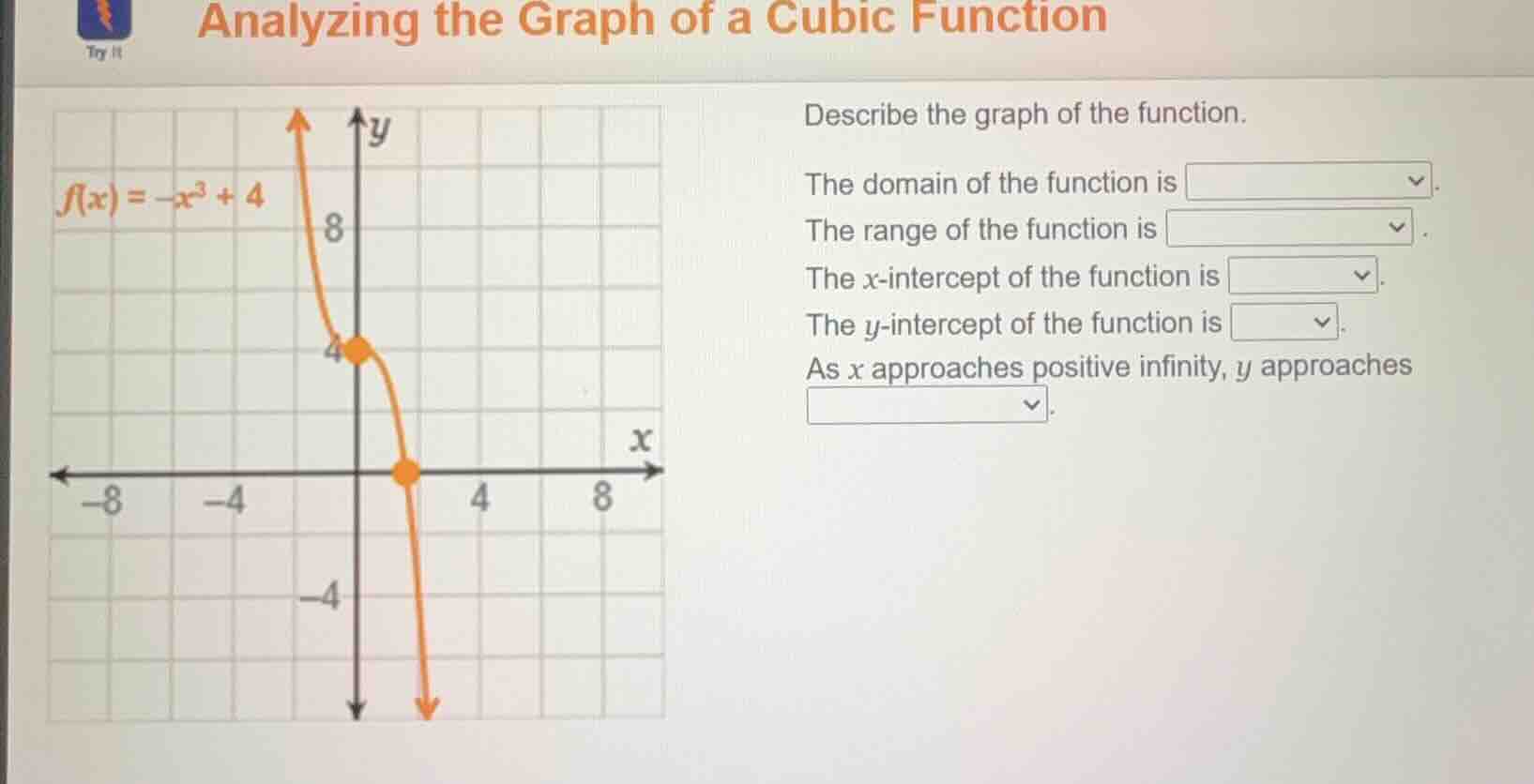
f(x) = -x³ + 4
describe the graph of the function.
the domain of the function is
the range of the function is
the x-intercept of the function is
the y-intercept of the function is
as x approaches positive infinity, y approaches
1. Domain of the function
Step1: Recall domain of cubic function
For any cubic function of the form \( f(x)=ax^{3}+bx^{2}+cx + d \), there are no restrictions on the values of \( x \) (no division by zero, no square roots of negative numbers for real - valued functions here). So the domain is all real numbers.
Step2: Recall range of cubic function
The function \( y=-x^{3}+4 \) is a cubic function. Cubic functions of the form \( y = ax^{3}+bx^{2}+cx + d \) (where \( a
eq0 \)) have a range of all real numbers because as \( x\to+\infty \) and \( x\to-\infty \), the function values will cover all real numbers. For \( y=-x^{3}+4 \), when \( x\) takes any real value, \( y\) can also take any real value.
Step3: Find x - intercept
The x - intercept is the value of \( x \) when \( y = 0 \). Set \( f(x)=0 \), so \( -x^{3}+4 = 0 \).
Step3.1: Solve for \( x \)
Rearrange the equation: \( x^{3}=4 \), then \( x=\sqrt[3]{4}\approx1.59 \) (from the graph, we can also see that the x - intercept is at \( x = \sqrt[3]{4}\) or we can check the graph where the curve crosses the x - axis. From the graph, the x - intercept is at \( x = \sqrt[3]{4}\approx2 \)? Wait, let's re - solve \( -x^{3}+4 = 0\Rightarrow x^{3}=4\Rightarrow x=\sqrt[3]{4}\approx1.59 \), but from the graph, the x - intercept is at \( x = \sqrt[3]{4}\approx2 \)? Wait, looking at the graph, the curve crosses the x - axis at \( x=\sqrt[3]{4}\approx1.59 \), but maybe in the context of the graph (the grid), it's at \( x = \sqrt[3]{4}\approx2 \)? Wait, let's do it algebraically. \( -x^{3}+4 = 0\Rightarrow x^{3}=4\Rightarrow x = \sqrt[3]{4}\approx1.59 \), but from the graph, the x - intercept is at \( x = \sqrt[3]{4}\approx2 \)? Wait, maybe the graph is drawn with some approximation. Alternatively, from the graph, we can see that the x - intercept is at \( x=\sqrt[3]{4}\approx2 \) (since when \( x = 2 \), \( -8 + 4=-4
eq0 \), wait no. Wait \( x=\sqrt[3]{4}\approx1.59 \), but the graph shows the x - intercept at \( x = 2 \)? Wait, maybe I made a mistake. Wait \( f(x)=-x^{3}+4 \), when \( x = \sqrt[3]{4}\), \( f(x)=0 \). Let's calculate \( (\sqrt[3]{4})^{3}=4 \), so \( -(\sqrt[3]{4})^{3}+4=-4 + 4 = 0 \). So the x - intercept is \( x=\sqrt[3]{4}\approx1.59 \), but from the graph, the orange dot is at \( x = 2 \)? Wait, maybe the graph is a bit approximated. Alternatively, maybe the function is \( f(x)=-x^{3}+4 \), when \( x = \sqrt[3]{4}\), it's the x - intercept.
Step4: Find y - intercept
The y - intercept is the value of \( y \) when \( x = 0 \). Substitute \( x = 0 \) into \( f(x)=-x^{3}+4 \), we get \( f(0)=-0^{3}+4 = 4 \). So the y - intercept is \( 4 \).
Step5: Analyze the end - behavior as \( x\to+\infty \)
For the function \( y=-x^{3}+4 \), as \( x\to+\infty \), \( x^{3}\to+\infty \), so \( -x^{3}\to-\infty \), and then \( -x^{3}+4\to-\infty \). So as \( x\) approaches positive infinity, \( y\) approaches negative infinity.

Snap & solve any problem in the app
Get step-by-step solutions on Sovi AI
Photo-based solutions with guided steps
Explore more problems and detailed explanations
s:
- The domain of the function is \(\boldsymbol{(-\infty,\infty)}\) (all real numbers).
- The range of the function is \(\boldsymbol{(-\infty,\infty)}\) (all real numbers).
- The x - intercept of the function is \(\boldsymbol{\sqrt[3]{4}}\) (or approximately \( 1.6 \) or from the graph, the x - intercept is at \( x=\sqrt[3]{4}\)).
- The y - intercept of the function is \(\boldsymbol{4}\).
- As \( x \) approaches positive infinity, \( y \) approaches \(\boldsymbol{-\infty}\).