QUESTION IMAGE
Question
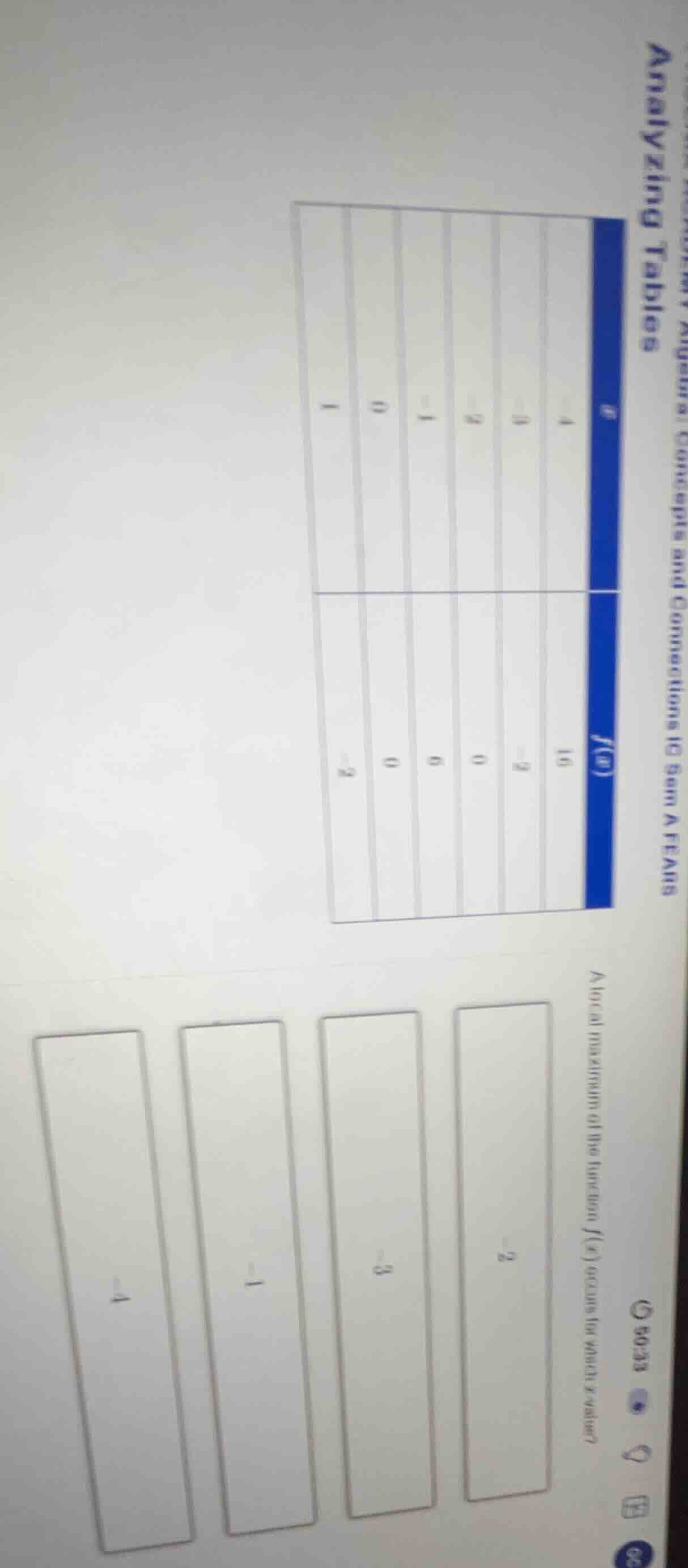
analyzing tables a local maximum of the function ( f(x) ) occurs for which ( x )-value? -4 -1 -3 -2 (table with ( x ) values: -4, -3, -2, -1, 0, 1 and ( f(x) ) values: 16, -3, 0, 5, 0, -2)
Step1: Define local maximum
A local maximum at $x=a$ means $f(a)$ is greater than $f(x)$ for nearby $x$.
Step2: Compare adjacent function values
Check each $x$:
- $x=-4$: $f(-4)=10$, $f(-3)=-2$ → $10 > -2$, but no left neighbor; not local max.
- $x=-3$: $f(-3)=-2$, $f(-4)=10$, $f(-2)=0$ → $-2 < 10$ and $-2 < 0$; not local max.
- $x=-2$: $f(-2)=0$, $f(-3)=-2$, $f(-1)=6$ → $0 < 6$; not local max.
- $x=-1$: $f(-1)=6$, $f(-2)=0$, $f(0)=0$ → $6 > 0$ and $6 > 0$; this is a local max.
- $x=0$: $f(0)=0$, $f(-1)=6$, $f(1)=-2$ → $0 < 6$; not local max.
- $x=1$: $f(1)=-2$, $f(0)=0$ → $-2 < 0$, no right neighbor; not local max.

Snap & solve any problem in the app
Get step-by-step solutions on Sovi AI
Photo-based solutions with guided steps
Explore more problems and detailed explanations
-1