QUESTION IMAGE
Question
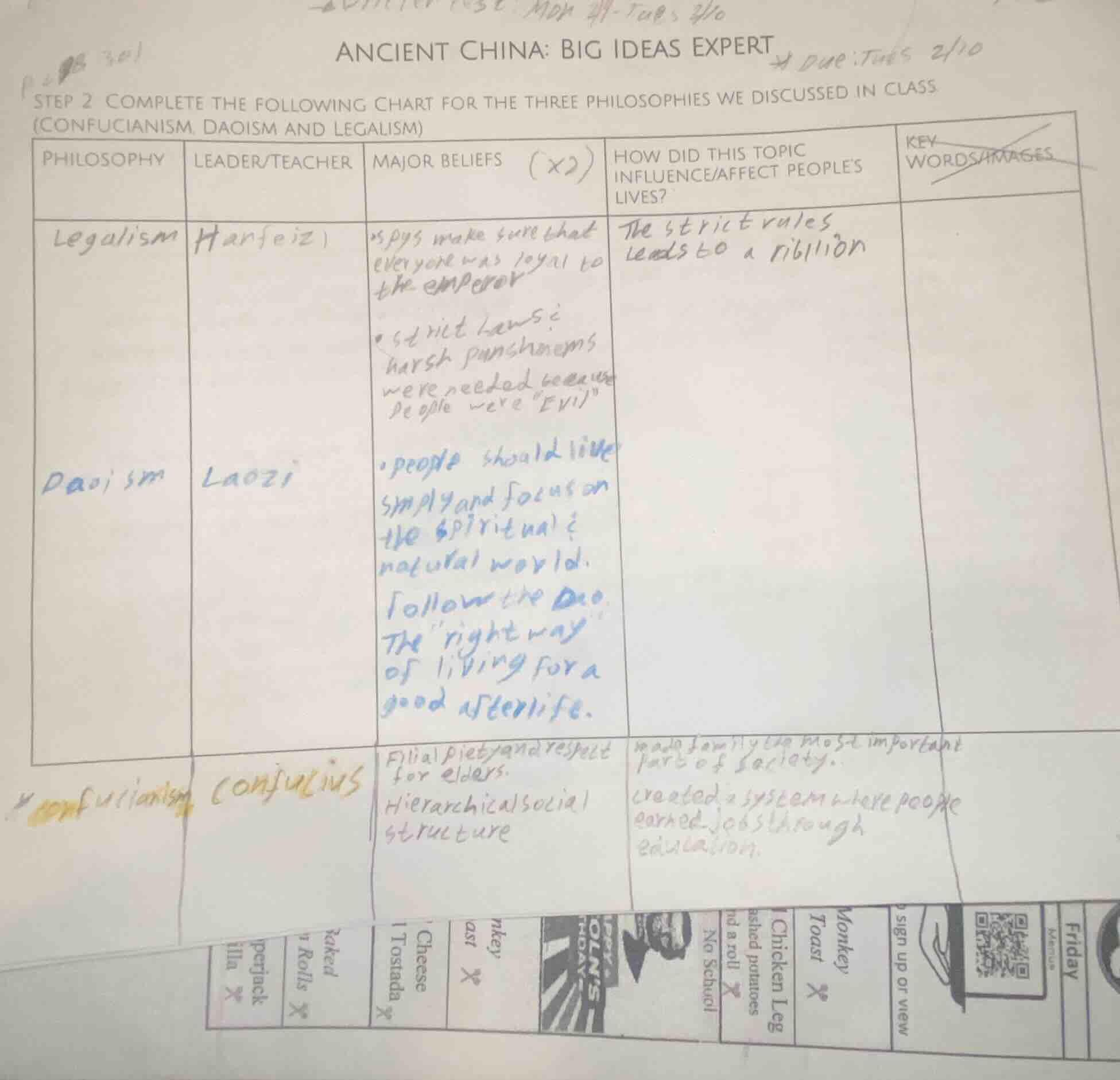
ancient china: big ideas expert
step 2 complete the following chart for the three philosophies we discussed in class (confucianism, daoism and legalism)
| philosophy | leader/teacher | major beliefs (×2) | how did this topic influence/affect peoples lives? | key words/images |
|---|---|---|---|---|
| daoism | laozi | people should live simply and focus on the spiritual & natural world; follow the dao. the right way of living for a good afterlife. | ||
| confucianism | confucius | filial piety and respect for elders; hierarchical social structure | made family the most important part of society; created a system where people earned jobs through education |
To complete the chart for the three philosophies (Confucianism, Daoism, and Legalism) in Ancient China, we analyze each section:
1. Legalism
- Leader/Teacher: Hanfeizi (correct, as Han Feizi is the key figure of Legalism).
- Major Beliefs:
- Spies ensure loyalty to the emperor (to maintain control).
- Strict laws and harsh punishments (because people are “evil” by nature, so strict governance is needed).
- How Did This Influence Lives?
The strict rules led to rebellion (since overly harsh laws often spark resistance).
- Key Words/Images: Law, Punishment, Emperor, Control.
2. Daoism
- Leader/Teacher: Laozi (correct, founder of Daoism).
- Major Beliefs:
- Live simply, focus on the spiritual and natural world (harmony with nature, minimalism).
- Follow the Dao (the “right way” of living for a good afterlife) (emphasizes aligning with the natural order).
- How Did This Influence Lives?
Daoism encouraged people to seek inner peace, live in harmony with nature, and avoid excessive ambition or conflict. It influenced art, literature, and personal spirituality (e.g., practices like meditation).
- Key Words/Images: Dao, Nature, Simplicity, Harmony.
3. Confucianism
- Leader/Teacher: Confucius (correct, founder of Confucianism).
- Major Beliefs:
- Filial piety (respect for elders) and hierarchical social structure (family and society follow a hierarchy: ruler-subject, parent-child, etc.).
- How Did This Influence Lives?
- Made family the most important part of society (filial piety strengthened family bonds).
- Created a system where people earned jobs through education (meritocracy, valuing learning and moral virtue for social mobility).
- Key Words/Images: Filial Piety, Hierarchy, Education, Family.
Final Chart (Completed)
| Philosophy | Leader/Teacher | Major Beliefs (×2) | How Did This Influence/Affect People’s Lives? | Key Words/Images |
|---|---|---|---|---|
| Daoism | Laozi | 1. Live simply, focus on spiritual/natural world<br>2. Follow the Dao (right way for afterlife) | Encouraged harmony with nature, inner peace, and spiritual reflection (influenced art, spirituality). | Dao, Nature, Simplicity |
| Confucianism | Confucius | 1. Filial piety/respect for elders<br>2. Hierarchical social structure | 1. Made family central to society<br>2. Created education-based job system (meritocracy). | Filial Piety, Hierarchy, Education |
This chart organizes the core ideas and impacts of each philosophy in Ancient China.

Snap & solve any problem in the app
Get step-by-step solutions on Sovi AI
Photo-based solutions with guided steps
Explore more problems and detailed explanations
To complete the chart for the three philosophies (Confucianism, Daoism, and Legalism) in Ancient China, we analyze each section:
1. Legalism
- Leader/Teacher: Hanfeizi (correct, as Han Feizi is the key figure of Legalism).
- Major Beliefs:
- Spies ensure loyalty to the emperor (to maintain control).
- Strict laws and harsh punishments (because people are “evil” by nature, so strict governance is needed).
- How Did This Influence Lives?
The strict rules led to rebellion (since overly harsh laws often spark resistance).
- Key Words/Images: Law, Punishment, Emperor, Control.
2. Daoism
- Leader/Teacher: Laozi (correct, founder of Daoism).
- Major Beliefs:
- Live simply, focus on the spiritual and natural world (harmony with nature, minimalism).
- Follow the Dao (the “right way” of living for a good afterlife) (emphasizes aligning with the natural order).
- How Did This Influence Lives?
Daoism encouraged people to seek inner peace, live in harmony with nature, and avoid excessive ambition or conflict. It influenced art, literature, and personal spirituality (e.g., practices like meditation).
- Key Words/Images: Dao, Nature, Simplicity, Harmony.
3. Confucianism
- Leader/Teacher: Confucius (correct, founder of Confucianism).
- Major Beliefs:
- Filial piety (respect for elders) and hierarchical social structure (family and society follow a hierarchy: ruler-subject, parent-child, etc.).
- How Did This Influence Lives?
- Made family the most important part of society (filial piety strengthened family bonds).
- Created a system where people earned jobs through education (meritocracy, valuing learning and moral virtue for social mobility).
- Key Words/Images: Filial Piety, Hierarchy, Education, Family.
Final Chart (Completed)
| Philosophy | Leader/Teacher | Major Beliefs (×2) | How Did This Influence/Affect People’s Lives? | Key Words/Images |
|---|---|---|---|---|
| Daoism | Laozi | 1. Live simply, focus on spiritual/natural world<br>2. Follow the Dao (right way for afterlife) | Encouraged harmony with nature, inner peace, and spiritual reflection (influenced art, spirituality). | Dao, Nature, Simplicity |
| Confucianism | Confucius | 1. Filial piety/respect for elders<br>2. Hierarchical social structure | 1. Made family central to society<br>2. Created education-based job system (meritocracy). | Filial Piety, Hierarchy, Education |
This chart organizes the core ideas and impacts of each philosophy in Ancient China.