QUESTION IMAGE
Question
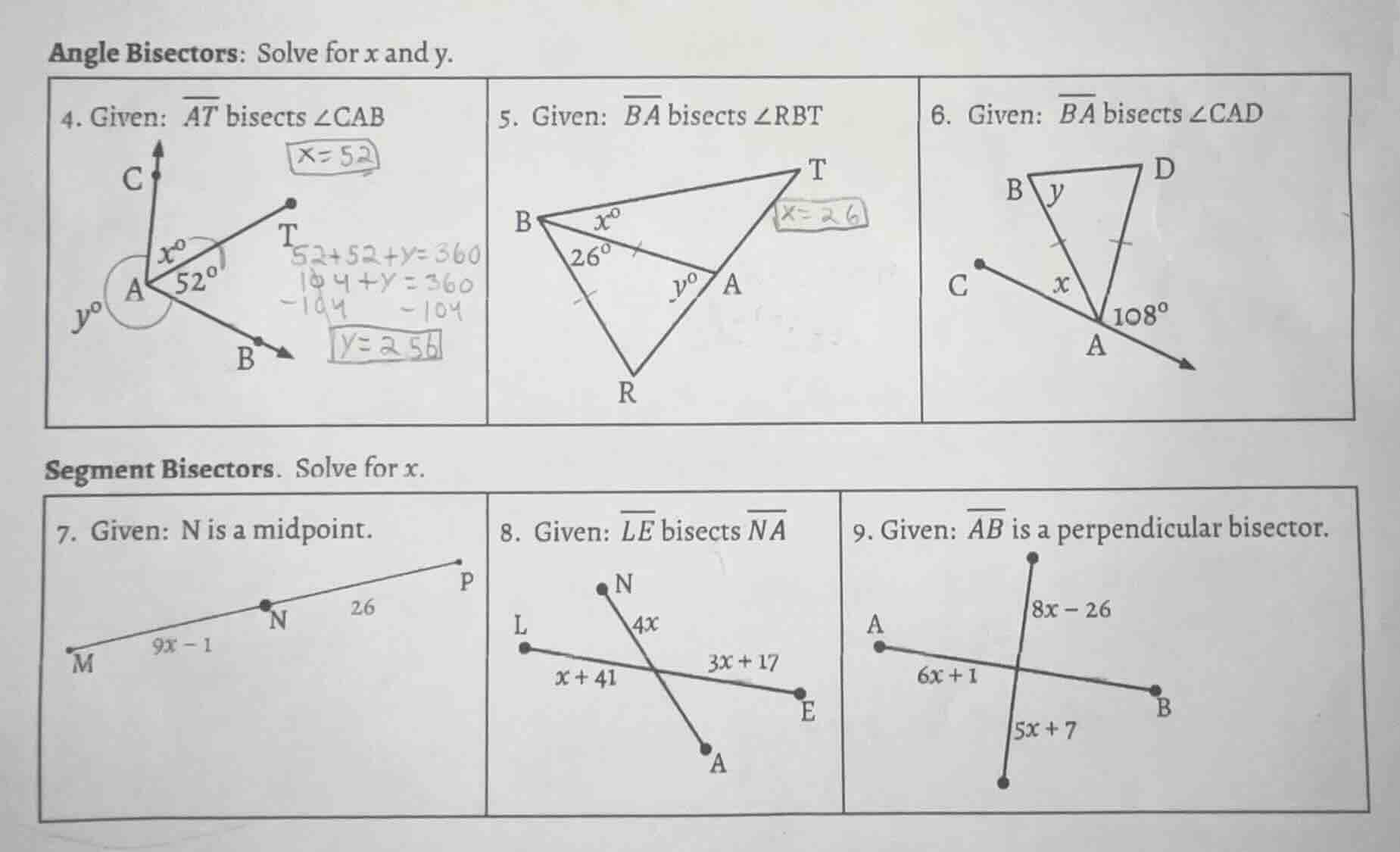
angle bisectors: solve for x and y.
- given: \\(\overline{at}\\) bisects \\(\angle cab\\)
- given: \\(\overline{ba}\\) bisects \\(\angle rbt\\)
- given: \\(\overline{ba}\\) bisects \\(\angle cad\\)
segment bisectors. solve for x.
- given: n is a midpoint.
- given: \\(\overline{le}\\) bisects \\(\overline{na}\\)
- given: \\(\overline{ab}\\) is a perpendicular bisector.
Problem 4:
Step1: Use Angle Bisector Definition
Since \( \overline{AT} \) bisects \( \angle CAB \), \( \angle CAT = \angle TAB = 52^\circ \), so \( x = 52 \).
Step2: Use Full Angle Sum
A full angle at \( A \) is \( 360^\circ \). So \( y + 52 + 52 = 360 \).
\[ y + 104 = 360 \]
Step3: Solve for \( y \)
Subtract 104 from both sides:
\[ y = 360 - 104 = 256 \]
Step1: Use Angle Bisector Definition
Since \( \overline{BA} \) bisects \( \angle RBT \), \( \angle RBA = \angle ABT = 26^\circ \), so \( x = 26 \).
Step2: Use Triangle Angle Sum (if needed, but here \( y \) in triangle: \( 180 - 26 - 26 - \angle T \), but from diagram, likely \( y = 180 - 26 - 26 = 128 \)? Wait, no, the diagram shows \( y \) as the angle at \( A \). Wait, in triangle \( RBA \), if \( \angle RBA = 26^\circ \), \( \angle R = 90^\circ \) (maybe isoceles), so \( y = 180 - 26 - 26 = 128 \)? But the given \( x = 26 \), so \( x = 26 \), and \( y = 180 - 26 - 26 = 128 \) (assuming triangle angle sum).
Step1: Use Angle Bisector and Linear Pair
\( \angle CAD \) and \( 108^\circ \) are linear pair? Wait, \( \overline{BA} \) bisects \( \angle CAD \), so \( \angle CAB = \angle BAD = x \). The straight line at \( A \): \( x + x + 108 = 180 \) (linear pair sum to \( 180^\circ \))? Wait, no, the diagram: \( \angle CAD \) is bisected by \( BA \), so \( \angle CAB = \angle BAD = x \), and \( \angle CAD + 108^\circ = 180^\circ \) (linear pair). So \( 2x + 108 = 180 \).
Step2: Solve for \( x \)
\[ 2x = 180 - 108 = 72 \]
\[ x = 36 \]
Step3: Use Triangle Angle Sum (triangle \( BAD \) is isoceles, so \( y = 180 - 36 - 36 = 108 \)? Wait, no, \( \angle BAD = x = 36 \), \( \angle ADB = 36 \) (isoceles), so \( y = 180 - 36 - 36 = 108 \)? Wait, no, the angle at \( B \) is \( y \), so \( y = 180 - 36 - 36 = 108 \)? Wait, maybe:
Linear pair: \( \angle CAD + 108^\circ = 180^\circ \) ⇒ \( \angle CAD = 72^\circ \). Bisected by \( BA \), so \( \angle CAB = \angle BAD = 36^\circ \) (so \( x = 36 \)). Then in triangle \( BAD \), \( \angle BAD = 36^\circ \), \( \angle ADB = 36^\circ \) (isoceles), so \( y = 180 - 36 - 36 = 108^\circ \).

Snap & solve any problem in the app
Get step-by-step solutions on Sovi AI
Photo-based solutions with guided steps
Explore more problems and detailed explanations
\( x = 52 \), \( y = 256 \)