QUESTION IMAGE
Question
angles challenge 2
name
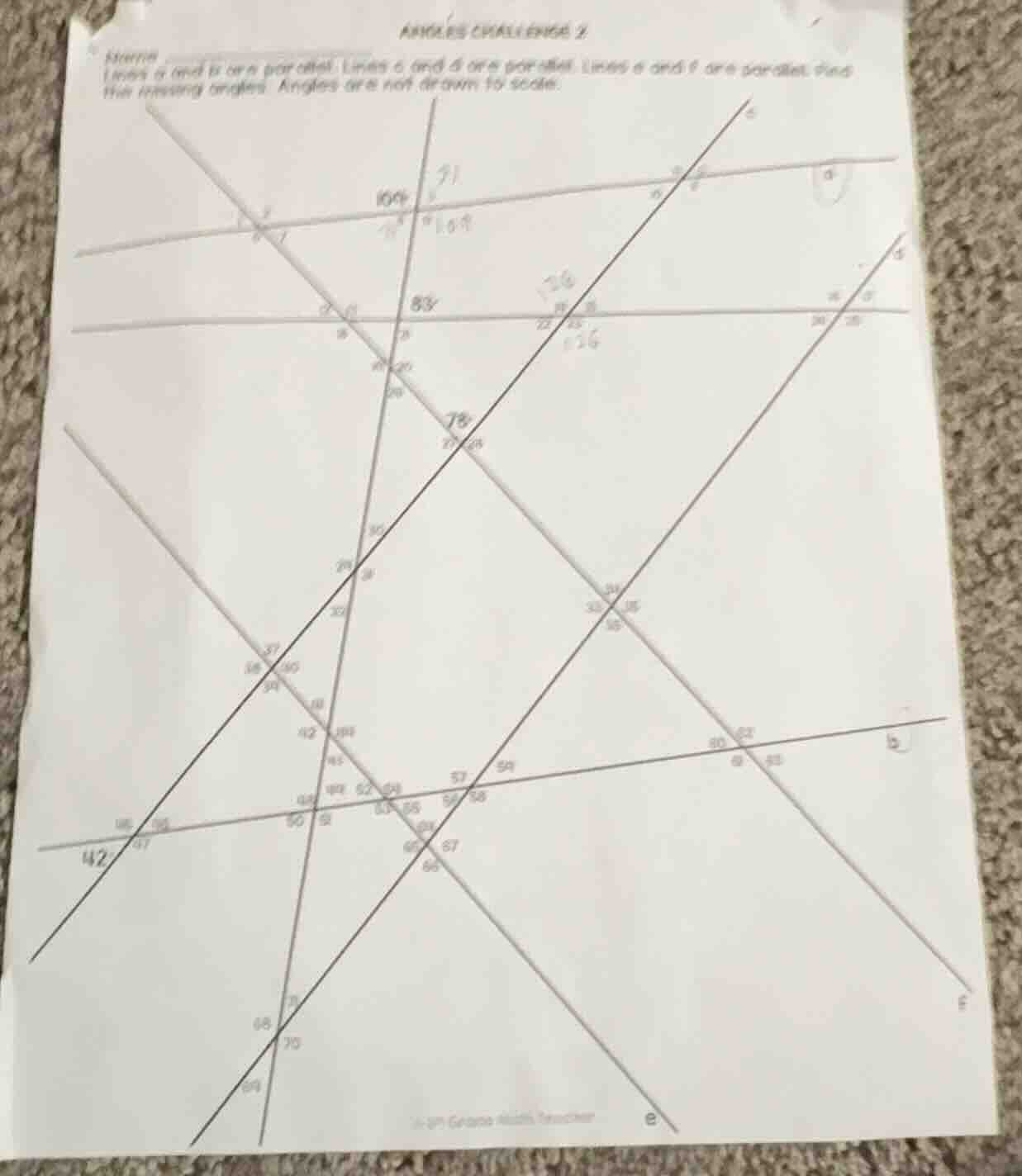
lines a and b are parallel. lines c and d are parallel. lines e and f are parallel. find the missing angles. angles are not drawn to scale.
Step1: Identify Angle Relationships
Given parallel lines and transversals, we use properties like supplementary angles (sum to \(180^\circ\)) and corresponding angles (equal for parallel lines). For example, if a known angle is \(142^\circ\), its supplementary angle is \(180 - 142 = 38^\circ\) (linear pair).
Step2: Apply Corresponding Angles
For parallel lines \(a\parallel b\) and transversal \(c\), corresponding angles are equal. If one angle is \(38^\circ\), the corresponding angle on the other parallel line is also \(38^\circ\).
Step3: Use Vertical Angles
Vertical angles are equal. If an angle and its vertical angle are formed, they have the same measure. For example, if an angle is \(78^\circ\), its vertical angle is also \(78^\circ\).
Step4: Calculate Remaining Angles
For angles in a triangle or linear pairs, sum of angles in a triangle is \(180^\circ\), and linear pairs sum to \(180^\circ\). For example, if two angles in a triangle are \(57^\circ\) and \(59^\circ\), the third is \(180 - 57 - 59 = 64^\circ\).

Snap & solve any problem in the app
Get step-by-step solutions on Sovi AI
Photo-based solutions with guided steps
Explore more problems and detailed explanations
The missing angles are calculated using angle properties (supplementary, corresponding, vertical angles) as follows (examples):
- Linear pair with \(142^\circ\): \(38^\circ\)
- Corresponding to \(38^\circ\): \(38^\circ\)
- Vertical to \(78^\circ\): \(78^\circ\)
- Third angle in triangle with \(57^\circ, 59^\circ\): \(64^\circ\)
(Note: Specific angles depend on the diagram's labeled positions, but the method uses angle relationships for parallel lines and transversals.)