QUESTION IMAGE
Question
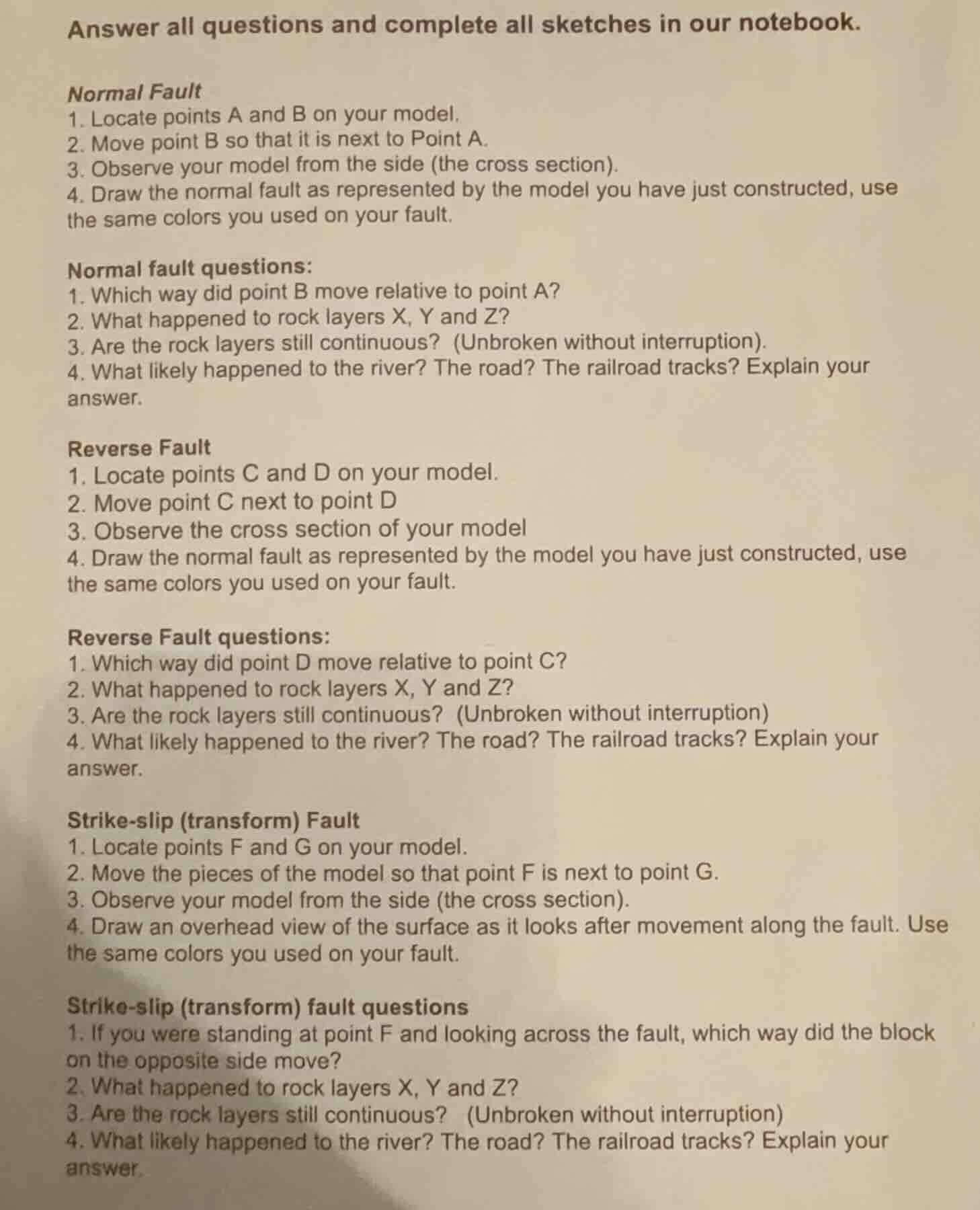
answer all questions and complete all sketches in our notebook.
normal fault
- locate points a and b on your model.
- move point b so that it is next to point a.
- observe your model from the side (the cross section).
- draw the normal fault as represented by the model you have just constructed, use the same colors you used on your fault.
normal fault questions:
- which way did point b move relative to point a?
- what happened to rock layers x, y and z?
- are the rock layers still continuous? (unbroken without interruption).
- what likely happened to the river? the road? the railroad tracks? explain your answer.
reverse fault
- locate points c and d on your model.
- move point c next to point d
- observe the cross section of your model
- draw the normal fault as represented by the model you have just constructed, use the same colors you used on your fault.
reverse fault questions:
- which way did point d move relative to point c?
- what happened to rock layers x, y and z?
- are the rock layers still continuous? (unbroken without interruption)
- what likely happened to the river? the road? the railroad tracks? explain your answer.
strike - slip (transform) fault
- locate points f and g on your model.
- move the pieces of the model so that point f is next to point g.
- observe your model from the side (the cross section).
- draw an overhead view of the surface as it looks after movement along the fault. use the same colors you used on your fault.
strike - slip (transform) fault questions
- if you were standing at point f and looking across the fault, which way did the block on the opposite side move?
- what happened to rock layers x, y and z?
- are the rock layers still continuous? (unbroken without interruption)
- what likely happened to the river? the road? the railroad tracks? explain your answer.
Brief Explanations
Normal Fault Questions
- In a normal fault, the hanging wall (where point B is typically located) moves downward relative to the footwall (point A).
- The rock layers X, Y, Z are offset; the hanging wall layers shift down, creating a step-like break.
- No, the rock layers are broken and no longer continuous.
- River: It will form a waterfall or steep rapids at the fault, as the riverbed is offset. Road/railroad: They will be broken and offset, with one section lower than the other, making them impassable until repaired.
Reverse Fault Questions
- In a reverse fault, the hanging wall (point D) moves upward relative to the footwall (point C).
- The rock layers X, Y, Z are offset, with the hanging wall layers pushed up and over the footwall layers, causing some layers to be overlapped.
- No, the rock layers are broken and discontinuous.
- River: It will flow backward or form a lake at the fault scarp, as the upstream side is now higher. Road/railroad: They will be broken, with one section raised above the other, creating a steep, impassable step.
Strike-slip (Transform) Fault Questions
- If standing at point F, the opposite block will move either left or right (if it's a right-lateral fault, the block moves right; left-lateral, it moves left).
- The rock layers X, Y, Z are offset horizontally but remain at the same vertical level.
- No, the rock layers are horizontally broken and discontinuous.
- River: It will be offset horizontally, creating a zigzag bend at the fault. Road/railroad: They will be horizontally offset, with the two sections no longer aligned, making them impassable.

Snap & solve any problem in the app
Get step-by-step solutions on Sovi AI
Photo-based solutions with guided steps
Explore more problems and detailed explanations
Normal Fault Answers
- Point B moved downward relative to point A.
- The rock layers are offset downward on one side of the fault.
- No
- River: Forms a waterfall/rapids at the fault offset. Road/railroad: Broken and vertically offset, impassable.
Reverse Fault Answers
- Point D moved upward relative to point C.
- The rock layers are offset, with one side pushed over the other.
- No
- River: Forms a lake/backflow at the fault scarp. Road/railroad: Broken and vertically offset, impassable.
Strike-slip (Transform) Fault Answers
- The opposite block moves either left or right (lateral direction).
- The rock layers are offset horizontally.
- No
- River: Horizontally offset into a zigzag. Road/railroad: Horizontally offset, misaligned and impassable.