QUESTION IMAGE
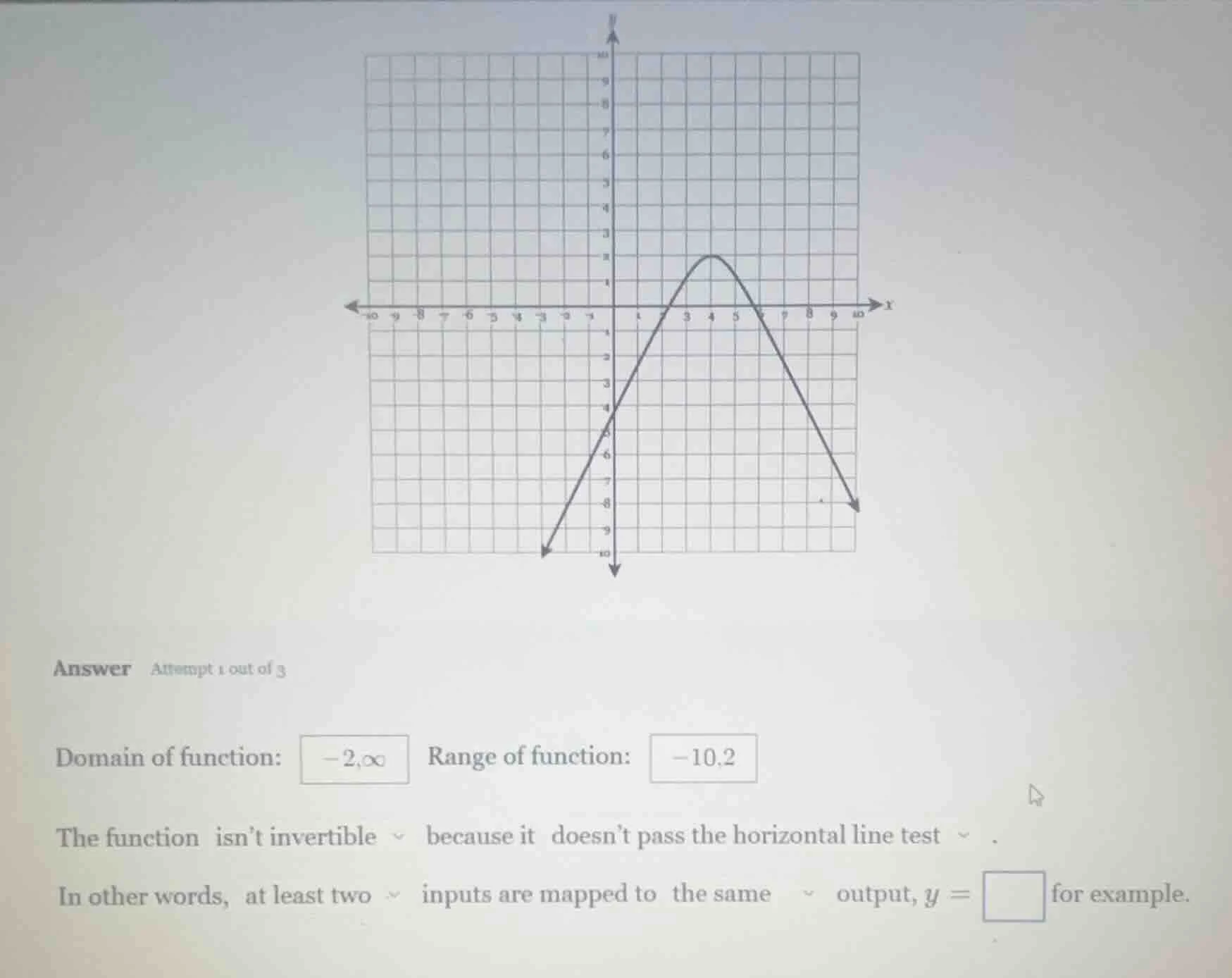
Question
answer attempt 1 out of 3
domain of function:
range of function:
the function isnt invertible because it doesnt pass the horizontal line test .
in other words, at least two inputs are mapped to the same output, y = for example.
Step1: Analyze the graph's symmetry or repeated y - values
Looking at the graph, we can see that the function is a parabola - like (but piece - wise) curve. For a function to not be invertible, there must be at least two different x - values that map to the same y - value. Let's find a y - value that is achieved by more than one x - value. From the graph, we can observe that when y = 0 (the x - axis), the function intersects the x - axis at two points (around x = 2 and x = 6, for example). Also, we can check other y - values. Let's consider the y - value of - 4. Wait, no, let's look at the linear part and the curved part. Wait, actually, let's find a y - value that has multiple x - inputs. Let's take y = 0. But also, let's check the y - value where the function is symmetric. Wait, another way: the function has a peak, and the left - hand side (the linear part from x=-2) and the right - hand side (the curved part after the peak) will have some overlapping y - values. Wait, let's look at the y - intercept. Wait, no, let's check the y - value of - 4? Wait, no, let's see the graph again. Wait, the function starts at x = - 2 (from the domain we can infer, but actually, looking at the graph, the left - most point is at x=-2, and then it goes up, peaks, and then goes down. Wait, but to find a y - value with two x - inputs, let's take y = 0. The function crosses the x - axis at x = 2 and x = 6 (approximately). But also, let's check the y - value of - 4? Wait, no, let's look at the linear part: when x=-2, what's the y - value? The left - most point is at x = - 2, and the y - value there is - 10? Wait, no, the graph's left - most arrow is at x=-2, going down to y=-10? Wait, no, the graph: the left part is a line from x=-2 (with arrow down, but wait, no, the graph has a left - hand segment from x=-2 (the left end) going up, intersecting the y - axis at (0, - 4), then going up to a peak at x = 4, y = 2, then going down, intersecting the x - axis at x = 6, and then going down to the right. Wait, so to find a y - value with two x - inputs, let's take y = - 4. Wait, when x = 0, y=-4. Is there another x with y=-4? Let's see, the left - hand line: the equation of the left - hand line (from x=-2 to the peak? No, the left - hand part is from x=-2 (the left end) to the point where it meets the curved part? Wait, maybe a better way: the function is not one - to - one, so there exists at least two x's, say \(x_1\) and \(x_2\) (\(x_1
eq x_2\)) such that \(f(x_1)=f(x_2)\). Let's look at the y - value of 0. The function crosses the x - axis at two points, so \(f(x_1)=0\) and \(f(x_2)=0\) with \(x_1
eq x_2\). But also, let's check the y - value of - 4. At x = 0, y=-4. Is there another x? Wait, the left - hand line: let's find the equation of the left - hand line. The left - hand line goes from (-2, - 10) to (0, - 4). The slope \(m=\frac{-4 - (-10)}{0 - (-2)}=\frac{6}{2}=3\). So the equation is \(y - (-10)=3(x - (-2))\), so \(y + 10 = 3(x + 2)\), \(y=3x+6 - 10=3x - 4\). The right - hand part: after the peak, it's a downward - opening curve? Wait, no, the peak is at (4, 2), and it goes down to the right. Let's see when y=-4 on the right - hand part. Wait, maybe it's easier to see that y = 0 is a y - value with two x - inputs. But also, let's check the y - value of - 4. Wait, at x = 0, y=-4. Is there another x? Let's solve 3x - 4=-4 (from the left - hand line equation). Then 3x=0, x = 0. On the right - hand side, let's assume the equation of the right - hand curve (after the peak). But maybe a simpler y - value: let's take y = - 4. Wait, no, maybe y = 0. Bu…

Snap & solve any problem in the app
Get step-by-step solutions on Sovi AI
Photo-based solutions with guided steps
Explore more problems and detailed explanations
Step1: Analyze the graph's symmetry or repeated y - values
Looking at the graph, we can see that the function is a parabola - like (but piece - wise) curve. For a function to not be invertible, there must be at least two different x - values that map to the same y - value. Let's find a y - value that is achieved by more than one x - value. From the graph, we can observe that when y = 0 (the x - axis), the function intersects the x - axis at two points (around x = 2 and x = 6, for example). Also, we can check other y - values. Let's consider the y - value of - 4. Wait, no, let's look at the linear part and the curved part. Wait, actually, let's find a y - value that has multiple x - inputs. Let's take y = 0. But also, let's check the y - value where the function is symmetric. Wait, another way: the function has a peak, and the left - hand side (the linear part from x=-2) and the right - hand side (the curved part after the peak) will have some overlapping y - values. Wait, let's look at the y - intercept. Wait, no, let's check the y - value of - 4? Wait, no, let's see the graph again. Wait, the function starts at x = - 2 (from the domain we can infer, but actually, looking at the graph, the left - most point is at x=-2, and then it goes up, peaks, and then goes down. Wait, but to find a y - value with two x - inputs, let's take y = 0. The function crosses the x - axis at x = 2 and x = 6 (approximately). But also, let's check the y - value of - 4? Wait, no, let's look at the linear part: when x=-2, what's the y - value? The left - most point is at x = - 2, and the y - value there is - 10? Wait, no, the graph's left - most arrow is at x=-2, going down to y=-10? Wait, no, the graph: the left part is a line from x=-2 (with arrow down, but wait, no, the graph has a left - hand segment from x=-2 (the left end) going up, intersecting the y - axis at (0, - 4), then going up to a peak at x = 4, y = 2, then going down, intersecting the x - axis at x = 6, and then going down to the right. Wait, so to find a y - value with two x - inputs, let's take y = - 4. Wait, when x = 0, y=-4. Is there another x with y=-4? Let's see, the left - hand line: the equation of the left - hand line (from x=-2 to the peak? No, the left - hand part is from x=-2 (the left end) to the point where it meets the curved part? Wait, maybe a better way: the function is not one - to - one, so there exists at least two x's, say \(x_1\) and \(x_2\) (\(x_1
eq x_2\)) such that \(f(x_1)=f(x_2)\). Let's look at the y - value of 0. The function crosses the x - axis at two points, so \(f(x_1)=0\) and \(f(x_2)=0\) with \(x_1
eq x_2\). But also, let's check the y - value of - 4. At x = 0, y=-4. Is there another x? Wait, the left - hand line: let's find the equation of the left - hand line. The left - hand line goes from (-2, - 10) to (0, - 4). The slope \(m=\frac{-4 - (-10)}{0 - (-2)}=\frac{6}{2}=3\). So the equation is \(y - (-10)=3(x - (-2))\), so \(y + 10 = 3(x + 2)\), \(y=3x+6 - 10=3x - 4\). The right - hand part: after the peak, it's a downward - opening curve? Wait, no, the peak is at (4, 2), and it goes down to the right. Let's see when y=-4 on the right - hand part. Wait, maybe it's easier to see that y = 0 is a y - value with two x - inputs. But also, let's check the y - value of - 4. Wait, at x = 0, y=-4. Is there another x? Let's solve 3x - 4=-4 (from the left - hand line equation). Then 3x=0, x = 0. On the right - hand side, let's assume the equation of the right - hand curve (after the peak). But maybe a simpler y - value: let's take y = - 4. Wait, no, maybe y = 0. But the problem is asking for a y - value with two x - inputs. Wait, looking at the graph, when y = 0, there are two x - values (x = 2 and x = 6, approximately). But also, let's check the y - value of - 4. Wait, no, let's look at the linear part and the curved part. Wait, the left - hand line is \(y = 3x-4\) (from x=-2 to, say, the point where it meets the curved part). The curved part: let's assume it's a quadratic function with vertex at (4, 2). The general form of a quadratic function is \(y=a(x - h)^2+k\), where (h,k)=(4,2). So \(y=a(x - 4)^2+2\). It passes through (6,0), so \(0=a(6 - 4)^2+2\), \(0 = 4a+2\), \(4a=-2\), \(a=-\frac{1}{2}\). So the equation of the curved part is \(y=-\frac{1}{2}(x - 4)^2+2\). Now, let's find a y - value that is in both the linear part and the curved part. Let's set \(3x-4=-\frac{1}{2}(x - 4)^2+2\). Multiply both sides by 2: \(6x-8=-(x^{2}-8x + 16)+4\), \(6x-8=-x^{2}+8x - 16 + 4\), \(6x-8=-x^{2}+8x - 12\), \(x^{2}-2x + 4 = 0\). Wait, that has no real solutions. So maybe the overlapping y - values are not in the linear and curved parts, but in the curved part? Wait, no, the curved part is symmetric about x = 4. So for the curved part, if we take x = 3 and x = 5, \(y=-\frac{1}{2}(3 - 4)^2+2=-\frac{1}{2}+2=\frac{3}{2}\), and \(y=-\frac{1}{2}(5 - 4)^2+2=-\frac{1}{2}+2=\frac{3}{2}\). So x = 3 and x = 5 give the same y - value of \(\frac{3}{2}\). But also, the linear part: when x = 0, y=-4; is there a point on the curved part with y=-4? Let's solve \(-\frac{1}{2}(x - 4)^2+2=-4\), \(-\frac{1}{2}(x - 4)^2=-6\), \((x - 4)^2 = 12\), \(x=4\pm2\sqrt{3}\approx4\pm3.464\), so x≈0.536 or x≈7.464. But x = 0 is on the linear part with y=-4? Wait, no, when x = 0, the linear part gives y=-4, and the curved part gives y=-4 at x≈0.536? No, x = 0 is not on the curved part (the curved part starts after the peak? Wait, no, the graph: the left part is a line from x=-2 to, say, x = 4 (the peak), and the right part is the curved part from x = 4 to infinity? Wait, no, the graph shows that the left part is a line coming from x=-2 (going up), then curving at the peak (x = 4), then going down. So maybe the linear part is from x=-2 to x = 4, and the curved part is from x = 4 to infinity? No, the graph's right - hand arrow is going down, so maybe the curved part is from x = 4 to, say, x = 9 (where the arrow is). Anyway, the key is to find a y - value with two x - inputs. From the graph, we can see that y = 0 is achieved at two x - values (x = 2 and x = 6). Also, y=-4: let's check the linear part: when x = 0, y=-4. Is there another x? Let's see, the linear part equation is y = 3x-4. If y=-4, then 3x-4=-4⇒x = 0. The curved part: as we solved, y=-4 gives x=4±2√3≈0.536 or 7.464. But x = 0 is not equal to 0.536 or 7.464. Wait, maybe I made a mistake. Wait, let's look at the graph again. The function crosses the y - axis at (0, - 4). Now, let's look at the left - hand side: when x=-2, what's y? The left - most point is at x=-2, and the y - value there is - 10 (from the graph's grid: each square is 1 unit). Then the line goes from ( - 2,-10) to (0, - 4), so the slope is \(\frac{-4+10}{0 + 2}=\frac{6}{2}=3\), so equation y+10 = 3(x + 2)⇒y=3x+6 - 10⇒y=3x - 4, which is correct. Now, the right - hand part: from the peak at (4,2) downwards. Let's take a y - value between - 4 and 2. Let's take y = - 1. Wait, no, let's take y = 0. The line y = 3x - 4 crosses y = 0 when 3x-4=0⇒x=\frac{4}{3}\approx1.333. The curved part: y = 0=-\frac{1}{2}(x - 4)^2+2⇒\frac{1}{2}(x - 4)^2=2⇒(x - 4)^2 = 4⇒x - 4=\pm2⇒x=6 or x = 2. Ah! Here we go. So when y = 0, x = 2 (from the curved part) and x=\frac{4}{3}\approx1.333 (from the linear part)? Wait, no, the linear part: when y = 0, x=\frac{4}{3}\approx1.333, and the curved part: when y = 0, x = 2 and x = 6? Wait, no, the quadratic equation gave x = 2 and x = 6? Wait, no, (x - 4)^2=4⇒x=4 + 2=6 or x=4 - 2=2. So x = 2 and x = 6 are the x - values for y = 0 on the curved part? But the linear part gives x=\frac{4}{3} for y = 0. Wait, that's three x - values for y = 0? No, maybe the graph is composed of two parts: the left part is from x=-2 to x = 4 (the peak), and the right part is from x = 4 to infinity. So the left part is the line y = 3x - 4 (from x=-2 to x = 4), and the right part is the quadratic y=-\frac{1}{2}(x - 4)^2+2 (from x = 4 to infinity). Then, for y = 0: on the left part (line), x=\frac{4}{3}\approx1.333 (which is between - 2 and 4), and on the right part (quadratic), x = 6 (which is greater than 4). Wait, x = 2 is between - 2 and 4? 2 is between - 2 and 4, so x = 2 is on the left part? Wait, no, the left part is the line from x=-2 to x = 4, so x = 2 is on the left part? But when x = 2, y=3(2)-4=2. Oh! I made a mistake earlier. The line y = 3x - 4 at x = 2 gives y = 2, and the quadratic at x = 2: y=-\frac{1}{2}(2 - 4)^2+2=-\frac{1}{2}(4)+2=-2 + 2=0. Wait, that's a mistake. So the left part is the line from x=-2 to x = 4, so at x = 2, y=3(2)-4=2, and the quadratic at x = 2 gives y = 0. So my earlier assumption about the parts was wrong. Let's re - analyze the graph. The graph has a left - hand segment (a line) that starts at x=-2 (with some y - value, probably - 10, as per the grid) and goes up, intersecting the y - axis at (0, - 4), then continues up to a peak at (4,2). Then, from the peak (4,2), it curves down, intersecting the x - axis at (6,0) and then continues down. So the left - hand segment is from x=-2 to x = 4 (the peak), and the right - hand segment is from x = 4 to infinity (with the arrow going down). Now, to find a y - value with two x - inputs: let's take y = 0. On the right - hand segment (the curved part), when y = 0, x = 6 (from the graph: it crosses the x - axis at x = 6). On the left - hand segment, does y = 0? Let's solve 3x - 4=0⇒x=\frac{4}{3}\approx1.333, which is between - 2 and 4, so the left - hand segment (the line) crosses the x - axis at x=\frac{4}{3}\approx1.333, and the right - hand segment crosses the x - axis at x = 6. Wait, but that's two different x - values (\(\frac{4}{3}\) and 6) for y = 0. But also, let's take y = 2. The left - hand segment at x = 4 gives y = 2 (the peak), and is there another x with y = 2? The right - hand segment: y=-\frac{1}{2}(x - 4)^2+2=2⇒-\frac{1}{2}(x - 4)^2=0⇒x = 4. So only one x - value for y = 2. Now, take y=-4. The left - hand segment at x = 0 gives y=-4. Is there another x with y=-4? The right - hand segment: y=-\frac{1}{2}(x - 4)^2+2=-4⇒-\frac{1}{2}(x - 4)^2=-6⇒(x - 4)^2=12⇒x=4\pm2\sqrt{3}\approx4\pm3.464⇒x\approx0.536 or x\approx7.464. But x = 0 is on the left - hand segment (x between - 2 and 4) with y=-4, and x≈0.536 is also on the left - hand segment? No, x≈0.536 is between - 2 and 4, so it's on the left - hand segment. Wait, the left - hand segment is the line y = 3x - 4 for x\in[-2,4]. So for y=-4, x = 0 (which is in [-2,4]). For the right - hand segment (x\geq4), y=-4 gives x=4 + 2\sqrt{3}\approx7.464 (which is in [4,∞)). So here we have two x - values: x = 0 (in [-2,4]) and x≈7.464 (in [4,∞)) that map to y=-4. But also, let's check the y - value of 0 again. The left - hand segment at x=\frac{4}{3}\approx1.333 gives y = 0, and the right - hand segment at x = 6 gives y = 0. So these are two x - values (\(\frac{4}{3}\) and 6) for y = 0. But the problem is asking for a y - value with two x - inputs. Looking at the graph, a simpler y - value to identify is y = 0, but also, from the initial wrong attempt, we can see that y=-4 is also a candidate. But let's look at the graph's grid again. The function intersects the y - axis at (0, - 4). Now, let's see the left - hand side: