QUESTION IMAGE
Question
answer attempt 1 out of 2
figure vwxy congruent to figure hijk because rigid motions be
used to map figure vwxy onto figure hijk.
figure vwxy similar to figure hijk because rigid motions and/or dilations
be used to map figure vwxy onto figure hijk.
To determine the congruence and similarity:
For Congruence:
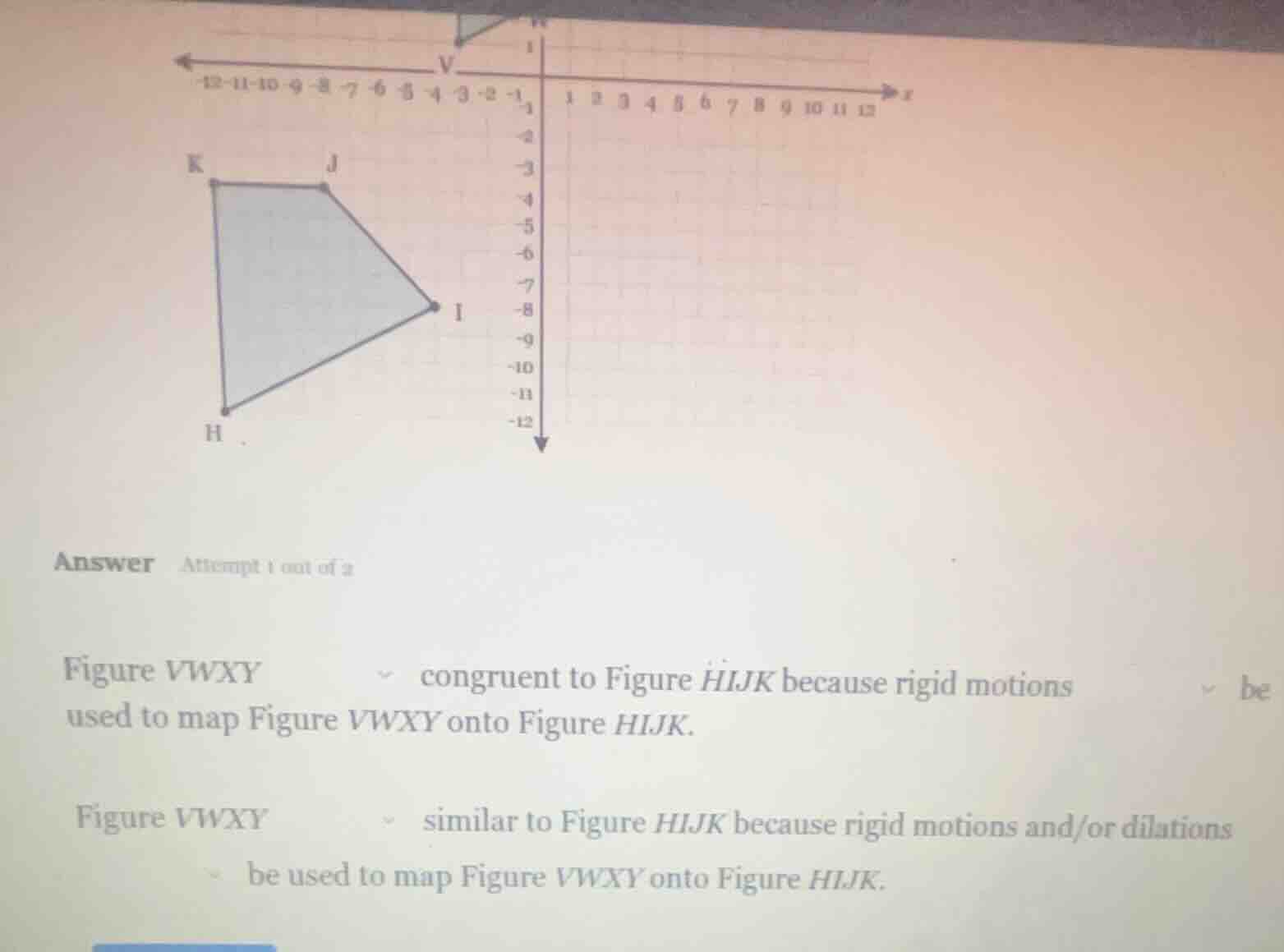
Congruent figures have the same shape and size, and rigid motions (translation, rotation, reflection) preserve size and shape. If the figures have different sizes (visually, VWXY is smaller than HIJK), rigid motions alone can’t map them (since rigid motions don’t change size). So Figure VWXY is not congruent to Figure HIJK because rigid motions cannot be used (size differs).
For Similarity:
Similar figures have the same shape (proportional sides, equal angles), and similarity allows rigid motions (to align shape) plus dilation (to scale size). Since VWXY and HIJK have the same shape (trapezoid-like) but different sizes, rigid motions (to align) and dilation (to scale) can map one to the other. So Figure VWXY is similar to Figure HIJK because rigid motions and/or dilations can be used.
Filling the Blanks:
- Figure VWXY \(\boldsymbol{\text{is not}}\) congruent to Figure HIJK because rigid motions \(\boldsymbol{\text{cannot}}\) be used to map Figure VWXY onto Figure HIJK.
- Figure VWXY \(\boldsymbol{\text{is}}\) similar to Figure HIJK because rigid motions and/or dilations \(\boldsymbol{\text{can}}\) be used to map Figure VWXY onto Figure HIJK.
(Note: The visual comparison of sizes (VWXY is smaller, HIJK is larger) drives the conclusion—congruence needs same size (rigid motions preserve size), similarity allows scaling (dilation) with rigid motions.)

Snap & solve any problem in the app
Get step-by-step solutions on Sovi AI
Photo-based solutions with guided steps
Explore more problems and detailed explanations
To determine the congruence and similarity:
For Congruence:
Congruent figures have the same shape and size, and rigid motions (translation, rotation, reflection) preserve size and shape. If the figures have different sizes (visually, VWXY is smaller than HIJK), rigid motions alone can’t map them (since rigid motions don’t change size). So Figure VWXY is not congruent to Figure HIJK because rigid motions cannot be used (size differs).
For Similarity:
Similar figures have the same shape (proportional sides, equal angles), and similarity allows rigid motions (to align shape) plus dilation (to scale size). Since VWXY and HIJK have the same shape (trapezoid-like) but different sizes, rigid motions (to align) and dilation (to scale) can map one to the other. So Figure VWXY is similar to Figure HIJK because rigid motions and/or dilations can be used.
Filling the Blanks:
- Figure VWXY \(\boldsymbol{\text{is not}}\) congruent to Figure HIJK because rigid motions \(\boldsymbol{\text{cannot}}\) be used to map Figure VWXY onto Figure HIJK.
- Figure VWXY \(\boldsymbol{\text{is}}\) similar to Figure HIJK because rigid motions and/or dilations \(\boldsymbol{\text{can}}\) be used to map Figure VWXY onto Figure HIJK.
(Note: The visual comparison of sizes (VWXY is smaller, HIJK is larger) drives the conclusion—congruence needs same size (rigid motions preserve size), similarity allows scaling (dilation) with rigid motions.)