QUESTION IMAGE
Question
answer the following question in the picture. *
lesson 8: exit ticket
are relationships predictable?
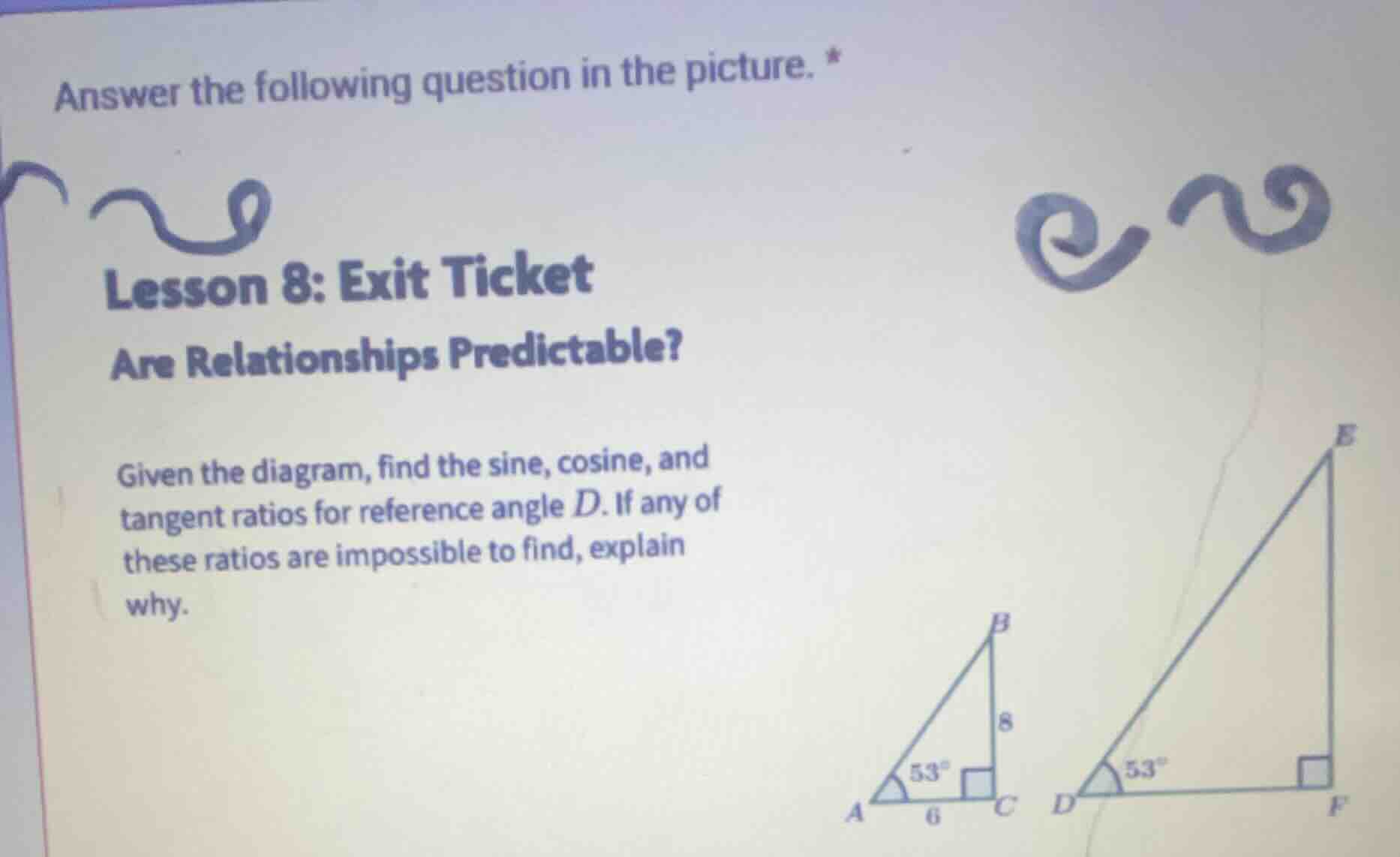
given the diagram, find the sine, cosine, and
tangent ratios for reference angle d. if any of
these ratios are impossible to find, explain
why.
(there are two right triangles in the diagram, one with vertices a, c, b (right - angled at c, ac = 6, bc = 8, angle at a is 53°) and the other with vertices d, f, e (right - angled at f, angle at d is 53°))
Step1: Analyze Triangle ABC (to find hypotenuse)
In right - triangle \(ABC\), \(AC = 6\), \(BC = 8\). By Pythagorean theorem \(AB=\sqrt{AC^{2}+BC^{2}}=\sqrt{6^{2}+8^{2}}=\sqrt{36 + 64}=\sqrt{100}=10\). Also, \(\angle A = 53^{\circ}\), and we know that \(\sin(53^{\circ})\approx\frac{4}{5}\), \(\cos(53^{\circ})\approx\frac{3}{5}\), \(\tan(53^{\circ})\approx\frac{4}{3}\) (from the ratio of sides \(BC/AB = 8/10=\frac{4}{5}\), \(AC/AB = 6/10=\frac{3}{5}\), \(BC/AC = 8/6=\frac{4}{3}\)).
Step2: Determine the ratios for \(\angle D\)
Since \(\angle D=53^{\circ}\) (same as \(\angle A\)) and triangle \(DEF\) is a right - triangle (right - angled at \(F\)), the trigonometric ratios for an acute angle in a right - triangle depend only on the measure of the angle (not the size of the triangle).
For \(\angle D\):
- \(\sin(D)=\sin(53^{\circ})=\frac{\text{opposite}}{\text{hypotenuse}}\). In a right - triangle with angle \(53^{\circ}\), the opposite side to \(53^{\circ}\) and adjacent side and hypotenuse have the same ratio as in triangle \(ABC\). So \(\sin(D)=\frac{4}{5}\) (or \(\frac{BC}{AB}=\frac{8}{10}\)).
- \(\cos(D)=\cos(53^{\circ})=\frac{\text{adjacent}}{\text{hypotenuse}}=\frac{3}{5}\) (or \(\frac{AC}{AB}=\frac{6}{10}\)).
- \(\tan(D)=\tan(53^{\circ})=\frac{\text{opposite}}{\text{adjacent}}=\frac{4}{3}\) (or \(\frac{BC}{AC}=\frac{8}{6}\)).
We can also think in terms of the general definition: Let the opposite side to \(\angle D\) be \(EF\), adjacent side be \(DF\), hypotenuse be \(DE\). Since \(\angle D = 53^{\circ}\) (same as \(\angle A\)), the ratios \(\frac{EF}{DE}\), \(\frac{DF}{DE}\), \(\frac{EF}{DF}\) will be equal to \(\frac{BC}{AB}\), \(\frac{AC}{AB}\), \(\frac{BC}{AC}\) respectively because the triangles are similar (AA similarity, as both are right - triangles and have a \(53^{\circ}\) angle).

Snap & solve any problem in the app
Get step-by-step solutions on Sovi AI
Photo-based solutions with guided steps
Explore more problems and detailed explanations
\(\sin(D)=\frac{4}{5}\), \(\cos(D)=\frac{3}{5}\), \(\tan(D)=\frac{4}{3}\)