QUESTION IMAGE
Question
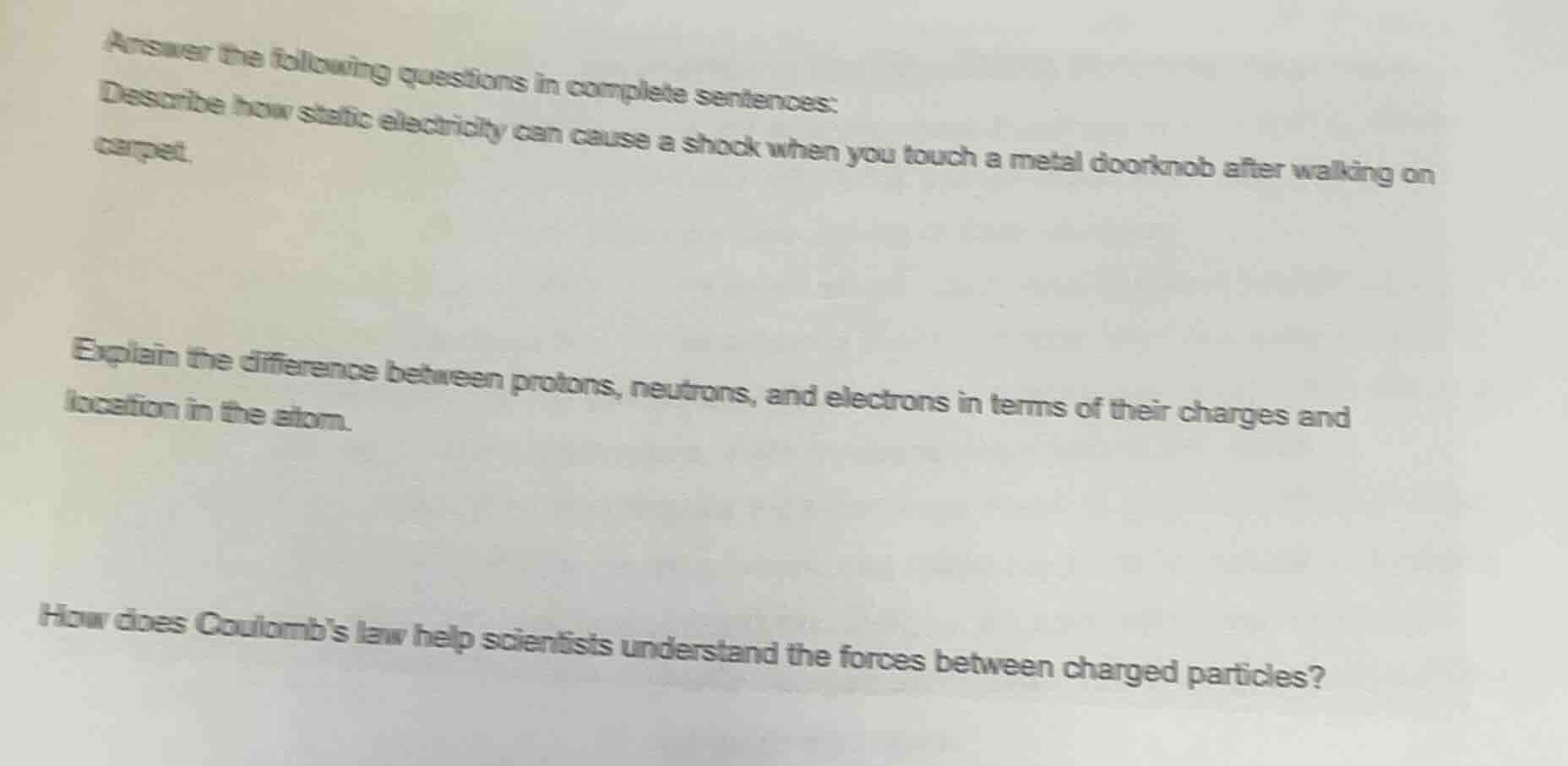
answer the following questions in complete sentences:
describe how static electricity can cause a shock when you touch a metal doorknob after walking on carpet.
explain the difference between protons, neutrons, and electrons in terms of their charges and location in the atom.
how does coulomb’s law help scientists understand the forces between charged particles?
Brief Explanations
- For the static shock question: When you walk on a carpet, your shoes rub against the carpet, transferring electrons onto your body, giving you a static electric charge. When you touch a conductive metal doorknob, the excess electrons on your body rapidly flow to the doorknob (which is at a lower potential) to balance the charge, and this quick flow of electrons is what creates the mild electric shock you feel.
- For the subatomic particle question: Protons are positively charged particles located in the dense central nucleus of an atom. Neutrons are neutral (no electric charge) and are also found in the atom's nucleus alongside protons. Electrons are negatively charged particles that orbit the nucleus in distinct energy levels or electron shells outside the nucleus.
- For Coulomb's law question: Coulomb's law mathematically quantifies the electrostatic force between two charged particles, stating that the force is directly proportional to the product of the magnitudes of the two charges and inversely proportional to the square of the distance between them ($F = k\frac{q_1q_2}{r^2}$, where $k$ is Coulomb's constant, $q_1$ and $q_2$ are the charges, and $r$ is the distance between them). This allows scientists to calculate and predict the strength and direction of attractive or repulsive forces between charged particles, which is foundational for understanding atomic structure, chemical bonding, and electrical phenomena.

Snap & solve any problem in the app
Get step-by-step solutions on Sovi AI
Photo-based solutions with guided steps
Explore more problems and detailed explanations
- When you walk on a carpet, friction between your shoes and the carpet transfers electrons to your body, giving you a net static charge; when you touch a metal doorknob, the excess electrons quickly flow from your body to the conductive doorknob to equalize the charge, creating the mild electric shock you feel.
- Protons are positively charged particles located in the atom's central nucleus; neutrons are neutral (uncharged) particles that also reside in the atom's nucleus; electrons are negatively charged particles that orbit the nucleus in outer electron shells.
- Coulomb's law provides a mathematical formula to calculate the electrostatic force between two charged particles, showing the force is directly related to the product of the charges and inversely related to the square of the distance between them, which lets scientists quantify and predict the attractive or repulsive forces that govern interactions between charged particles, supporting understanding of atomic, chemical, and electrical systems.