QUESTION IMAGE
Question
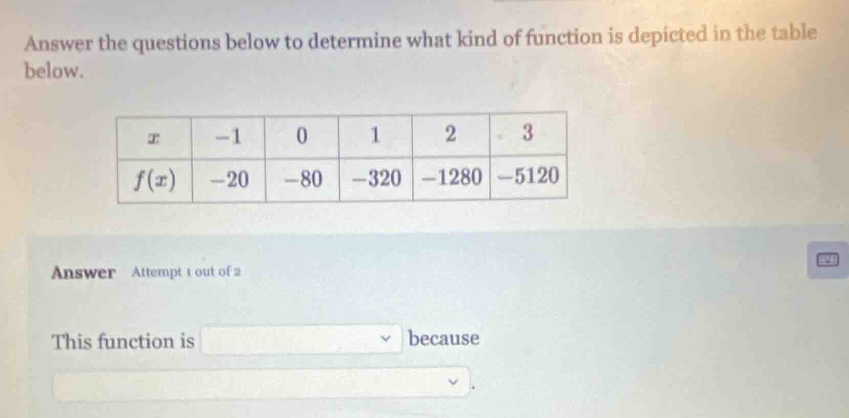
answer the questions below to determine what kind of function is depicted in the table below.
| x | -1 | 0 | 1 | 2 | 3 |
| f(x) | -20 | -80 | -320 | -1280 | -5120 |
answer attempt 1 out of 2
this function is because
.
Step1: Check for common ratio
To determine if it's exponential, we check the ratio between consecutive \( f(x) \) values. Let's calculate the ratios:
- From \( x = -1 \) to \( x = 0 \): \( \frac{f(0)}{f(-1)}=\frac{-80}{-20} = 4 \)
- From \( x = 0 \) to \( x = 1 \): \( \frac{f(1)}{f(0)}=\frac{-320}{-80}=4 \)
- From \( x = 1 \) to \( x = 2 \): \( \frac{f(2)}{f(1)}=\frac{-1280}{-320} = 4 \)
- From \( x = 2 \) to \( x = 3 \): \( \frac{f(3)}{f(2)}=\frac{-5120}{-1280}=4 \)
Step2: Determine the function type
Since the ratio between consecutive \( f(x) \) values is constant (equal to 4), the function is exponential. In an exponential function, the output values have a constant common ratio, unlike linear functions which have a constant difference.

Snap & solve any problem in the app
Get step-by-step solutions on Sovi AI
Photo-based solutions with guided steps
Explore more problems and detailed explanations
This function is \(\boldsymbol{\text{exponential}}\) because the ratio of consecutive \( f(x) \) values is constant (equal to 4).