QUESTION IMAGE
Question
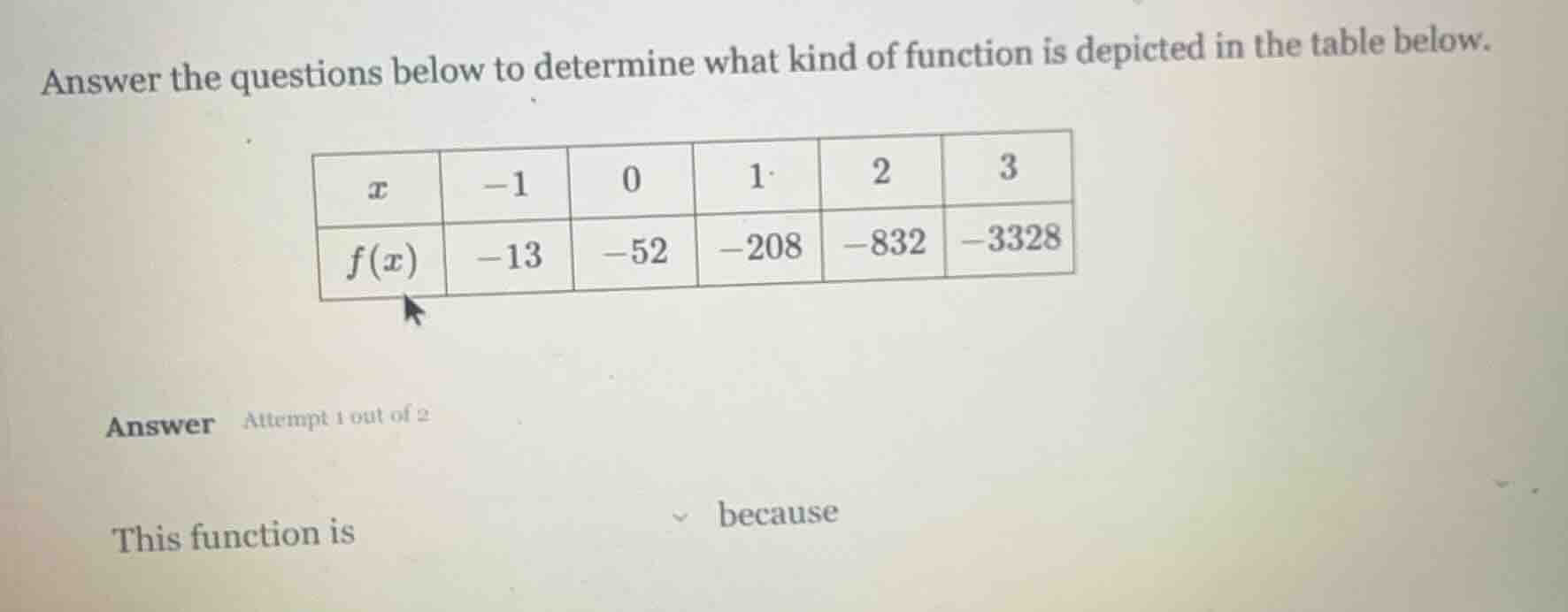
answer the questions below to determine what kind of function is depicted in the table below.
| $x$ | $-1$ | $0$ | $1$ | $2$ | $3$ |
| $f(x)$ | $-13$ | $-52$ | $-208$ | $-832$ | $-3328$ |
answer attempt 1 out of 2
this function is \\(\quad\\) because
Step1: Check first differences
Calculate $\Delta f(x) = f(x_{n+1}) - f(x_n)$:
$\Delta f(-1\to0) = -52 - (-13) = -39$
$\Delta f(0\to1) = -208 - (-52) = -156$
$\Delta f(1\to2) = -832 - (-208) = -624$
$\Delta f(2\to3) = -3328 - (-832) = -2496$
First differences are not constant.
Step2: Check common ratios
Calculate $r = \frac{f(x_{n+1})}{f(x_n)}$:
$r_{-1\to0} = \frac{-52}{-13} = 4$
$r_{0\to1} = \frac{-208}{-52} = 4$
$r_{1\to2} = \frac{-832}{-208} = 4$
$r_{2\to3} = \frac{-3328}{-832} = 4$
The ratio between consecutive $f(x)$ values is constant.

Snap & solve any problem in the app
Get step-by-step solutions on Sovi AI
Photo-based solutions with guided steps
Explore more problems and detailed explanations
This function is an exponential function because the ratio of consecutive output values (for equally spaced input values) is a constant 4, which is the defining characteristic of an exponential function.