QUESTION IMAGE
Question
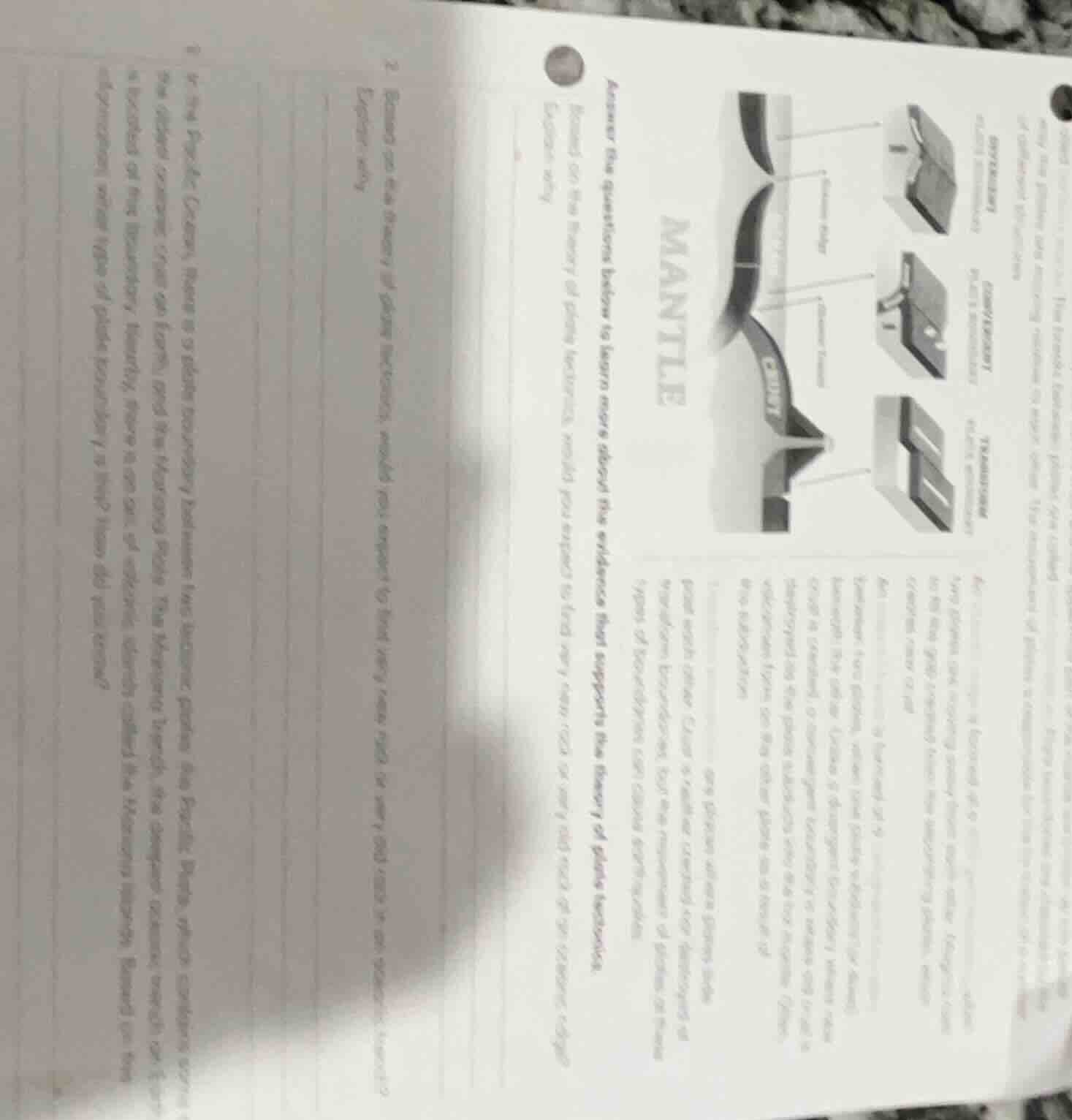
answer the questions below to learn more about the evidence that supports the theory of plate tectonics.mantle1. based on the theory of plate tectonics, would you expect to find very new rock or very old rock at an oceanic ridge? explain why.2. based on the theory of plate tectonics, would you expect to find very new rock or very old rock at an oceanic trench? explain why.3. in the pacific ocean, there is a plate boundary between two tectonic plates: the pacific plate, which contains some of the oldest oceanic crust on earth, and the mariana plate. the mariana trench, the deepest oceanic trench on earth, is located at this boundary. nearby, there is an arc of volcanic islands called the mariana islands. based on this information, what type of plate boundary is this? how do you know?
Step1: Analyze oceanic trench geology
Oceanic trenches form at convergent boundaries where dense oceanic crust subducts beneath another plate. The subducting crust melts, and new crust forms at mid-ocean ridges, not trenches. Old crust is pushed down here.
Step2: Conclude rock age expectation
Since the crust at trenches is being recycled (old crust subducting), very old rock, not new rock, is expected here.
The Mariana Trench is a convergent (oceanic-oceanic) plate boundary where the Pacific Plate subducts under the Mariana Plate. Subduction zones are associated with convergent boundaries, where one plate pushes under another.

Snap & solve any problem in the app
Get step-by-step solutions on Sovi AI
Photo-based solutions with guided steps
Explore more problems and detailed explanations
You would expect to find very old rock at an oceanic trench. This is because oceanic trenches form at convergent plate boundaries where dense, old oceanic crust subducts beneath another tectonic plate, rather than new crust being created (which occurs at divergent boundaries like mid-ocean ridges).
---